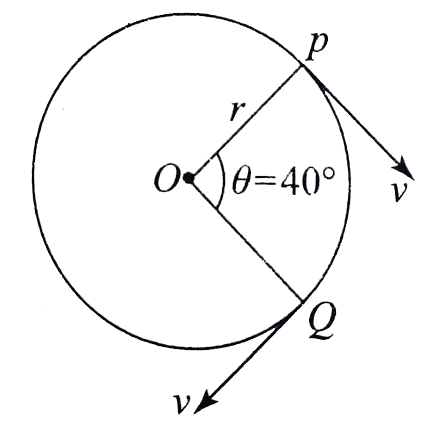
A
B
C
D
Text Solution
Verified by Experts
The correct Answer is:



Topper's Solved these Questions
BASIC MATHEMATICS AND VECTORS
ERRORLESS|Exercise NCERT Based Questions (Multiplication of Vectors )|23 VideosBASIC MATHEMATICS AND VECTORS
ERRORLESS|Exercise NCERT Based Questions (Lami.s Theorem)|2 VideosBASIC MATHEMATICS AND VECTORS
ERRORLESS|Exercise NCERT Based Questions (Fundamentals of Vectors)|25 VideosELASTICITY
ERRORLESS|Exercise ASSERTION & REASON |10 Videos
Similar Questions
Explore conceptually related problems
ERRORLESS-BASIC MATHEMATICS AND VECTORS-NCERT Based Questions (Addition and Subtraction of Vectors )
- What can be the angle between (vec(P) + vec(Q)) and (vec(P) - vec(Q))...
Text Solution
|
- Two vectors vec A and vec B are such that vec A + vec B = vec A- vec B...
Text Solution
|
- In the given circuit, the current through zener diode is :
Text Solution
|
- Three froces acting on a body are shown in the figure. To have the res...
Text Solution
|
- given that vecA+vecB+vecC=0 out of three vectors two are equal in magn...
Text Solution
|
- A certain vector in the xy plane has an x-component of 12 m and a y-co...
Text Solution
|
- If vec(a) and vec(b) are two unit vectors, then the vector (vec(a) + v...
Text Solution
|
- Let the angle between two non - zero vectors vec(A) and vec(B) be 120^...
Text Solution
|
- 100 coplanar forces each equal to 10 n act on a body. Each force makes...
Text Solution
|
- Three concurrent force of the same magnitude are in equilibrium. What ...
Text Solution
|
- Two forces F(1) and F(2) are acting on a body. One force is double tha...
Text Solution
|
- At what angle must the two forces (x+y) and (x-y) act so that the resu...
Text Solution
|
- The resultant of two vectors A and B is perpendicular to the vector A ...
Text Solution
|
- Given that vec(A)+vec(B)=vec(C ) and that vec(C ) is perpendicular to ...
Text Solution
|
- An object of m kg with speed of v m s^(-1) strikes a wall at an angle ...
Text Solution
|
- A plane is revolving around the earth with a speed of 100 km/hr at a c...
Text Solution
|
- A particle is moving on a circular path of radius r with uniform veloc...
Text Solution
|
- A vector vec(a) is turned without a change in its length through a sma...
Text Solution
|
- ABCDEF is a regular hexagon with point O as centre. The value of vec(A...
Text Solution
|
- The five sides of a regular pentagon are represented by vectors vec(A)...
Text Solution
|