Home
Class 11
PHYSICS
Figure below shows a small mass connecte...

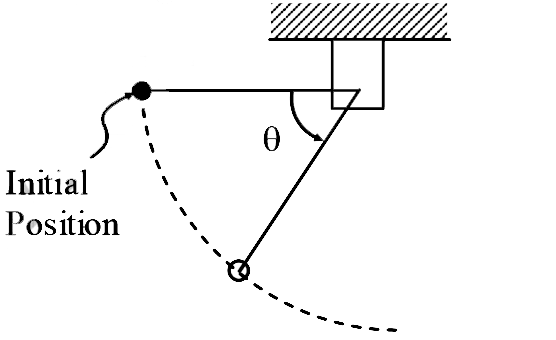
Figure below shows a small mass connected to a string, which is attached to a vertical post. If the ball is released when the string is horizontal as shown, the magnitude of the total acceleration (including radial and tangential) of the mass as a function of the angle `Theta`is

A

`g sin theta`

B

`gsqrt(3 cos^2 theta +1)`

C

`g cos theta`

D

`gsqrt(3 sin^2 theta +1)`

Text Solution

Verified by Experts

The correct Answer is:

D

Radial acceleration = `v^2/R = (2gl sin theta)/l = 2g sin theta`
`[ :. v = sqrt(2gh)]`
Tangential acceleration `= g cos theta`
Total acceleration
`=sqrt(4g^2 sin^2 theta cos^2 theta + g^2 cos^2 theta )implies g sqrt(1+3 sin ^2 theta)`
Promotional Banner

Topper's Solved these Questions

  • WORK, ENERGY POWER AND COLLISION

    ERRORLESS|Exercise NCERT BASED QUESTIONS (Power)|18 Videos
  • WORK, ENERGY POWER AND COLLISION

    ERRORLESS|Exercise NCERT BASED QUESTIONS (Elastic and Inelastic Collision)|44 Videos
  • WORK, ENERGY POWER AND COLLISION

    ERRORLESS|Exercise NCERT BASED QUESTIONS (Work Done by Variable Force)|26 Videos
  • WAVES AND SOUND

    ERRORLESS|Exercise ASSERTION & REASON |25 Videos

Similar Questions

Explore conceptually related problems

The given figure shows a small mass connected to a string which is atteched to a string , which is attached to a vertical post. If the mass is released from rest when the string is horizontal as shown the magnitude of the total acceleration of the mass as friction of the angle theta is

A ball A of mass m attached to a string of length L is released when the string is horizontal. It strikes another ball B of mass 2 m suspended to another string of length L at rest as shown. Find the maximum angle made by the string if the collision is completely inelastic.

A ball of mass 1 kg is attached to an inextensible string. The ball is released from the position shown in figure. Find the impulse imparted by the string to the ball immediately after the string becomes taut.

A simple pendulum consists of a ball of mass m connected to a string of length L . The ball is pulled aside so that the string makes an angle of 53^(@) with the verticle and is released. Find the ratio of the minumum and the tension in the string.

In a simple pendulum, the breaking strength of the string is double the weight of the bob. The bob is released from rest when the string is horizontal. The string breaks when it makes an angle theta with the vertical.

A bob of mass m attached with a string of length l tied to a point on ceiling is released from a position when its string is horizontal. At the bottom most point of its motion, an identical mass m gently stuck to it. Find the maximum angle from the vertical to which it rotates.

A mass is attached to the end of a string of length l which is tied to a fixed point O. The mass is released from the initial horizontal position of the string. Below the point O at what minimum distance a peg P should be fixed so that the mass turns about P and can describe a complete circle in the vertical plane?

In the figure, blocks A and B of masses 2m and m are connected with a string and system is hanged vertically wioth the help of spring. Spring has negligible mass. Find out magnitude of acceleration of masses 2 m and m just after the instant when the string is cut

A mass attached to one end of a string crosses top - most point on a vertical circle with critical speed. Its centripetal acceleration when string becomes horizontal will be (where, g=gravitational acceleration)

ERRORLESS-WORK, ENERGY POWER AND COLLISION-NCERT BASED QUESTIONS (Conservation of Energy and Momentum)
  1. An electron and a proton are moving under the influence of mutual forc...

    Text Solution

    |

  2. A proton is kept at rest. A positively charged particle is released fr...

    Text Solution

    |

  3. Figure below shows a small mass connected to a string, which is attach...

    Text Solution

    |

  4. A particle is acted upon by a force given by F = - alphax^(3) -betax^...

    Text Solution

    |

  5. A block of mass m slides from rest at a height H on a frictionless inc...

    Text Solution

    |

  6. A body moves in a circular orbit of radius R under the action of a cen...

    Text Solution

    |

  7. A particle with total mechanical energy, which is small and negative, ...

    Text Solution

    |

  8. A uniform thin rod of length 2L and mass m lies on a horizontal table....

    Text Solution

    |

  9. The graph between the resistive force F acting on a body and the dista...

    Text Solution

    |

  10. Which of the following graph is correct between kinetic energy E, pote...

    Text Solution

    |

  11. The potential energy of the system is represented in the first figure....

    Text Solution

    |

  12. The graph betwee sqrt(E) and (1)/(p) is (E=kinetic energy and p= momen...

    Text Solution

    |

  13. A particle of mass 4 m which is at rest explodes into three fragments....

    Text Solution

    |

  14. A particle is dropped a height h. A constant horizontal velocity is gi...

    Text Solution

    |

  15. Which of the diagram shown in figures respresents variation of total m...

    Text Solution

    |

  16. Which of the diagrams shown in figure. Most closely shows the variatio...

    Text Solution

    |

  17. A raindrop falling from a height h above ground, attains a near termin...

    Text Solution

    |

  18. Which of the diagrams in figure, correctly shows the change in kineti...

    Text Solution

    |

  19. Two rectangular blocks A and B of masses 2 kg and 3 kg respectively ar...

    Text Solution

    |

  20. The ring R in the arrangement shown can slide along a smooth, fixed, h...

    Text Solution

    |
