Home
Class 11
PHYSICS
Two particles A and B, move with constan...

Two particles A and B, move with constant velocities `vec(v_(1))" and "vec(v_(2))`. At the initial moment their position vectors are `vec(r_(1))" and "vec(r_(2))` respectively. The condition for particle A and B for their collision is

A

`vecr_1 .vecv_1 = vecr_2 .vecv_2`

B

`vecr_1 xxvecv_1 = vecr_2 xxvecv_2`

C

`vecr_1 -vecr_2 = vecv_1 -vecv_2`

D

`(vecr_1-vecr_2)/(|vecr_1-vecr_2|)=(vecv_2-vecv_1)/(|vecv_2-vecv_1|)`

Text Solution

Verified by Experts

The correct Answer is:
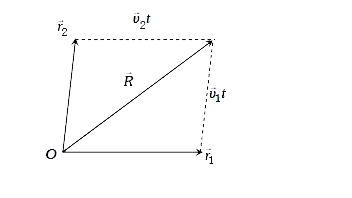
D

`vecR = vecr_1 + vecv_1 t = vecr_2 + vecv_2 t`
`implies vecr_(1) -vecr_(2) = (vecv_2 -vecv_1) t`

So, `((r_1-r_2))/(|vecr_1-vecr_2|)=((v_2-v_1)t)/(|vecv_2-vecv_1|t)`
`implies (vecr_1-vecr_2)/(|vecr_1-vecr_2|)=(vecv_1-vecv_2)/(|vecv_1-vecv_2|)`
Promotional Banner

Topper's Solved these Questions

  • WORK, ENERGY POWER AND COLLISION

    ERRORLESS|Exercise ASSERTION & REASON |22 Videos
  • WORK, ENERGY POWER AND COLLISION

    ERRORLESS|Exercise NCERT BASED QUESTIONS (Perfectly Inelastic Collision)|9 Videos
  • WAVES AND SOUND

    ERRORLESS|Exercise ASSERTION & REASON |25 Videos

Similar Questions

Explore conceptually related problems

Two point masses 1 and 2 move with uniform velocities vec(v)_(1) and vec(v)_(2) , respectively. Their initial position vectors are vec(r )_(1) and vec(r )_(2) , respectively. Which of the following should be satisfied for the collision of the point masses?

Two particles, 1 and 2, move with constant velocities v_1 and v_2 . At the initial moment their radius vectors are equal to r_1 and r_2 . How must these four vectors be interrelated for the particles to collide?

The position vector of A,B are vec a and vec b respectively.The position vector of C is (5(vec a)/(3))-vec b then

If two bodies are in motion with velocity vec(v)_(1) and vec(v)_(2) :

Two particles 1 and 2 move with velocities vec v_1 and vec v_2 making the angles theta_1 and theta_2 with the line joining them, respectively. Find angular velocity of relative to 1 . .

Particle A of mass m_1 moving with velocity (sqrt3hati+hatj)ms^(-1) collides with another particle Bof mass m_2 which is at rest initially. Let vec(V_1) and vec(V_2) be the velocities of particles A and B after collision respectively. If m_1 = 2m_2 and after collision vec(V_1) - (hati + sqrt3hatj)ms^(-1) , the angle between vec (V_1) and vec (V_2) is :

Two particles A and B are revolving with constant angular velocity on two concentric circles of radius 1m and 2m respectively as shown in figure. The positions of the particles at t = 0 are shown in figure. The positions of the particles at t=0 are shown in figure. if m_(A)=2kg, m_(B)= 1kg and vec(P)_(A) and vec(P)_(B) are linear momentum of the particle then what is the maximum value of |vec(P)_(A)+vec(P)_(B)| in kg-m/sec in subsequent motion of two particles.

Two particles of masses m_(1) and m_(2) in projectile motion have velocities vec(v)_(1) and vec(v)_(2) , respectively , at time t = 0 . They collide at time t_(0) . Their velocities become vec(v')_(1) and vec(v')_(2) at time 2 t_(0) while still moving in air. The value of |(m_(1) vec(v')_(1) + m_(2) vec(v')_(2)) - (m_(1) vec(v)_(1) + m_(2) vec(v)_(2))|

If vec F is the force acting in a particle having position vector vec r and vec tau be the torque of this force about the origin, then

A charge particle of mass m and charge q is projected with velocity v along y-axis at t=0. Find the velocity vector and position vector of the particle vec v (t) and vec r (t) in relation with time.

ERRORLESS-WORK, ENERGY POWER AND COLLISION-PAST YEARS QUESTIONS
  1. A bomb of mass 3.0 kg explodes in air into two pieces of masses 2.0 kg...

    Text Solution

    |

  2. A vertical spring with force constant k is fixed on a table. A ball of...

    Text Solution

    |

  3. A spherical ball of mass 20kg is stationary at the top of a hill of he...

    Text Solution

    |

  4. A block of mass 10 kg, moving in x-direction with a constant speed of ...

    Text Solution

    |

  5. A particle of mass M starting from rest undergoes uniform acceleration...

    Text Solution

    |

  6. A body of mass 1 kg begins to move under the action of a time depende...

    Text Solution

    |

  7. A body is moved along a straight line by a machine delivering constant...

    Text Solution

    |

  8. A partical of mass m is driven by a machine that deleveres a constant ...

    Text Solution

    |

  9. A ball hits a vertical wall horizontal at 10 m/s bounces back at 10 m/...

    Text Solution

    |

  10. A body falling from a height of 10m rebounds from hard floor. If it lo...

    Text Solution

    |

  11. A neutron makes a head-on elastic collision with a stationary deuteron...

    Text Solution

    |

  12. A ball is thrown vertically downwards from a height of 20 m with an in...

    Text Solution

    |

  13. Two particles A and B, move with constant velocities vec(v(1))" and "v...

    Text Solution

    |

  14. Two particles of masses m1,m2 move with initial velocities u1 and u2 ...

    Text Solution

    |

  15. Two identical balls A and B having velocity of 0.5 m//s and -0.3 m//s ...

    Text Solution

    |

  16. Body A of mass 4m moving with speed u collides with another body B of ...

    Text Solution

    |

  17. In an inelastic collision, what is conserved

    Text Solution

    |

  18. A metal ball of mass 2 kg moving with a velocity of 36km//h has a head...

    Text Solution

    |

  19. Water falls from a height of 60m at the rate of 15 kg/s to operate a t...

    Text Solution

    |

  20. A ball of mass 0.15kg is dropped from a height 10m strikes the ground ...

    Text Solution

    |

