Home
Class 11
PHYSICS
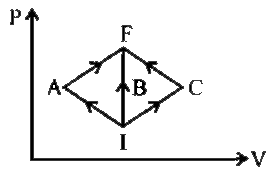
In the P - V diagram, I is the initial s...

In the P - V diagram, I is the initial state and F is the final state. The gas goes from I to F by
(i) IAF, (ii) IBF and (iii) ICF.

The heat absorbed by the gas is

A

The same in all three processes

B

The same in (i) and (ii)

C

Greater in (i) than in (ii) A B C

D

The same in (i) and (iii)

Text Solution

Verified by Experts

The correct Answer is:

C

`Delta Q=Delta U + Delta W`
Since, `Delta U` is same for all process
`Delta W_1` = +ve, `Delta W_2 = 0, Delta W_3` = -ve `:. Delta Q_1 gt Delta Q_2`
Promotional Banner

Topper's Solved these Questions

  • THERMODYNAMICS

    ERRORLESS|Exercise NCERT BASED QUESTIONS (ISOTHERMAL PROCESS)|16 Videos
  • THERMODYNAMICS

    ERRORLESS|Exercise NCERT BASED QUESTIONS (ADIABATIC PROCESS)|31 Videos
  • SURFACE TENSION

    ERRORLESS|Exercise ASSERTION & REASON|11 Videos
  • THERMOMETRY, THERMAL EXPANSION AND CALORIMETRY

    ERRORLESS|Exercise ASSERTION & REASON|10 Videos

Similar Questions

Explore conceptually related problems

When a thermodynamic system is taken from an initial state I to a final state F along the path IAF, as shown in Fig. the heat energy absorbed by the system is Q = 55 J and work done by the system is W = 25 J . If the same system is taken along the path IBF, the value of Q = 35 J . (a) If W = - 15 J for the curved path FI, how much heat energy is lost by the system along this path ? (b) If U_(1) = 10 J , what is U_(F) ? (d) If U_(B) = 20 J , what is Q for the process BF and IB ?

One mole of an ideal gas is taken from state A to state B by three different processes (a) ACB , (b) ADB and (c ) AEB as shown in the P - V diagram. The heat absorbed by the gas is

An ideal gas of mass m in a state A goes to another state B via three different processes as shown in Fig. If Q_(1), Q_(2) and Q_(3) denote the heat absorbed by the gas along the three paths, then

Six grams of hydrogen gas at a temperature of 273 K isothoermally expanded to five times its initial volume and then isochorically heated so that the pressure in the final state becomes equal to that in the initial state. Find the total amount of heat absorbed by the gas during the entire process.

An ideal gas goes from State A to state B via three different process as indicate in the P-V diagram. If Q_(2), Q_(3) indicates the heat absorbed by the gas along the three processes and DeltaU_(1), DeltaU_(2), DeltaU_(3) indicates the change in internal energy along the three processes respectively, then

An ideal gas undergoes a four step cycle as shown in the P-V diagram below. During this cycle heat is absorbed by the gas in

Figure shows the p-V diagram of an ideal gas undergoing a change of state from A to B. Four different parts I, II, III and IV as shown in the figure may lead to the same change of state. ltBrgt

A thermodynamic system goes from states (i) P_(1) V to 2P_(1) , V (ii) P , V to P , 2 V . Then work done in the two cases is

An ideal gas goes from the state i to the state int as shown in .the work done by the gas during the process

ERRORLESS-THERMODYNAMICS-ASSERTION AND REASON
  1. In the P - V diagram, I is the initial state and F is the final state....

    Text Solution

    |

  2. Assertion: Reversible systems are difficult to find in real world. R...

    Text Solution

    |

  3. Assertion: Air quickly leaking out of a balloon becomes coolers. Rea...

    Text Solution

    |

  4. Aseertion: Thermodynamics process in nature are irreversible. Reason...

    Text Solution

    |

  5. Assertion: When a bottle of cold carbonated drink is opened, a slight...

    Text Solution

    |

  6. Assertion: The isothermal curves intersect each other at a certain poi...

    Text Solution

    |

  7. Assertion: In adiabatic compression, the internal energy and temperatu...

    Text Solution

    |

  8. Statement-1: In isothermal process whole of the heat energy suppled to...

    Text Solution

    |

  9. Assertion : We can not change the temperature of a body without givin...

    Text Solution

    |

  10. Statement I: The specific heat of a gas in an adiabatic process is zw...

    Text Solution

    |

  11. Assertion: The isothermal curves intersect each other at a certain poi...

    Text Solution

    |

  12. Assertion: The heat supplied to a system is always equal to the increa...

    Text Solution

    |

  13. Assertion: The temperature of the surface of the sun is approximately ...

    Text Solution

    |

  14. Assertion : It is not possible for a system, unaided by an external a...

    Text Solution

    |

  15. Assertion : If an electric fan be switched on in a closed room, the a...

    Text Solution

    |

  16. Assertion : When a glass of hot milk is placed in a room and allowed t...

    Text Solution

    |

  17. Statement-1 : In an adiabatic process, change in internal energy of a ...

    Text Solution

    |

  18. Assertion : The Carnot cycle is useful in understanding the performanc...

    Text Solution

    |

  19. A : Work done by a gas in isothermal expension is more than the work d...

    Text Solution

    |

  20. Assertion : First law of thermodynamics is a restatement of the princi...

    Text Solution

    |

  21. Assertion : Zeroth law of thermodynamic explain the concept of energy...

    Text Solution

    |
