Home
Class 11
PHYSICS
Following figure shows on adiabatic cyli...

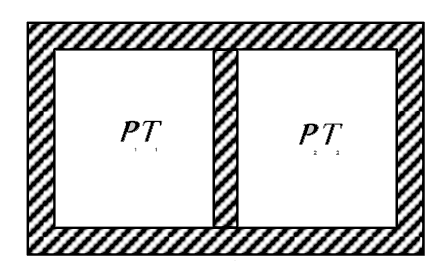
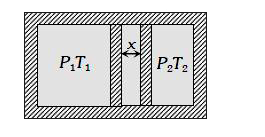
Following figure shows on adiabatic cylindrical container of volume `V_(0)` divided by an adiabatic smooth piston (area of cross-section = A ) in two equal parts. An ideal gas `(C_(p)//C_(y)=lambda)` is at pressure `P_1` and temperature `T_1` in left part and gas at pressure `P_2` and temperature `T_2` in right part. The piston is slowly displaced and released at a position where it can stay in equilibrium. The final pressure of the two parts will be (Suppose x = displacement of the piston)

A

`P_2`

B

`P_1`

C

`(P_1((V_0)/(2))^gamma)/(((V_0)/(2)+Ax)^(gamma))`

D

`(P_2((V_0)/(2))^gamma)/(((V_0)/(2)+Ax)^(gamma))`

Text Solution

Verified by Experts

The correct Answer is:
C

Final volume of the left and right part
`V_L =(V_0)/(2) + Ax`
`V_R=(V_0)/(2)-Ax`
Since, container wall and piston are adiabatic in left side and gas undergoes adiabatic expansion on right side the gas undergoes adiabatic compression.
`P_1((V_0)/(2))^(gamma)=P_f((V_0)/(2)+Ax)^(gamma)` (for left side)
`P_2((V_0)/(2))^(gamma)=P_f((V_0)/(2)-Ax)^(gamma)` (for right side)
`:. (P_1)/(P_2) = (((V_0)/(2)+Ax)^(gamma))/(((V_0)/(2)-Ax)^(gamma)) implies Ax = (V_0)/(2)([P_1^(1//gamma)-P_2^(1//gamma)])/([P_1^(1//gamma)+P_2^(1//gamma)])`
Now, `P_f =(P_1((V_0)/(2))^(gamma))/([(V_0)/(2)+Ax]^(gamma)) `
Promotional Banner

Topper's Solved these Questions

  • THERMODYNAMICS

    ERRORLESS|Exercise NCERT BASED QUESTIONS (ISOBARIC AND ISOCHORIC PROCESS)|10 Videos
  • THERMODYNAMICS

    ERRORLESS|Exercise NCERT BASED QUESTIONS (HEAT ENGINE, REFRIGERATOR AND SECOND LAW OF THERMODYNAMICS)|35 Videos
  • THERMODYNAMICS

    ERRORLESS|Exercise NCERT BASED QUESTIONS (ISOTHERMAL PROCESS)|16 Videos
  • SURFACE TENSION

    ERRORLESS|Exercise ASSERTION & REASON|11 Videos
  • THERMOMETRY, THERMAL EXPANSION AND CALORIMETRY

    ERRORLESS|Exercise ASSERTION & REASON|10 Videos

Similar Questions

Explore conceptually related problems

Following figure shows on adiabatic cylindrical container of volume V_(0) divided by an adiabatic smooth piston (area of cross-section = A ) in two equal parts. An ideal gas (C_(p)//C_(y)=lambda) is at pressure P and temperature T in left part and gas at pressure P and temperature T in right part. The piston is slowly displaced and released at a position where it can stay in equilibrium. The final pressure of the two parts will be (Suppose x = displacement of the piston)

In given figure, an adiabatic cylindrical tube of volume 2V_(0) is divided in two equal parts by a frictionless adiabatic separator. An ideal gas in left side of a tube having pressure P_(1) and temperature T_(1) where as in the right side having pressure P_(2) and temperature T_(2).C_(p)//C_(v) =gamma is the same for both the gases. The separator is slid slowly and is released at a position where it can stay in equilibrium. Find (a) the final volumes of the two parts (b) the heat given to the gas in the left part and (c) the final common pressure of the gases,

Figure shows an adiabatic cylindrical tube of volume (V_0) divided in two parts by a frictionless adibatic separator . Initially, the separator is kept in the middle, an ideal gas at pressure (p_1) and the temperatures (T_1) is injected into the left part and the another ideal gas at pressures (P_2) and temperature (T_2) is injected into the right part. (C_p / C_v = gamma) is the same for both the gases. The separator is slid slowly and is released at a position where it can stay in equilibrium. Find (a) the volumes of the parts, (b) the heat given to the gas in the left part and (c) the final common pressure of the gases.

Show a cylindrical tube of volume V_(0) divided in two parts by a frictionless separator. The walls of the tube are adiabatic but the separator is conducting, Ideal gases ate filled in the two parts. When the swparator is kept in the middle, the pressure are p_(1) and p-(2) in the left part and the right part respectively. The separator is slowly slid and is released at a position where it can stay in equilibrium. Find the volumes if the two parts. (figure)

A cylindrical container of volume V_(0) is divided into two parts by a thin conducting separator of negligible mass. The walls of the container are adiabatic. Ideal gases are filled in the two parts such that the pressures are P_(0) " and " 2 P_(0) when the separator is held in the middle of the container (see figure). Now the separator is slowly slid and released in a position where it stays in equilibrium. Find the volume of the two parts.

An insulated container of gas has two chambers separated by an insulating partition. One of the chmabers has volume V_1 and contains ideal gas at pressure P_1 and temperature T_1 .The other chamber has volume V_2 and contains ideal gas at pressure P_2 and temperature T_2 . If the partition is removed without doing any work on the gas, the final equilibrium temperature of the gas in the container will be

In an adiabatic change, the pressure p and temperature T of a diatomic gas are related by the relation ppropT^alpha , where alpha equals

A diathermic piston divides adiabatic cylinder of volume V0 into two equal parts as shown in the figure. Both parts contain ideal monoatomic gases. The initial pressure and temperature of gas in left compartment are P0 and T0 while that in right compartment are 2P0 and 2T0. Initially the piston is kept fixed and the system is allowed to acquire a state of thermal equilibrium. The pressure in left compartment after thermal equilibrium is achieved is

One mole of an ideal gas ( C_p//C_v = gamma ) at absolute temperature T_1 is adiabatically compressed from an initial pressure P_1 to a final pressure P_2 . The resulting temperature T_2 , of the gas is given by:

ERRORLESS-THERMODYNAMICS-NCERT BASED QUESTIONS (ADIABATIC PROCESS)
  1. An ideal gas follows a process described by PV^(2)=C from (P(1), V(1),...

    Text Solution

    |

  2. One mole of a monoatomic ideal gas is expanded by a process described ...

    Text Solution

    |

  3. Following figure shows on adiabatic cylindrical container of volume V(...

    Text Solution

    |

  4. Pressure-temperature relationship for an ideal gas undergoing adiabati...

    Text Solution

    |

  5. 1mm^3 of a gas is compressed at 1 atmospheric pressure and temperature...

    Text Solution

    |

  6. An ideal gas at pressure of 1 atmosphere and temperature of 27^(@)C is...

    Text Solution

    |

  7. The ratio of adiabatic bulk modulus and isothermal bulk modulus of a g...

    Text Solution

    |

  8. A diatomic gas initially at 18^(@) is compressed adiabatically to one-...

    Text Solution

    |

  9. An ideal gas at 27^(@)C is compressed adiabatically to 8//27 of its or...

    Text Solution

    |

  10. The temperature of a hypothetical gas increases to sqrt(2) times when ...

    Text Solution

    |

  11. The state of an ideal gas was changed isobarically. The graph depicts ...

    Text Solution

    |

  12. The bulk modulus of a gas is defined as B = -VdP/dV. For an adiabatic ...

    Text Solution

    |

  13. The work done in an adiabatic change in a gas depends only on

    Text Solution

    |

  14. One mole of an ideal gas at an initial temperature true of TK does 6R ...

    Text Solution

    |

  15. One mole of an ideal gas with gamma=1.4, is adiabatically compressed s...

    Text Solution

    |

  16. Ideal gas undergoes an adiabatic change in its state from (P1 V1 , T1...

    Text Solution

    |

  17. A gas expands with temperature according to the relation V = kT^(2//3)...

    Text Solution

    |

  18. The internal energy of the gas increases In

    Text Solution

    |

  19. In changing the state of a gas adiabatically from an equilibrium state...

    Text Solution

    |

  20. During an adiabatic expansion, the increase in volume is associated wi...

    Text Solution

    |

