Home
Class 11
PHYSICS
A system is taken from state a to state ...

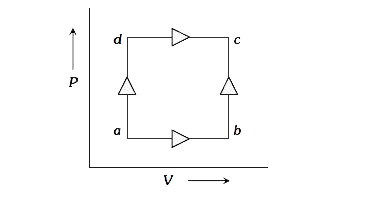
A system is taken from state a to state c by two paths adc and abc as shown in the figure. The internal energy at a is `U_a` = 10J. Along the path adc the amount of heat absorbed `delta Q_1 = 50 J` and the work obtained `delta W_1=20 J` whereas along the path abc the heat absorbed `delta Q_2 = 36 J`. The amount of work along the path abc is

A

10 J

B

12 J

C

36 J

D

6 J

Text Solution

Verified by Experts

The correct Answer is:

D

`Delta Q_("adc")=Delta U_("adc")+DeltaW_("adc")`
`implies 50=DeltaU_("adc")+20 implies DeltaU_("adc")=30J`
Now, `DeltaQ_("abc")= DeltaU_("abc") +W_("abc") implies W_("abc")=36-30=6J`.
Promotional Banner

Topper's Solved these Questions

  • THERMODYNAMICS

    ERRORLESS|Exercise ASSERTION AND REASON|20 Videos
  • THERMODYNAMICS

    ERRORLESS|Exercise NCERT BASED QUESTIONS (HEAT ENGINE, REFRIGERATOR AND SECOND LAW OF THERMODYNAMICS)|35 Videos
  • SURFACE TENSION

    ERRORLESS|Exercise ASSERTION & REASON|11 Videos
  • THERMOMETRY, THERMAL EXPANSION AND CALORIMETRY

    ERRORLESS|Exercise ASSERTION & REASON|10 Videos

Similar Questions

Explore conceptually related problems

A sample of an ideal gas is taken through the cyclic process abca and shown in the figure. The chagne in the internal energy of the gas along the path ca is -180J . The gas aborbs 250J of heat along the path ab and 60 J along the path bc. the work done by the along the path abc is:

In the figure an ideal gas changes is state from state A to state C by two paths ABC and AC. (a) Find the path along which the work done is least. (b) The internal energy of the gas at A is 10 J and the amount of heat supplied to change its state to C through the path AC is 200 J. Calculate the internal energy at C. (c) The internal energy of the gas at state B is 20 J. Fid the amount of the heat supplied to gas to go from A to B.

When a system is taken from state i to state f along the path iaf, it is found that Q=50 cal and W=20 cal . Along the path ibf Q=36cal . W along the path ibf is

A system is taken from state a to state c along the path adc (figure). The amount of heat absorbed is 10 cals and work done on the gas is 138 J . Calculate the work done on//by the gas when 20 cals of heat are absorbed in taking the system from state a to state c along the path abc

A system is taken from state A to state B along two different paths 1 and 2 . The heat absorbed and work done by the system along these two paths are Q_(1) and W_(1) and W_(2) respectively.

In the given figure, an ideal gas changes it state from A to state C by two paths ABC and AC . (i) Find the path along which work done is the least. (ii) The internal energy of the gas at A to 10J and the amount of heat supplied to change its state to C through the path AC is 200J . Calculate the internal energy at C . (iii) The internal energy of the gas at state B is 30J . Find the amount of heat supplied to the gas to go from A to B .

A system absorb 600 J of heat and work equivalent to 300 J on its surroundings. The change in internal energy

ERRORLESS-THERMODYNAMICS-PAST YEARS QUESTIONS
  1. Heat energy absorbed by a system in going through a cyclic process sho...

    Text Solution

    |

  2. A sample of ideal monoatomic gas is taken round the cycle ABCA as show...

    Text Solution

    |

  3. A system is taken from state a to state c by two paths adc and abc as ...

    Text Solution

    |

  4. A sample of 0.1 g of water of 100^(@)C and normal pressure (1.013 xx 1...

    Text Solution

    |

  5. An ideal gas A and a real gas B have their volumes increases from V to...

    Text Solution

    |

  6. Air in a cylinder is suddenly compressed by a piston, which is then ma...

    Text Solution

    |

  7. During an adiabatic process, the pressure of a gas is found to be prop...

    Text Solution

    |

  8. In the given (V - T) diagram, what is the relation between pressure P1...

    Text Solution

    |

  9. A gas is compressed isothermally to half its initial volume. The same ...

    Text Solution

    |

  10. 4.0 g of a gas occupies 22.4 litres at NTP. The specific heat capacity...

    Text Solution

    |

  11. In which of the following processes, heat is neither absorbed nor rele...

    Text Solution

    |

  12. A sample of gas expands from volume V(1) to V(2). The amount of work d...

    Text Solution

    |

  13. Thermodynamic processes are indicated in the following diagram

    Text Solution

    |

  14. A Carnot engine, having an efficiency of eta=1//10 as heat engine, is ...

    Text Solution

    |

  15. Two Carnot engines are operated in succession. The first engine receiv...

    Text Solution

    |

  16. The cofficient of performance of a refrigerator is 5. If the temperatu...

    Text Solution

    |

  17. A refrigerator works between 4^(@)C and 30^(@)C. It is required to rem...

    Text Solution

    |

  18. The temperature inside a refrigerator is t2 °C and the room temperatur...

    Text Solution

    |

  19. The efficiency of an ideal heat engine working between the freezing po...

    Text Solution

    |

  20. Two cylinders A and B of equal capacity are connected to each other vi...

    Text Solution

    |
