Home
Class 12
PHYSICS
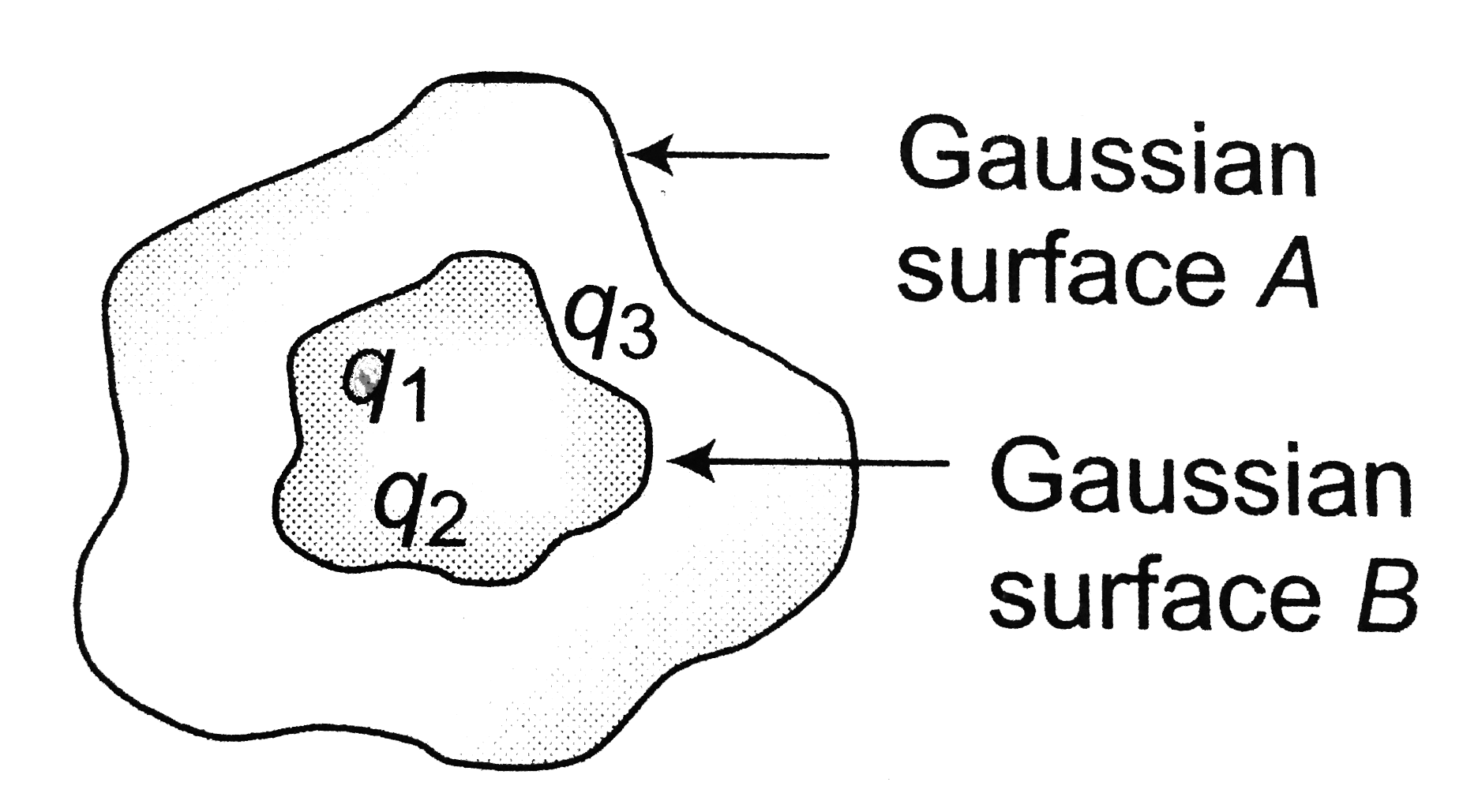
The electric flux for Gaussian surface A...

The electric flux for Gaussian surface `A` that enclose the charge particles in free space is (given `q_(1)= -14nC,q_(2)= 78.85nC,q_(3)= -56nC)`

A

`10^3 Nm^2 C^(-1)`

B

`10^3 Nm^(-1) m^(-2)`

C

`6.32 xx10^3 Nm^2 C^(-1)`

D

`6.32 xx10^3 CN^(-1) m^(-2)`

Text Solution

Verified by Experts

The correct Answer is:

A

`phi=q_("in")/(epsilon_0)=((-14 + 78.85-56)xx10^(-9))/(8.85 xx10^(-12))=10^3 Nm^2 //C`
Promotional Banner

Topper's Solved these Questions

  • ELECTROSTATICS

    ERRORLESS|Exercise NCERT BASED QUESTIONS (Capacitance)|59 Videos
  • ELECTROSTATICS

    ERRORLESS|Exercise NCERT BASED QUESTIONS (Grouping of Capacitors)|58 Videos
  • ELECTROSTATICS

    ERRORLESS|Exercise NCERT BASED QUESTIONS (Electric Dipole)|21 Videos
  • ELECTRONICS

    ERRORLESS|Exercise Assertion & Reason|26 Videos
  • MAGNETIC EFFECTS OF CURRENT

    ERRORLESS|Exercise ASSERTION & REASON |18 Videos

Similar Questions

Explore conceptually related problems

Electric flux through a closed surface in free space enclosing a charge q is

The electric flux through a chlosed surface area S enclosing charge Q is phi . If the surface area is doubled, then the flux is

In the given figure, there are four point charges placed at the vertices of a square of side, a=1.4 m . If q_(1)=+18 nC,q_(2)=-24 nC,q_(3)+35nC and q_(4)=+16 nC m then find the electric at the centre P of the square Assume the potential to be zero at infinity.

In Fig., the four particles form a square of edge length a = 5.00 cm and have charges q_(1) = +3 nC, q_(2) = -15 nC, q_(3) = +15 nC , and q_(4) = -30 nC . In unit-vector notation, what net electric field do the particles produce at the square's center ?

What is the electric potential at point P, located at the center of the square of charged particles shown in Fig. 24-16a? The distanced is 1.3 m, and the charges are q_(1) = + 12 nC, " "q_(3) = +31 nC , q_(2) = - 24 nC," "q_(4)=+17 nC.

Consider a Gaussian spherical surface covering a dipole of charge q and -q, then

Gauss's law and Coulomb's law , although expressed in different forms , are equivalent ways of describing the relation between charge and electric field in static conditions . Gauss's law is epsilon_(0) phi = q_(encl) ,when q(encl) is the net charge inside an imaginary closed surface called Gaussian surface. The two equations hold only when the net charge is in vaccum or air . A Gaussian surface encloses two of the four positively charged particles. The particles that contribute to the electric field at a point P on the surface are

Gauss's law and Coulomb's law , although expressed in different forms , are equivalent ways of describing the relation between charge and electric field in static conditions . Gauss's law is epsilon_(0) phi = q_(encl) ,when q(encl) is the net charge inside an imaginary closed surface called Gaussian surface. The two equations hold only when the net charge is in vaccum or air . If the charge q_(3) and q_(4) are displaced (always remaining outside the Gaussian surface), then consider the following two statements : A : Electric field at each point on the Gaussian surface will remain same . B : The value of oint vec(E ) .d vec(A) for the Gaussian surface will remain same.

A charge q is enclosed as shown below the electric flux is

ERRORLESS-ELECTROSTATICS-NCERT BASED QUESTIONS (Electric Flux and Gauss.s Law)
  1. Electric field of an infinitely long straight wire is proportional to:

    Text Solution

    |

  2. Electric charge is uniformly distributed along a along straight wire o...

    Text Solution

    |

  3. q(1),q(2),q(3) and q(4) are point charges located at point as shown in...

    Text Solution

    |

  4. Gauss’s law should be invalid if

    Text Solution

    |

  5. The electric intensity due to a uniformly charged infinite cylinder of...

    Text Solution

    |

  6. The electric flux for Gaussian surface A that enclose the charge parti...

    Text Solution

    |

  7. A point charge causes an electric flux of -1.0 xx10^3 Nm^(-2)C^(-1) ...

    Text Solution

    |

  8. An infinitely long thin straight wire has uniform linear charge densit...

    Text Solution

    |

  9. Figure shown below is a distribution of charges. The flux of electric ...

    Text Solution

    |

  10. A charge 10 muC is placed at the centre of a hemisphere of radius R = ...

    Text Solution

    |

  11. The total electric flux through a cube when a charge 8q is placed at o...

    Text Solution

    |

  12. The adjacent diagram shows a charge +Q held on an insulating support S...

    Text Solution

    |

  13. A sphere of radius R has a volume density of charge rho= kr, where r i...

    Text Solution

    |

  14. The electric field in a certain region is acting radially outwards and...

    Text Solution

    |

  15. five charge q(1),q(2),q(3),q(4)and q(5) are fixed at their positions a...

    Text Solution

    |

  16. Consider a solid cube made up of insulating material having a uniform ...

    Text Solution

    |

  17. A linear charge having linear charge density lambda pentrates a cube d...

    Text Solution

    |

  18. A point charge q is placed at one corner of a cube of edge a. The flu...

    Text Solution

    |

  19. In figure +Q charge is located at one of the edge of the cube as show...

    Text Solution

    |

  20. A charge Q is enclosed by a Gaussian spherical surface of radius R. If...

    Text Solution

    |
