Home
Class 12
PHYSICS
A charge q is placed at the centre of th...

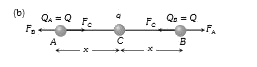
A charge q is placed at the centre of the line joining two equal charges Q. The system of the three charges will be in equilibrium if q is equal to:

A

`-Q//2`

B

`-Q//4`

C

`+Q//4`

D

`+Q//2`

Text Solution

Verified by Experts

The correct Answer is:
B


For Equilibrium at B
`vecF_A+vecF_C=0 implies vecF_A=-vecF_C`
`implies (KQ^2)/((2x)^2)=-(KQq)/x^2 implies q =-Q//4`
Promotional Banner

Topper's Solved these Questions

  • ELECTROSTATICS

    ERRORLESS|Exercise ASSERTION & REASON|25 Videos
  • ELECTROSTATICS

    ERRORLESS|Exercise NCERT BASED QUESTIONS (Grouping of Capacitors)|58 Videos
  • ELECTRONICS

    ERRORLESS|Exercise Assertion & Reason|26 Videos
  • MAGNETIC EFFECTS OF CURRENT

    ERRORLESS|Exercise ASSERTION & REASON |18 Videos

Similar Questions

Explore conceptually related problems

If a charge q is placed at the centre of the line joining two equal charges Q such that the system is in equilibrium then the value of q is

A point charge q is placed at the centre of a line joining two equal charges Q. The whole system is in the state of equilibrium. Can you impose some lower limit on the magnitude of the charge Q?

A charge "q" is placed at the centroid of an equilateral triangle. Three charges having same "],[" charge equal to "Q" are placed at the vertices of the triangle.The system of four charges will be in equilibrium if "q" is equal to

A charge q is placed in the middle of a line joining the two equal and like point charge Q .This charge q will remain in equilibrium if q=(Q)/(x) .What is x ?

A charge Q is placed at the centre of the line joining two point charges +q and +q as shown in figure. The ratio of charges Q and q is

Two equal charges, +Q each, are at a distance r from each other. A third charge is placed on the line joining the above two charges such that all these charges are in equilibrium. Find q, in terms of Q.

Two point charges q_(1) = +2 C and q_(2) = - 1C are separated by a distance d . The position on the line joining the two charges where a third charge q = + 1 C will be in equilibrium is at a distance

Two idential point charges Q are kept at a distance r from each other. A third point charge is placed on the line joing the above two charges such that all the three charges are in equilibrium. The third charge (a) should be of magnitude q=……….. (b) should be of sign ....... (c ) should be placed ........ .

ERRORLESS-ELECTROSTATICS-PAST YEARS QUESTIONS
  1. Calculate the number of electrons constituting one coulomb of charge.

    Text Solution

    |

  2. Two identical conductors of copper and aluminium are placed in an iden...

    Text Solution

    |

  3. A charge q is placed at the centre of the line joining two equal charg...

    Text Solution

    |

  4. Two charge spheres separated at a distance d exert a force F on each o...

    Text Solution

    |

  5. Three charges are placed at the vertices of an equilateral trianlge of...

    Text Solution

    |

  6. Two pitch balls carrying equal charges are suspended from a common poi...

    Text Solution

    |

  7. Two identical charged spheres suspended form a common point by two mas...

    Text Solution

    |

  8. Suppose the charge of a proton and an electron differ slightely. One o...

    Text Solution

    |

  9. Two point charges A and B, having charges +Q and -Q respectively, are ...

    Text Solution

    |

  10. The figure shows the path of a positively charged particle 1 through a...

    Text Solution

    |

  11. The spatial distribution of the electric field due to charges (A,B) is...

    Text Solution

    |

  12. Charges q is uniformly distributed over a thin half ring of radius R. ...

    Text Solution

    |

  13. A, B and C are three points in a uniform electric field. The electric ...

    Text Solution

    |

  14. Equipotential surfaces associated with an electric field which is incr...

    Text Solution

    |

  15. In the figure, a proton moves a distance d in a unform electric vecE a...

    Text Solution

    |

  16. A proton is about 1840 times heavier than an electron. When it is acce...

    Text Solution

    |

  17. The electric field due to uniformly charged sphere of radius R as a fu...

    Text Solution

    |

  18. The potential difference (V(A)-V(B)) between the point A and B in th...

    Text Solution

    |

  19. The diagram below show regions of equipotential: A positive chrages ...

    Text Solution

    |

  20. An electron is moving in a circular path under the influence of a tran...

    Text Solution

    |

