Home
Class 12
PHYSICS
Two pitch balls carrying equal charges a...

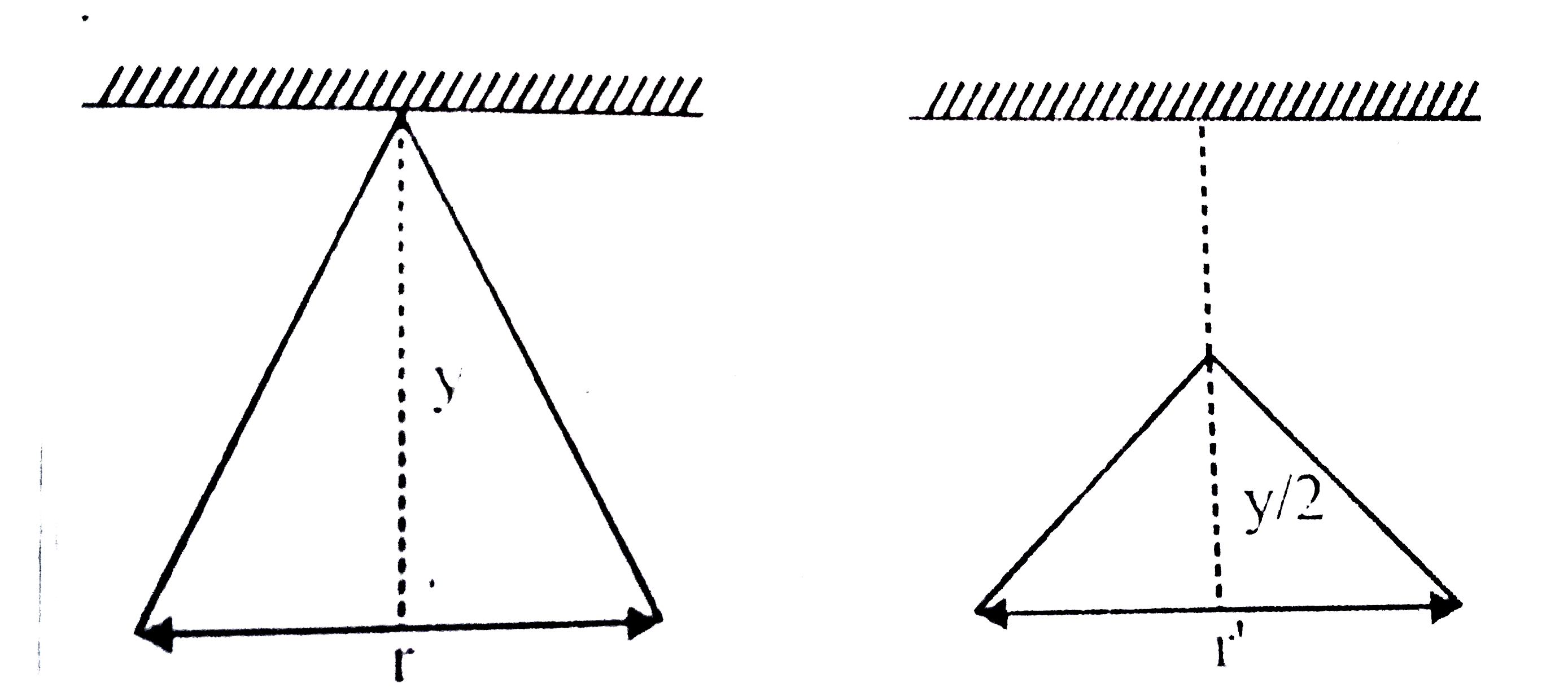
Two pitch balls carrying equal charges are suspended from a common point by strings of equal length, the equilibrium separation between them is r. Now the strings are rigidly clamped at half the height. The equilibrium separation between the balls now become

A

`((2r)/3)`

B

`(1/sqrt2)^2`

C

`(r/(root(3)(2)))`

D

`((2r)/sqrt3)`

Text Solution

Verified by Experts

The correct Answer is:
C

`tantheta=(r//2)/y=r/(2y)`
`T cos theta = mg `
`T sin theta =F`
`tan theta =F/(mg)`

By eq. (i) and (ii)
`r/(2y)=F/(mg) =(Kq^2)/(r^2mg)impliesy =(r^3mg)/(2Kq^2)`
Since, `y prop r^3`
Now ,`y/(y//2) =(r/r_1)^3`
`implies r/r_1=(2)^(1//3)implies r_1 =r (1/2)^(1//3)`
Promotional Banner

Topper's Solved these Questions

  • ELECTROSTATICS

    ERRORLESS|Exercise ASSERTION & REASON|25 Videos
  • ELECTROSTATICS

    ERRORLESS|Exercise NCERT BASED QUESTIONS (Grouping of Capacitors)|58 Videos
  • ELECTRONICS

    ERRORLESS|Exercise Assertion & Reason|26 Videos
  • MAGNETIC EFFECTS OF CURRENT

    ERRORLESS|Exercise ASSERTION & REASON |18 Videos

Similar Questions

Explore conceptually related problems

Two path balls carrying eqaul chareges are suspended froom a common point by strings of equal length, the strings are rightly clamped at half the height. The equilibrium separation between the balls, now becomes :

Two point charges are suspended from a given point as shown in figure. Find the equilibrium seperation between them

Two indentical pith balls, each carrying charge q, are suspended from a common point by two strings of equal length l. Find the mass of each ball if the angle between the strings is 2theta in equilibrium.

Two identical pith balls are charged by rubbing against each other. They are suspended from a horizontal rod through two strings of length 20 cm each, the separation between the susjpension points being 5 cm. in equilibrium, the separation between the balls in 3 cm. Find the mass of each ball and the tension in the strings. the charge on each ball gas a magnitude 2.0 xx 10^(-8) C.

Two identical ball having mass density rho , mass m and charge q are suspended from a common point by two insulating massless strings of equal length. At equilibrium each string makes an angle theta with the vertical. Now both the balls are immersed in a fluid. At equilibrium, theta remains same. If the mass density of liquid is sigma then dielectric constant of liquid will be

Two identical tennis balls each having mass 'm' and charge 'q' are suspended from a fixed point by threads of length 'l'. What is the equilibrium separation when each thread makes a small angle 'theta' with the vertical ?

Assertion : Two identical balls are charged by q. They are suspended from a common point by two insulating threads l each. In equilibrium, the angle between the tension in the threads is 180^(@) . (Ignore gravity). Reason : In equilibrium tension in the spring is T=1/(4pi epsi_(0)) (q.q)/l^(2)

Two identical balls each having a density rho are suspended from as common point by two insulating strings of equal length. Both the balls have equal mass and charge. In equilibrium each string makes an angle theta with vertical. Now, both the balls are immersed in a liquid. As a result the angle theta does not change. The density of the liquid is sigma . Find the dielectric constant of the liquid.

Two identical balls having equal positive charge q coulomb are suspended by two in painting strings of equal length. What would be the effect on the force when a plastic sheet is inserted between the two?

ERRORLESS-ELECTROSTATICS-PAST YEARS QUESTIONS
  1. Two charge spheres separated at a distance d exert a force F on each o...

    Text Solution

    |

  2. Three charges are placed at the vertices of an equilateral trianlge of...

    Text Solution

    |

  3. Two pitch balls carrying equal charges are suspended from a common poi...

    Text Solution

    |

  4. Two identical charged spheres suspended form a common point by two mas...

    Text Solution

    |

  5. Suppose the charge of a proton and an electron differ slightely. One o...

    Text Solution

    |

  6. Two point charges A and B, having charges +Q and -Q respectively, are ...

    Text Solution

    |

  7. The figure shows the path of a positively charged particle 1 through a...

    Text Solution

    |

  8. The spatial distribution of the electric field due to charges (A,B) is...

    Text Solution

    |

  9. Charges q is uniformly distributed over a thin half ring of radius R. ...

    Text Solution

    |

  10. A, B and C are three points in a uniform electric field. The electric ...

    Text Solution

    |

  11. Equipotential surfaces associated with an electric field which is incr...

    Text Solution

    |

  12. In the figure, a proton moves a distance d in a unform electric vecE a...

    Text Solution

    |

  13. A proton is about 1840 times heavier than an electron. When it is acce...

    Text Solution

    |

  14. The electric field due to uniformly charged sphere of radius R as a fu...

    Text Solution

    |

  15. The potential difference (V(A)-V(B)) between the point A and B in th...

    Text Solution

    |

  16. The diagram below show regions of equipotential: A positive chrages ...

    Text Solution

    |

  17. An electron is moving in a circular path under the influence of a tran...

    Text Solution

    |

  18. An electron falls from rest through a vertical distance h in a uniform...

    Text Solution

    |

  19. A hallow metal sphere of radius R is uniformly charged. The electric f...

    Text Solution

    |

  20. Two parallel infinite line charges with linear charge densities +lambd...

    Text Solution

    |

