Home
Class 11
PHYSICS
A train accelerates from rest at a const...

A train accelerates from rest at a constant rate a for distance `x_(1)` and time `t_91)`. After that is retards at constant rate `beta` for distance `x_(2)` and time `t_(2)` and comes to the rest. Which of the following relation is correct:-

A

`x_1/x_2 = alpha/beta = t_1/t_2`

B

`x_1/x_2 = beta/alpha = t_1/t_2`

C

`x_1/x_2 = alpha/beta = t_2/t_1`

D

`x_1/x_2 = beta/alpha = t_2/t_1`

Text Solution

Verified by Experts

The correct Answer is:
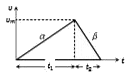
B


`t_1 = (v_m)/(alpha), `t_2 = (v_m)/(beta)`
`x_1 = 1/2 v_m t_1`
`x_2 = 1/2 v_m t_2`
`x_1/x_2 = (t_1)/(t_2) = beta/alpha`
Promotional Banner

Topper's Solved these Questions

  • MOTION IN ONE DIMENSION

    ERRORLESS|Exercise NCERT BASED QUESTIONS (RELATIVE MOTION )|18 Videos
  • MOTION IN ONE DIMENSION

    ERRORLESS|Exercise NCERT BASED QUESTIONS (MOTION UNDER GRAVITY )|56 Videos
  • MOTION IN ONE DIMENSION

    ERRORLESS|Exercise NCERT BASED QUESTIONS (UNIFORM MOTION )|24 Videos
  • KINETIC THEORY OF GASES

    ERRORLESS|Exercise ASSERTION AND REASON |16 Videos
  • MOTION IN TWO DIMENSION

    ERRORLESS|Exercise ASSERTION & REASON|19 Videos

Similar Questions

Explore conceptually related problems

An elevator accelerates from rest at a constant rate alpha for time interval t_(1) and travels a distance S_(1) It them retards at a constant rate beta for time interval t_(2) and finally comes to rest after travelling a distance S_(2) during its retardation Show that: (S_(1))/(S_(2))=(t_(1))/(t_(2))=(beta)/(alpha) .

A train accelerates from at the constant rate b for time t_(2) at a constant rate a and then it retards at the comes to rest. Find the ratio t_(1) // t_(2) .

A train moves from rest with acceleration alpha and in time t_(1) covers a distance x. It then decelerates rest at constant retardation beta for distance y in time t_(2) . Then

A scooter accelerates from rest for time t_(1) at constant rate a_(1) and then retards at constant rate a_(2) for time t_(2) and comes to rest. The correct value of (t_(1))/(t_(2)) will be :-

A car, starting from rest, has a constant acceleration for a time interval t_1 during which it covers a distance In the next time interval the car has a constant retardation and comes to rest after covering a distance in time Which of the following relations is correct?

A car accelerates from rest at constant rate of 2ms^(-2) for some time. Immediately after this, it retards at a constant rate of 4ms^(-2) and comes to rest. The total time for which it remains in motion is 3 s. Taking the moment of start of motion as t = 0, answer the following questions. If the time of acceleration is t_(1) , then the speed of the car at t=t_(1) is

A car accelerates from rest at constant rate of 2ms^(-2) for some time. Immediately after this, it retards at a constant rate of 4ms^(-2) and comes to rest. The total time for which it remains in motion is 3 s. Taking the moment of start of motion as t = 0, answer the following questions. Let t be a time instant greater than t_(1) but less than 3 s. The velocity at this time instant is

A car accelerates from rest at constant rate of 2ms^(-2) for some time. Immediately after this, it retards at a constant rate of 4ms^(-2) and comes to rest. The total time for which it remains in motion is 3 s. Taking the moment of start of motion as t = 0, answer the following questions. What is the distance travelled by it during the time of increasing speed ?

ERRORLESS-MOTION IN ONE DIMENSION-NCERT BASED QUESTIONS (NON-UNIFORM MOTION )
  1. Two bodies are thrown simultaneously from a tower with same initial ve...

    Text Solution

    |

  2. Four marbles are dropped from the top of a tower one after the other w...

    Text Solution

    |

  3. A train accelerates from rest at a constant rate a for distance x(1) a...

    Text Solution

    |

  4. A particle starts from rest with uniform acceleration and it's velocit...

    Text Solution

    |

  5. A point mass starts moving in a straight line with a constant accelera...

    Text Solution

    |

  6. A particle is moving in a straight line and passes through a point O w...

    Text Solution

    |

  7. A stone is dropped from a height h. Simultaneously, another stone is t...

    Text Solution

    |

  8. A point initially at rest moves along x-axis. Its acceleration varies ...

    Text Solution

    |

  9. A particle moves along x-axis as x=4(t-2)+a(t-2)^2 Which of the foll...

    Text Solution

    |

  10. The velocity of a body depends on time according to the equative v = 2...

    Text Solution

    |

  11. The displacement of a particle is given by y = a + bt + ct^2 - dt^4. T...

    Text Solution

    |

  12. The position x of a particle varies with time t as x=at^(2)-bt^(3) .Th...

    Text Solution

    |

  13. The motion of a particle is described by the equation x = a+bt^(2) whe...

    Text Solution

    |

  14. The motion of a particle is described by the equation at u = at.The di...

    Text Solution

    |

  15. The relation 3t=sqrt(3x)+6 describe the displacement of a particle in ...

    Text Solution

    |

  16. Equation of displacement for any particle is s = 3t^(3) +7t^(2) +14t8m...

    Text Solution

    |

  17. Starting from rest, acceleration of a particle is a = 2 (t-1). The vel...

    Text Solution

    |

  18. A particle moves along X-axis in such a way that its coordinate X vari...

    Text Solution

    |

  19. The position of a particle moving on a straight line is proportional t...

    Text Solution

    |

  20. The displacement of a particle is moving by x = (t - 2)^2 where x is i...

    Text Solution

    |

