Home
Class 11
PHYSICS
A mass m is suspended separately by two ...

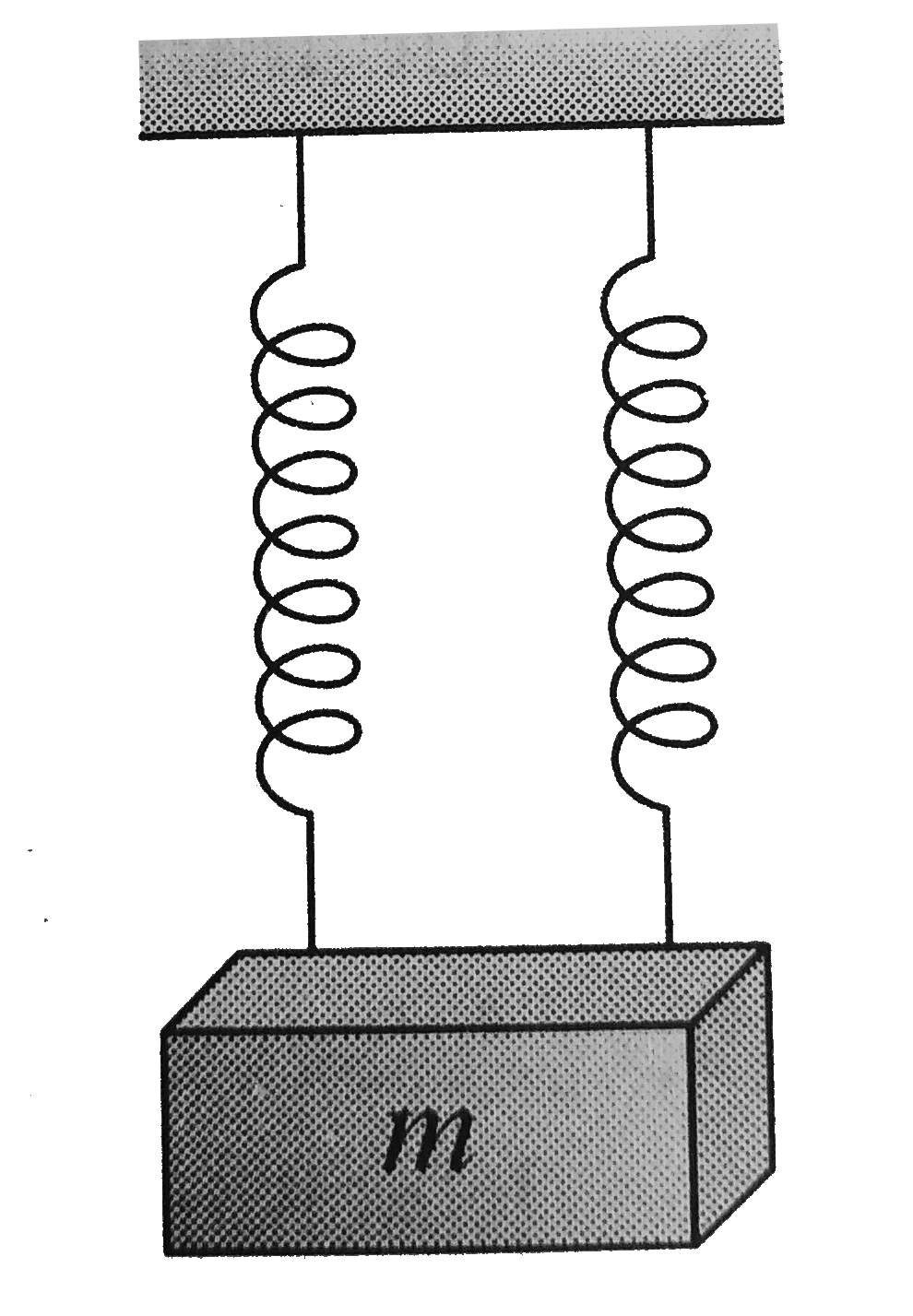
A mass `m` is suspended separately by two different springs of spring constant `k_(1)` and `k_(2)` given the time period `t_(1)` and `t_(2)` respectively. If the same mass `m` is shown in the figure then time period `t` is given by the relation

A

`t=t_(1)+t_(2)`

B

`t=(t_(1).t_(2))/(t_(1)+t_(2))`

C

`t^(2)=t_(1)^(2)+t_(2)^(2)`

D

`t^(-2)=t_(1)^(-2)+t_(2)^(-2)`

Text Solution

Verified by Experts

The correct Answer is:

D

`t_(1)=2pisqrt((m)/(K_(1))) and t_(2)=2pisqrt((m)/(K_(2)))`
`K_(eq)=K_(1)+K_(2)`
`therefore t=2pisqrt((m)/(K_(1)+K_(2)))implies (1)/(t_(2))=(1)/(4pi^(2))((K_(1))/(m)+(K_(2))/(m))`
`implies (1)/(t^(2))=(1)/(t_(1)^(2))+(1)/(t_(2)^(2)) implies t^(-2)=t_(1)^(-2)+t_(2)^(-2)`.
Promotional Banner

Topper's Solved these Questions

  • SIMPLE HARMONIC MOTION

    ERRORLESS|Exercise NCERT BASED QUESTIONS (Superposition of S.H.M.s and Resonance)|7 Videos
  • SIMPLE HARMONIC MOTION

    ERRORLESS|Exercise PAST YEARS QUESTIONS|28 Videos
  • SIMPLE HARMONIC MOTION

    ERRORLESS|Exercise NCERT BASED QUESTIONS (Simple Pendulum)|27 Videos
  • ROTATIONAL MOTION

    ERRORLESS|Exercise Assertion & Reason|25 Videos
  • SURFACE TENSION

    ERRORLESS|Exercise ASSERTION & REASON|11 Videos

Similar Questions

Explore conceptually related problems

A mass is suspended separately by two different springs in successive order, then time periods is t_(1) "and" t_(2) respectively. It is connected by both springs as shown in fig. then time period is t_(0) . The correct relation is

A mass is suspended separately by two springs of spring constants k_(1) and k_(2) in successive order. The time periods of oscillations in the two cases are T_(1) and T_(2) respectively. If the same mass be suspended by connecting the two springs in parallel, (as shown in figure) then the time period of oscillations is T. The correct relations is

When a block of mass m is suspended separately by two different springs have time period t_(1)" and "t_(2) . If same mass is connected to parallel combination of both springs, then its time period is given by :-

Two spring of spring constants k_(1) and k_(2) ar joined and are connected to a mass m as shown in the figure. Calculate the frequency of oscillation of mass m.

A mass m is suspended from the two coupled springs connected in series. The force constant for spring are k_(1) and k_(2) . The time period of the suspended mass will be:

A mass m is suspended from the two coupled springs connected in series. The force constant for springs are k_(1) "and" k_(2). The time period of the suspended mass will be

A mass M is suspended by two springs of force constants K_(1) and K_(2) respectively as shown in the diagram. The total elongation (stretch) of the two springs is

A mass is suspended separately by two springs and the time periods in the two cases are T_(1) and T_(2) . Now the same mass is connected in parallel (K = K_(1) + K_(2)) with the springs and the time is suppose T_(P) . Similarly time period in series is T_(S) , then find the relation between T_(1),T_(2) and T_(P) in the first case and T_(1),T_(2) and T_(S) in the second case.

ERRORLESS-SIMPLE HARMONIC MOTION-NCERT BASED QUESTIONS (Spring Pendulum)
  1. An ideal spring with spring constant K = 200 N / m is fixed on one end...

    Text Solution

    |

  2. A body of mass 0.01 kg executes simple harmonic motion (SHM) about x=0...

    Text Solution

    |

  3. The springs shown are identical. When A =4 kg , the elongation of spr...

    Text Solution

    |

  4. Two masses m1 and m2 are suspended together by a massless spring of co...

    Text Solution

    |

  5. A small mass m attached to one end of a spring with a negligible mass ...

    Text Solution

    |

  6. One end of a spring of force constant k is fixed to a vertical wall an...

    Text Solution

    |

  7. Three masses 700g, 500g, and 400 g are suspended at the end of a sprin...

    Text Solution

    |

  8. A mass m is suspended from the two coupled springs connected in series...

    Text Solution

    |

  9. As shown in figure, a simple harmonic motion oscillator having identic...

    Text Solution

    |

  10. What will be the force constant of the spring system shown in the figu...

    Text Solution

    |

  11. Two spring of spring constant k(1) and k(2) are joined in series The e...

    Text Solution

    |

  12. A weightless spring of length 60 cm and force constant 200 N/m is kept...

    Text Solution

    |

  13. A mass m is suspended from a spring of length l and force constant K ....

    Text Solution

    |

  14. A mass m is suspended separately by two different springs of spring co...

    Text Solution

    |

  15. Two identical balls A and B each of mass 0.1 kg are attached to two id...

    Text Solution

    |

  16. A particle of mass 'm' is attached to three identical springs A,B and ...

    Text Solution

    |

  17. A particle oscillating under a force vecF=-kvecx-bvecv is a (k and b a...

    Text Solution

    |

  18. The equation of a damped simple harmonic motion is m(d^2x)/(dt^2)+b(dx...

    Text Solution

    |

  19. A simple pendulum is set into vibrations. The bob of the pendulum come...

    Text Solution

    |

  20. A block off mass 200 g executing SHM under the unfluence of a spring o...

    Text Solution

    |
