Home
Class 12
PHYSICS
A proton accelarted by a potential diff...

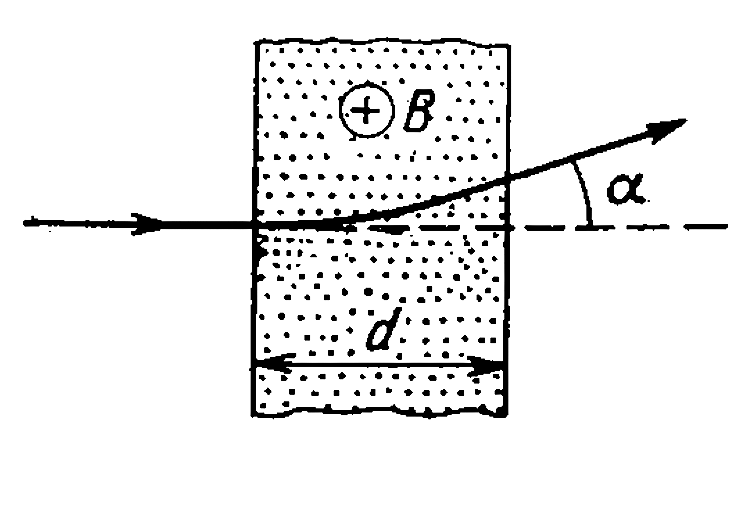
A proton accelarted by a potential differnce `V = 500 kV` fieles through a unifrom transverse magnetic filed the induction `B = 0.54 T`. The field occupies a region of space `d = 10 cm` in thickness (Fig). Find the angle `alpha` through which the proton deviates from the initial direction of its motion.

A

`15^(@)`

B

`30^(@)`

C

`45^(@)`

D

`60^(@)`

Text Solution

Verified by Experts

The correct Answer is:

B

`sin theta = (d)/( r)`
`r = (mv)/(qB) = (1)/(B) sqrt((2mV)/(q))`
`sin theta = Bd sqrt((q)/(2mV))`
`= 0.51 xx 0.1 sqrt((1.6 xx 10^(-19))/(2 xx 1.67 xx 10^(-27) xx 500 xx 10^(3)))`
`implies sin theta = (1)/(2) implies theta = 30^(@)`
Promotional Banner

Topper's Solved these Questions

  • MAGNETIC EFFECTS OF CURRENT

    ERRORLESS|Exercise NCERT BASED QUESTIONS (Force and Torque on a Current Carrying Conductor )|51 Videos
  • MAGNETIC EFFECTS OF CURRENT

    ERRORLESS|Exercise PAST YEARS QUESTIONS |48 Videos
  • MAGNETIC EFFECTS OF CURRENT

    ERRORLESS|Exercise ASSERTION & REASON |18 Videos
  • ELECTROSTATICS

    ERRORLESS|Exercise ASSERTION & REASON|25 Videos
  • MAGNETISM

    ERRORLESS|Exercise Assertion and Reason|22 Videos

Similar Questions

Explore conceptually related problems

A particle accelerated by a potential difference V flies through a uniform transverse magnetic field with induction B. The field occupies a region of space din thickness. Prove that the angle a through which the particle deviates from the initial direction of its motion is given by. alpha=sin^(-1)(dBsqrt((q)/(2 Vm))) where m is the mass of the particle.

A charged particle having mass m and charge q is acceleration by a potential difference V, it files through a uniform tranverse magnetic field b.The field occupies a region of space d.Find the time interval for which it remains inside the magnetic field (i) An alpha particle is acceleration by a potential difference of 10^(4) V. Find the change in tis direction of motiom if it enters normally in a region of thicknees 0.1 , having transverse magnetic induction of 0.1T(m_(aplha)=6.4xx10^(-27)kg) (ii) a 10 g bullet having a charge of 4muC is fired at a speed 270ms^(-1) in a horizontal direction,A vertical magnetic field as it travels through 100 m .Make appropriate approximations

An electron accelerated by a potential difference V=1.0 kV moves in a uniform magnetic field at an angle alpha = 30^@ to the vector B whose modulus is B=29 mT. Find the pitch of the helical trajectory of the electron.

A proton of mass m and charge q is accelerated by a potential difference V in a perpendicular magnetic field B occupying space t. The value of sin theta where theta is deviation of proton from initial direction is

A proton accelarted by a potential differnce V gets into the unifrom electric field of a paralallel-plate capacitor whose plates extended over a length l in the motion direction. The field strenth varies with time as E = at , where a is a constant. Assuming the proton to be non-relatistic, find the angle between the motion directions of the proton before and after its fight throgh the capacitor, the proton gets in the field at the moment t = 0 . The edge effects are to be neglected.

A proton and an alpha particle accelerated through the same potential difference enter a region of uniform magnetic field normally if the radius of the proton orbit is 10 cm ten radius of alpha particle is

A proton, a deuteron and an alpha particle, are accelerated through the same potential difference and then subjected to a unifrom magnetic field vecB , perpendicular to the direction of their motions. Compare (i) their kinetic energies, and (ii) if the radius of the ciruclar path described by proton is 5 cm, determine the radii of the paths described by deuteron and alpha partcile.

ERRORLESS-MAGNETIC EFFECTS OF CURRENT -NCERT BASED QUESTIONS (Motion of Charged Particle in Magnetic Field)
  1. The magnetic field in a certain region of space is given by B=8.35 xx1...

    Text Solution

    |

  2. A particle with charge q, moving with a momentum p, enters a uniform ...

    Text Solution

    |

  3. A proton accelarted by a potential differnce V = 500 kV fieles throug...

    Text Solution

    |

  4. A charged particle of charge q and mass m, gets deflected through an a...

    Text Solution

    |

  5. A point charge Q(=3xx10^(-12)C) rotates uniformly in a vertical circle...

    Text Solution

    |

  6. An electron and a proton, both having the same kinetic energy, enter a...

    Text Solution

    |

  7. If a proton, deuteron, and alpha particle on being accelerated by the ...

    Text Solution

    |

  8. An electron is accelerated by a potential difference of 12000 volts. I...

    Text Solution

    |

  9. A moving charge will gain energy due to the application of

    Text Solution

    |

  10. A charged particle is moving in a uniform magnetic field in a circular...

    Text Solution

    |

  11. The maximum velocity to which a proton can be accelerated in a cycl...

    Text Solution

    |

  12. A proton and an alpha particle are separately projected in a region wh...

    Text Solution

    |

  13. Two particles A and B having equal charges +6C, after being accelerate...

    Text Solution

    |

  14. An electron enters a chamber in which a uniform magnetic field is pres...

    Text Solution

    |

  15. A proton carrying 1 MeV kinetic energy is moving in a circular path of...

    Text Solution

    |

  16. A proton of energy 2 MeV is moving perpendicular to uniform magnetic f...

    Text Solution

    |

  17. A deutron of kinetic energy 50 keV is describing a circular orbit of r...

    Text Solution

    |

  18. Mixed He^(+) and O^(2+) ions (mass of He^(+)=4 amu and that of O^(2+)=...

    Text Solution

    |

  19. A uniform magnetic field B = 1.2 mT is directed vertically upward thro...

    Text Solution

    |

  20. Identify the correct statement from the following

    Text Solution

    |
