Home
Class 12
PHYSICS
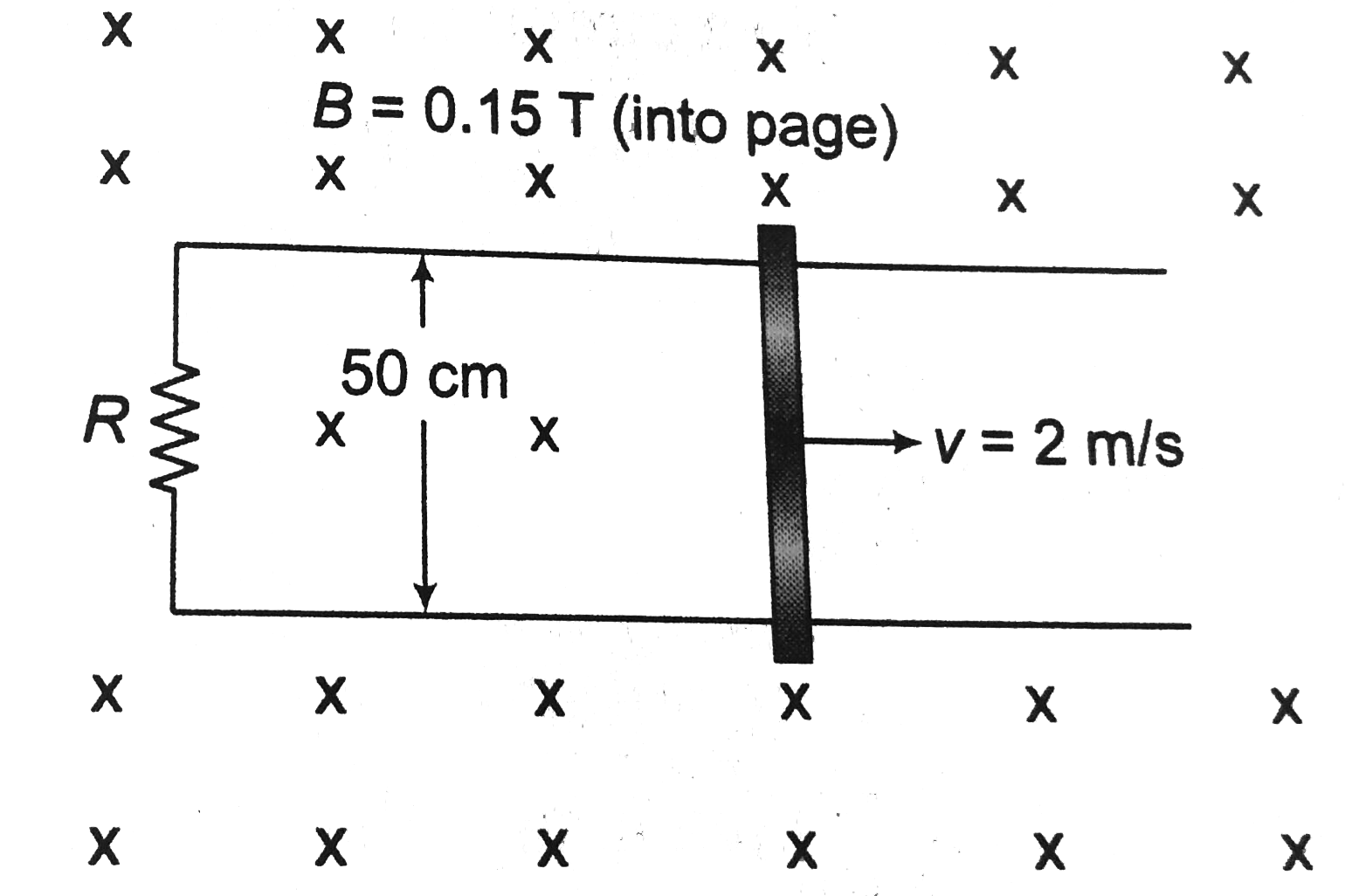
As shown in figure, a metal rod complete...

As shown in figure, a metal rod completes the circuit. The circuit area is perpendicular to a magnetic field with `B = 0.15 T`. If the resistance of the total circuit is `3 Omega`, how large a force is needed to move the rod as indicated with a constant speed of 2 m/s?

A

`3.75xx10^(-3)N`

B

`3.75xx10^(-2)N`

C

`3.75xx10^(2)N`

D

`3.75xx10^(-4)N`

Text Solution

Verified by Experts

The correct Answer is:

A

`F=IlB=(Blv)/R*lB`
= `(B^(2)l^(2)v)/R=((0.15)^(2)xx(0.5)^(2)xx2)/3`
= `3.75xx10^(-3)N`.
Promotional Banner

Topper's Solved these Questions

  • ELECTROMAGNETIC INDUCTION

    ERRORLESS|Exercise NCERT BASED QUESTIONS (STATIC EMI)|39 Videos
  • ELECTROMAGNETIC INDUCTION

    ERRORLESS|Exercise NCERT BASED QUESTIONS (APPLICATION OF EMI (Dynamo, Transformer…))|20 Videos
  • ELECTROMAGNETIC INDUCTION

    ERRORLESS|Exercise ASSERTION & REASON|20 Videos
  • CURRENT ELECTRICITY

    ERRORLESS|Exercise ASSERTION AND REASON|26 Videos
  • ELECTRON, PHOTON, PHOTOELECTRIC EFFECT & X -RAY

    ERRORLESS|Exercise ASSERTION & REASON|27 Videos

Similar Questions

Explore conceptually related problems

As shown in the figure a metal rod makes contact and complete the circuit. The circuite is perpendicular to the magnetic field with B=0.15 tesla. If the resistance is 3Omega force needed to move the rod as indicated with a constant speed of 2m//sec is

A 0.5m long metal rod PQ completes the circuit as shown in the figure. The area of the circuit is perpendicular to the magnetic field of flux density 0.15 T . If the resistance of the total circuit is 3Omega calculate the force needed to move the rod in the direction as indicated with a constant speed of 2 ms^(-1)

A metallic rod completes its circuit as shown in the figure. The circuit is normal to a magnetic field of B=0.15 tesla. If the resistances of the rod is 3Omega the force required to move the rod with a constant velocity of 2m//sec is-

A metal rod of length l cuts across a uniform magnetic field B with a velocity v. If the resistance of the circuit of which the rod forms a part is r, then the force required to move the rod is

The conducting rod ab shown in figure makes contact with metal rails ca and db . The apparatus is in a uniform magnetic field 0.800 T , perpendicular to the plane of the figure. (a) Find the magnitude of the emf induced in the rod when it is moving toward the right with a speed 7.50 m//s . (b) In what direction does the current flow in the rod? (c) If the resistance of the circuit abdc is 1.50 Omega (assumed to be constant), find the force (magnitude and direction) required to keep the rod moving to the right with a constant speed of 7.50 m//s . You can ignore friction. (d) Compare the rate at which mechanical work is done by the force (Fu) with the rate at which thermal energy is developed in the circuit (I^2R) .

A wire of length 1 m is moving at a speed of 2 ms^(-1) perpendicular to its length and a homogeneous magnetic field of 0.5T . The ends of the wire are joined to a circuit of resistance 6 Omega . The rate at which work is being done to keep the wire moving at constant speed is

Imagine a would where free magnetic charges exist. In this world, a circuit is made with a U shape wire and a rod free to slide on it. A current carried by free magnetic charges can flow in the circuit. When the circuit is placed in a uniform electric field. E perpendicular to the plane of the plane of the circuit and the rod is pulled to the right with a constant speed v, the "magnetic EMF" in the current and the direction of the corresponding current. arising because of changing electric flux will be (l is the length of the rod and c is speed of light).

ERRORLESS-ELECTROMAGNETIC INDUCTION-NCERT BASED QUESTIONS (Motional EMI)
  1. A straight conductor 0.1 m long moves in a uniform magnetic field 0.1 ...

    Text Solution

    |

  2. A metallic square loop ABCD is moving in its own plane with velocity v...

    Text Solution

    |

  3. The magnitude of the earth's magnetic field at a place is B(0) and an...

    Text Solution

    |

  4. A rectangular loop with a sliding connector of length l = 1.0 m is sit...

    Text Solution

    |

  5. A square metallic wire loop of side 0.1 m and resistance of 1W is move...

    Text Solution

    |

  6. A conductor ABOCD moves along its bisector with a velocity of 1 m//s t...

    Text Solution

    |

  7. A conducting rod PQ of length l=1.0m is moving with a uniform speed v2...

    Text Solution

    |

  8. As shown in figure, a metal rod completes the circuit. The circuit are...

    Text Solution

    |

  9. A physicist works in a laboratory where the magnetic field is 2T. She ...

    Text Solution

    |

  10. A wire cd of length l and mass m is sliding without friction on conduc...

    Text Solution

    |

  11. A rectangular loop of wire in the plane of the paper starts outside a ...

    Text Solution

    |

  12. A conducting rod of mass m and length l is free to move without fricti...

    Text Solution

    |

  13. A conducting bar of mass m and length l moves on two frictionless para...

    Text Solution

    |

  14. A wheel with ten metallic spokes each 0.50 m long is rotated with a sp...

    Text Solution

    |

  15. A rectangular coil ABCD is rotated anticlockwise with a uniform angula...

    Text Solution

    |

  16. A rectangular coil of 300 turns has an average area of average area of...

    Text Solution

    |

  17. v20.2

    Text Solution

    |

  18. Two identical metallic square loops L(1) " and " L(2) are placed next ...

    Text Solution

    |

  19. A metallic ring of radius a and resistance R is held fixed with its ax...

    Text Solution

    |

  20. An aircraft with a wingspan of 40 m flies a speed of 1080 km hr(1) in ...

    Text Solution

    |
