Home
Class 11
PHYSICS
Three equal masses of 1 kg each are plac...

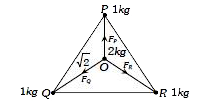
Three equal masses of 1 kg each are placed at the vertices of an equilateral triangle PQR and a mass of 2 kg is placed at the centroid O of the triangle which is at a distance of `sqrt(2)m` from each of the vertices of the triangle. The force, in newton, acting on the mass of 2 kg is :

A

2

B

`sqrt2`

C

1

D

Zero

Text Solution

Verified by Experts

The correct Answer is:
D


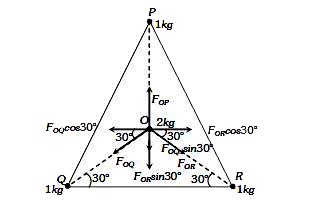
Here, OP=OQ=OR=`sqrt2`m
The gravitational force on mass 2 kg at O due to mass
1kg at P is `F_(OP)=(Gxx2xx1)/((sqrt2)^2)=G` along OP
The gravitational force on mass 2 kg at O due to mass
1kg at Q is `F_(OQ)=(Gxx2xx1)/((sqrt2)^2)=G` along OQ
The gravitational force on mass 2 kg at O due to mass
1kg at R is `F_(OR)=(Gxx2xx1)/((sqrt2)^2)=G` along OR
Resolve forces `F_(OQ)` and `F_(OR)` into two rectangular components.
`F_(OQ)cos30^(@)` and `F_(OR)cos30^(@)` are equal in magnitude of equal and opposite direction.
`=F_(OP)-(F_(OQ)sin30^(@)+F_(OR)sin30^(@))`
`=G-(Gxx1/2+Gxx1/2)=G-G=Zero N`
Promotional Banner

Topper's Solved these Questions

  • GRAVITATION

    ERRORLESS|Exercise NCERT BASED QUESTIONS (Acceleration Due to Gravity)|39 Videos
  • GRAVITATION

    ERRORLESS|Exercise NCERT BASED QUESTIONS (Gravitation Potential, Energy and Escape Velocity)|38 Videos
  • FRICTION

    ERRORLESS|Exercise ASSERTION & REASON |8 Videos
  • KINETIC THEORY OF GASES

    ERRORLESS|Exercise ASSERTION AND REASON |16 Videos

Similar Questions

Explore conceptually related problems

Three equal masses of 2kg each are placed at the vertices of an equilateral triangle and a mass of 4 kg is placed at the centroid of the triangle which is at a distance of sqrt(2) m from each of the vertices of the triangle. The force, (in newton) acting on the mass of 4 kg is

Three equal masses of 1 kg each are placed at the vertices of an equilateral Delta PQR and a mass of 2kg is placed at the centroid O of the triangle which is at a distance of sqrt(2) m from each the verticles of the triangle. Find the force (in newton) acting on the mass of 2 kg.

Three equal masses of 1 kg each are placed at the vertices of an equilateral triangle which is at a distance of sqr(2) m from each of the vertices of the triangle .The force . In newton , acting on the mass of 2 kg is

Three masses of 1 kg each are kept at the vertices of an equilateral triangle of side 3 m. What is the force acting on a point mass of 5 kg placed at its centroid ?

Two balls of mass m each are placed at the two vertices of an equilateral triangle. Another ball of mass 2m is placed at the third vertex of the triangle. Locate the centre of mass of the system.

Three equal masses of 1.5 kg each are fixed at the vertices of an equilateral triangle of side 1 m. What is the force acting on a particle of mass 1 kg placed at its centroid ?

Three equal masses of 1 kg each are placed at the vertices of an equilateral triangle of side 1 m, then the gravitational force on one of the masses due to other masses is (approx.)

Three masses each of mass m are palced at the vertices of an equilateral triangles ABC of side l as shown in figure. The force acting on a mass 2m placed at the centroid O of the triangle is

Three equal masses 2m each are placed at the vertices an equilateral triangle PQR (i) What is the force acting on a mass m placed at the centroid G of the triangle ? (ii) What is the force on mass m if the mass at the vertex P is quadrupled ? Take PG = QG = RG = 1m

Three particles each of mass m are kept at the vertices of an equilateral triangle of side L . What is the gravitational potential at the centroid of the triangle?

ERRORLESS-GRAVITATION-Assertion and Reason
  1. Three equal masses of 1 kg each are placed at the vertices of an equil...

    Text Solution

    |

  2. Statement I: The smaller the orbit of a planet around the Sun, the sho...

    Text Solution

    |

  3. Statement -1: Gravitational force between two particles is negligibly ...

    Text Solution

    |

  4. Assertion: There is no effect of rotation of a earth on acceleration d...

    Text Solution

    |

  5. Assertion : We can not move even a finger without disturbing all the s...

    Text Solution

    |

  6. Assertion : If a pendulum falls freely, then its time period becomes i...

    Text Solution

    |

  7. Statement I: If the earth suddenly stops rotating about its axis, then...

    Text Solution

    |

  8. Assertion : The difference in the value of acceleration due to gravity...

    Text Solution

    |

  9. Assertion: For the plantes orbiting around the sun, angular speed, lin...

    Text Solution

    |

  10. Assertion : A force act upon the earth revolving in a circular orbit...

    Text Solution

    |

  11. Assertion: The speed of revolution of an artificial satellite revoving...

    Text Solution

    |

  12. Assertion : Gravitational potential of earth at every place on it is...

    Text Solution

    |

  13. Assertion : Even when orbit of a satellite is elliptical, its plane of...

    Text Solution

    |

  14. Assertion : A planet moves faster, when it is closer to the sun in i...

    Text Solution

    |

  15. Assertion : Orbital velocity of a satellite is greater than its esca...

    Text Solution

    |

  16. Assertion : The speed of satellite always remains constant in an orb...

    Text Solution

    |

  17. Assertion : Earth has an atmosphere but the moon does not. Reason ...

    Text Solution

    |

  18. Assertion: The time period of geostationary satellite is 24 hrs. Rea...

    Text Solution

    |

  19. Assertion : The principle of superposition is not valid for gravitat...

    Text Solution

    |

  20. Assertion: Two different planets have same escape velocity. Reason:...

    Text Solution

    |

  21. Assertion: The time period of revolution of a satellite close to surfa...

    Text Solution

    |