Home
Class 11
PHYSICS
particles of masses 2M m and M are resec...

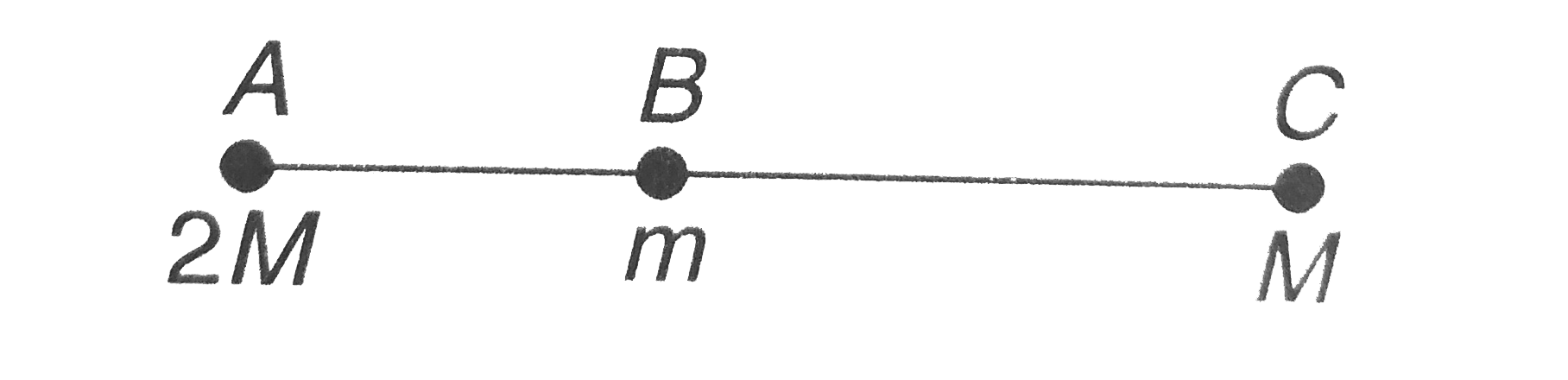
particles of masses 2M m and M are resectively at points A , B and C with ` AB = (1)/(2) (BC)` m is much - much smaller than M and at time ` t=0` they are all at rest as given in figure . As subsequent times before any collision takes palce .

A

m will remain at rest

B

m will move towards M

C

m will move towards 2M

D

m will have oscillatory motion

Text Solution

Verified by Experts

The correct Answer is:

C

Force on B due to `A=F_(BA)=(G(2Mm))/((AB)^2)` towards BA
Force on B due to `C=F_(BC)=(GMm)/((BC)^2)` towards BC
As, (BC)=2AB
`rArrF_(BC)=(GMm)/((2AB)^2)=(GMm)/(4(AB)^2)ltF_(BA)`
Hence, m will move towards BA (i.e., 2M )
Promotional Banner

Topper's Solved these Questions

  • GRAVITATION

    ERRORLESS|Exercise NCERT BASED QUESTIONS (Acceleration Due to Gravity)|39 Videos
  • GRAVITATION

    ERRORLESS|Exercise NCERT BASED QUESTIONS (Gravitation Potential, Energy and Escape Velocity)|38 Videos
  • FRICTION

    ERRORLESS|Exercise ASSERTION & REASON |8 Videos
  • KINETIC THEORY OF GASES

    ERRORLESS|Exercise ASSERTION AND REASON |16 Videos

Similar Questions

Explore conceptually related problems

Two particle of masses m and 2m are coliding elastically as given in figure. If V_(1) and V_(2) speed of particle just after collision then

A particle A of mass m initially at rest slides down a height of 1.25 m on a frictionless ramp, collides with and sticks to an identical particles B of mass m at rest as shown in the figure. Then, particles A and B together collide elastically with particle G of mass 2m at rest. The speed of particle G after the collision with combined body (A+B) would be (Take, g =10 ms^(-2))

consider a head on collision between two particles of masses m_1 and m_2 . The initial speeds of the particles are u_1 and u_2 in the same directioin. The collision starts at t=0 and the particles interact for a time inteval /_\t. Lduring the collision the speed o the first particle varies as v(t)=u_1+t//_\(v_1-u_1) Find the speed of the second particle as as function of time during the collision.

Blocks of masses m , 2m , 4m and 8m are arranged in a line on a frictionless floor . Another block of mass m , moving with speed v along the same line (see figure ) collides with mass m in perfectly inelastic manner. All the subsequent collisions are also perfectly inelastic. By the time the last block of mass 8 m starts moving the total energy loss is p% of the original energy . Value of 'p' is close to :

Two particles of masses m_1 and m_2 in projectile motion have velocities vecv_1 and vecv_2 respectively at time t=0. They collide at time t_0. Their velocities become vecv_1' and vecv_2' at time 2t_0 while still moving in air. The value of |(m_1vecv_1' + m_2vecv_2') - (m_1vecv_1 + m_2vecv_2)| is

A particle of mass m collides elastically with the pan of mass (M = 2m) of a spring balance, as shown in figure. Pan is in equillibrium before collision. Spring constant is k and speed of the particle before collision is v_(0) . Answer the following three questions regarding this collision. Minimum kinetic energy of the particle after collision is

A particle of mass m collides elastically with the pan of mass (M = 2m) of a spring balance, as shown in figure. Pan is in equillibrium before collision. Spring constant is k and speed of the particle before collision is v_(0) . Answer the following three questions regarding this collision. Maximum compression in the spring after the collision the

At time t=0 , a particle is at (-1m, 2m) and at t=2s it is at (-4m,6m) . From this we can conclude that in the given time interval.

ERRORLESS-GRAVITATION-Assertion and Reason
  1. particles of masses 2M m and M are resectively at points A , B and C w...

    Text Solution

    |

  2. Statement I: The smaller the orbit of a planet around the Sun, the sho...

    Text Solution

    |

  3. Statement -1: Gravitational force between two particles is negligibly ...

    Text Solution

    |

  4. Assertion: There is no effect of rotation of a earth on acceleration d...

    Text Solution

    |

  5. Assertion : We can not move even a finger without disturbing all the s...

    Text Solution

    |

  6. Assertion : If a pendulum falls freely, then its time period becomes i...

    Text Solution

    |

  7. Statement I: If the earth suddenly stops rotating about its axis, then...

    Text Solution

    |

  8. Assertion : The difference in the value of acceleration due to gravity...

    Text Solution

    |

  9. Assertion: For the plantes orbiting around the sun, angular speed, lin...

    Text Solution

    |

  10. Assertion : A force act upon the earth revolving in a circular orbit...

    Text Solution

    |

  11. Assertion: The speed of revolution of an artificial satellite revoving...

    Text Solution

    |

  12. Assertion : Gravitational potential of earth at every place on it is...

    Text Solution

    |

  13. Assertion : Even when orbit of a satellite is elliptical, its plane of...

    Text Solution

    |

  14. Assertion : A planet moves faster, when it is closer to the sun in i...

    Text Solution

    |

  15. Assertion : Orbital velocity of a satellite is greater than its esca...

    Text Solution

    |

  16. Assertion : The speed of satellite always remains constant in an orb...

    Text Solution

    |

  17. Assertion : Earth has an atmosphere but the moon does not. Reason ...

    Text Solution

    |

  18. Assertion: The time period of geostationary satellite is 24 hrs. Rea...

    Text Solution

    |

  19. Assertion : The principle of superposition is not valid for gravitat...

    Text Solution

    |

  20. Assertion: Two different planets have same escape velocity. Reason:...

    Text Solution

    |

  21. Assertion: The time period of revolution of a satellite close to surfa...

    Text Solution

    |
