Home
Class 11
PHYSICS
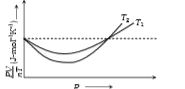
The figure below shows the plot of (PV)/...

The figure below shows the plot of `(PV)/(nT)` versus P for oxygen gas at two different temperatures

Read the following statements concerning the above curves:
(i) The dotted line comesponds to the ideal gas behaviour
(ii) `T_1gtT_2`
(iii) The value of `(PV)/(nT)` at the point where the curves meet on the y-axis is the same for all gases
Which of the above statement is true

A

(i) only

B

(i) and () only

C

All of these

D

None of these

Text Solution

Verified by Experts

The correct Answer is:

C

(i) `(PV)/(nT)` = constant for dotted lines, i.e. behaves ideally.
(ii) At high temperature, deviation of the gas is less and at low temperature the deviation of gas is more i.e. `T_1 gt T_2`
(iii) Since, two curves intersect at dotted line, so the value of `(PV)/(nT)` at that point on the y-axis is same for all gases.
Promotional Banner

Topper's Solved these Questions

  • KINETIC THEORY OF GASES

    ERRORLESS|Exercise ASSERTION AND REASON |16 Videos
  • KINETIC THEORY OF GASES

    ERRORLESS|Exercise NCERT BASED QUESTIONS (Pressure and Energy)|31 Videos
  • GRAVITATION

    ERRORLESS|Exercise Assertion and Reason |25 Videos
  • MOTION IN ONE DIMENSION

    ERRORLESS|Exercise ASSERTION AND REASON|24 Videos

Similar Questions

Explore conceptually related problems

The figure shows the plot of (PV)/(nT) vs P, for oxygen gas at two different temperatures then

If lines T_(1) and T_(2) touch the curve y=x^(2)-3x+2 at the points where the curve meets the X- axis, then

All curves for real gases approach the ideal gas behaviour at

Figure shows graphs of pressure versus density for an ideal gas at two temperatures T_1 and T_2 Then

What is the nature of graph of PV versus P for a given mass of a gas at constant temperature?

Figure shows plot of PV//T versus P"for" 1.00 xx 10^(-3) kg of oxygen gas at two different temperatures. (i) What does the dotted plot signify? (ii) Which is true . T_(1) gt T_(2) "or" T_(1) lt T_(2) ? (iii) What is the value of PV//T where the curves meet on the y-axis?

The curve drawn below shows the variations of P as a function of 1//V for a fixed mass and temperature of an ideal gas. It follows from the curve that:

Fig shows of PV//T versus P for 1.00 xx 10^(-3) kg of oxygen gas at two different temperatures. (a) What does the dotted plot signify ? (b) Which is true : T_(1) lt T_(2) or T_(2) lt T_(1) ? ( c) What is the value of PV//T where the curves meet on the Y-axis ? (d) If we obtained similar plot for 1.00 xx 10^(-3) kg of hydrogen, would we get the same value of PV//T at the point where the curves meet on the y-axis ? If not, what mass of hydrogen yield the same value of PV//T (for low pressure high temperature region of the plot) ? (Molecular mass of H = 2.02 u , of O = 32.0 u, R = 8.31 J "mol"^(-1) K^(-1)

ERRORLESS-KINETIC THEORY OF GASES -PAST YEARS QUESTIONS
  1. Two balloons are filled one with pure He gas and the other with air r...

    Text Solution

    |

  2. Two vessels separately contain two ideal gases A and B at the same tem...

    Text Solution

    |

  3. The figure below shows the plot of (PV)/(nT) versus P for oxygen gas a...

    Text Solution

    |

  4. The pressure (p) and the dencity rho of given mass of a gas expressed ...

    Text Solution

    |

  5. If pressure of CO(2) (real gas ) in a container is given by P = (RT)/...

    Text Solution

    |

  6. Th rate of diffusion is

    Text Solution

    |

  7. The molecules of a given mass of gas have a rms velocity of 200 m//sec...

    Text Solution

    |

  8. According to the kinetic theory of gases, at absolute temperature

    Text Solution

    |

  9. Gas at a pressure P(0) in contained as a vessel. If the masses of all ...

    Text Solution

    |

  10. At constant volume, temperature is increased. Then

    Text Solution

    |

  11. For gas at a temperature T the root-mean-square speed v(rms), the most...

    Text Solution

    |

  12. At what temperature will the rms speed of oxygen molecules become just...

    Text Solution

    |

  13. Increase in temperature of a gas filled in a container would lead to :

    Text Solution

    |

  14. One mole of an ideal diatomic gas undergoes a transition from A to B a...

    Text Solution

    |

  15. The amount of heat energy required to raise the temperature of 1 g of ...

    Text Solution

    |

  16. The molar specific heats of an ideal gas at constant pressure and volu...

    Text Solution

    |

  17. A gas mixture consists of 2 moles of oxygen and 4 moles of argon at te...

    Text Solution

    |

  18. The ratio of the specific heats C(p)/C(v)=gamma in terms of degrees of...

    Text Solution

    |

  19. When an ideal monoatomic gas is heated at constant pressure, fraction ...

    Text Solution

    |

  20. One mole of an ideal monatomic gas undergoes a process described by th...

    Text Solution

    |
