Home
Class 12
PHYSICS
Consider a ray of light incident from ai...

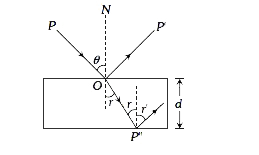
Consider a ray of light incident from air onto a slab of glass (refractive index n) of width d, at an angle `theta` . The phase difference between the ray reflected by the top surface of the glass and the bottom surface is

A

`(4pid)/(lambda)(1-(1)/(n^(2))sin^(2)theta)^(1//2)+ pi`

B

`(4pid)/(lambda)(1-(1)/(n^(2))sin^(2)theta)^(1//2)`

C

`(4pid)/(lambda)(1-(1)/(n^(2))sin^(2)theta)^(1//2)+ pi//2`

D

`(4pid)/(lambda)(1-(1)/(n^(2))sin^(2)theta)^(1//2)+ 2pi`

Text Solution

Verified by Experts

The correct Answer is:
A

Consider the diagram, the ray (P) is incident at an angle `theta` and gets reflected in the direction P . and refracted in the direction P" . Due to reflection from the glass medium, There is a phase change of `pi` .
time taken to travel along OP"
`Deltat= (OP")/(v)= (d//cosr)/(c//n)= (nd)/(ccosr)`
From Snell.s law, `n=(sintheta)/(sinr)`
`implies sinr= (sintheta)/(n)`
`cosr= sqrt(1-sin^(2)r)= sqrt(1-(sin^(2)theta)/(n^(2)))`

`:.Deltat= (nd)/(c(1-(sin^(2)theta)/(n^(2)))^(1//2))= (nd)/(c)(1-(sin^(2)theta)/(n^(2)))^(-1//2))`
Phase difference
`Deltaphi= (2pi)/(T) xx Deltat= (2pind)/(lambda) (1-(sin^(2)theta)/(n^(2)))^(-1//2)`
So, net phase difference = `Deltaphi + pi = (4pid)/(lambda)(1-(1)/(n^(2))sin^(2)theta)^(-1//2)+ pi`
Promotional Banner

Topper's Solved these Questions

  • WAVE OPTICS AND ELECTROMAGNETIC THEORY

    ERRORLESS|Exercise NCERT BASED QUESTIONS (Diffraction of Light)|20 Videos
  • WAVE OPTICS AND ELECTROMAGNETIC THEORY

    ERRORLESS|Exercise NCERT BASED QUESTIONS (Polarization of Light)|17 Videos
  • WAVE OPTICS AND ELECTROMAGNETIC THEORY

    ERRORLESS|Exercise ASSERTION & REASON |27 Videos
  • RAY OPTICS

    ERRORLESS|Exercise Assertion & Reason|30 Videos

Similar Questions

Explore conceptually related problems

A ray of light is incident on the surface of plate of glass of refractive index 1.5 at the polarising angle. The angle of refraction of the ray will be

A ray of light is incident on a glass slab of refractive index 1.5, making an angle of 40^(@) with the surface. The angle of refraction in glass is

A ray of light incident from air on a glass plate of refractive index n is partly reflected and partly refracted at the two surfaces of the glass. The displacement y_(0) in the figure is

A ray of light incident from air on a glass plate of refractive index n is partly reflected and partly refracted at the two surfaces of the glass. The displacement y_(0) in the figure is

A ray of light is incident on the surface of a glass plate of refractive index 1.6 at polarzing angle. Calculate the angles of reflection and refraction.

A ray of light falls on a glass plate of refractive index mu=1.5 . What is the angle of incidence of the ray if the angle between the reflected and refracted rays is 90^@ ?

A ray of light is incident on a glass slab at an angle of 45^(@) . If refractive index of glass be 1.6, what is the angle of refraction ?

A slab of water is on the top of a glass slab of refractive index 2. At what angle to the normal must a ray be incident on the top sureface of th eglass slab so that it is reflected from the bottom surface as shown in figure ?

A ray incident at a point at an angle of incidence of 60^(@) enters a glass sphere with refractive index sqrt(3) and it is reflected and refracted at the farther surface of the sphere. The angle between the reflected and refracted rays at this surface is:

A ray of light passes throught a plane glass slab of thickness t and refractive index mu = 1.5 . The angle between incident ray and emergent ray will be

ERRORLESS-WAVE OPTICS AND ELECTROMAGNETIC THEORY-NCERT BASED QUESTIONS (Young’s Double Slit Experiment and Biprism)
  1. Two ideal slits S(1) and S(2) are at a distance d apart, and illuninat...

    Text Solution

    |

  2. Two coherent sources separated by distance d are radiating in phase ha...

    Text Solution

    |

  3. In Young's double slit experiment, the phase difference between the li...

    Text Solution

    |

  4. Consider a ray of light incident from air onto a slab of glass (refrac...

    Text Solution

    |

  5. Consider Fraunhoffer diffraction pattern obtained with a single slit i...

    Text Solution

    |

  6. A parallel monochromatic beam of light is incident normally on a narro...

    Text Solution

    |

  7. In a Young's double slit experiment (slit distance d) monochromatic li...

    Text Solution

    |

  8. n Young's double slit experiment with sodium vapour lamp of wavelength...

    Text Solution

    |

  9. In Young's double slit experiment, distance between two sources is 0.1...

    Text Solution

    |

  10. The maximum intensity of fringes in Young's experiment is I. If one of...

    Text Solution

    |

  11. The intensity of the light coming from one of the slits in a Young's d...

    Text Solution

    |

  12. In the Young's double-slit experiment,the intensity of light at a poin...

    Text Solution

    |

  13. In a Young's double slit experiment the intensity of light at each sli...

    Text Solution

    |

  14. Oil floating on water looks cloured due to interference of light. What...

    Text Solution

    |

  15. In the Young's double slit experiment , a mica slip of thickness t and...

    Text Solution

    |

  16. A thin sheet of glass (refractive index 1.5) of thickness 6 microns, i...

    Text Solution

    |

  17. When one of the slits of Young's experiment is covered with a transpar...

    Text Solution

    |

  18. A monochromatic beam of light fall on YDSE apparatus at some angle (sa...

    Text Solution

    |

  19. In a double-slit experiment, fringes are produced using light of wavel...

    Text Solution

    |

  20. In Young's double slit experiment, the aperture screen distance is 2m....

    Text Solution

    |

