Home
Class 12
PHYSICS
Statement I: In Young's double-slit expe...

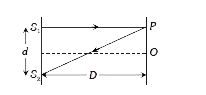
Statement I: In Young's double-slit experiment, the two slits are at distance d apart. Interference pattern is observed on a screen at distance D from the slits. At a point on the screen which is directly opposite to one of the slits, a dark fringe is observed. Then, the wavelength of wave is proportional to the squar of distance between two slits.
Statement II: For a dark fringe, intensity is zero

A

If both assertion and reason are true and the reason is the correct explanation of the assertion

B

If both assertion and reason are true but reason is not the correct explanation of the assertion

C

If assertion is true but reason is false.

D

If the assertion and reason both are false

Text Solution

Verified by Experts

The correct Answer is:
B


When dark fringe is obtained at the point opposite to one of the slits then
`S_(1)P= D` and `S_(2)P= sqrt(D^(2)+ d^(2))= D(1+(d^(2))/(D^(2)))^(1//2)= D(1+ (d^(2))/(2D^(2)))`
Path difference = `S_(2)P- S_(1)P`
`= D(1+ (d^(2))/(2D^(2)))-D=(d^(2))/(2D)= (lambda)/(2)`
`lambda= (d^(2))/(D) implies lambda prop d^(2)`
Now, intensity of a dark fringe is zero.
Promotional Banner

Topper's Solved these Questions

  • WAVE OPTICS AND ELECTROMAGNETIC THEORY

    ERRORLESS|Exercise PAST YEARS QUESTIONS|45 Videos
  • RAY OPTICS

    ERRORLESS|Exercise Assertion & Reason|30 Videos

Similar Questions

Explore conceptually related problems

Statement-1: In Young's double slit experiment the two slits are at distance d apart. Interference pattern is observed on a screen at distance D from the slits. At a poit on the screen when it is directly opposite to one of the slits, a dard fringe is observed then the wavelength of wave is proportional of square of distance of two slits. Statement-2: In Young's double slit experiment, for identical slits, the intensity of a dark fringe is zero.

In Young's double slit experiment, the two slits are at a distance 'd' apart. Interference pattern is observed on a screen at a distance D front the slit, if at a point on the screen, directly opposite to the slits, the first dark fringe is observed, then wave length of the wave will be

In Young's double slit experiment the two slits are d distance apart. Interference pattern is observed on a screen at a distance D from the slits. A dark fringe is observed on the screen directly opposite to one of the slits. The wavelength of light is

In Young's double slit experiment, white light is used. The seperation between the slits is kept 1 mm and intensity is observed on screen distance 2m from the plane of the slits. At a point on the screen directly opposite to the either slit which of the following wavelength is not present

In Young's double-slit experiment, the slit are 0.5 mm apart and the interference is observed on a screen at a distance of 100 cm from the slits, It is found that the ninth bright fringe is at a distance of 7.5 mm from the second dark fringe from the center of the fringe pattern. The wavelength of the light used is

In a double slit experiment, the distance between the slits is d. The screen is at a distance D from the slits. If a bright fringe is formed opposite to one of the slits, its order is

In a double slit experiment , the coherent sources are spaced 2d apart and the screen is placed a distance D from the slits. If n^("th") bright fringe is formed on the screen exactly opposite to a slit , the value of n must be -

In Young's double slit experiment the slits are 0.5 mm apart and interference is observed on a screen placed at a distance of 100 cm from the slits. It is found that the 9^(th) bright fringe is at a distance of 8.835 mm from the second dark fringe from the centre of the fringe pattern. Find the wavelength of light used.

In Young's double slit experiment, the slits are 0.5mm apart and interference pattern is observed on a screen placed at a distance of 1.0m from the plane containg the slits. If wavelength of the incident light is 6000Å , then the separation between the third bright fringe and the central maxima is

ERRORLESS-WAVE OPTICS AND ELECTROMAGNETIC THEORY-ASSERTION & REASON
  1. Assertion: When a light wave travels from a rarer to a denser medium, ...

    Text Solution

    |

  2. Assertion: A narrow pulse of light is sent through a medium. The pulse...

    Text Solution

    |

  3. Statement I: In Young's double-slit experiment, the two slits are at d...

    Text Solution

    |

  4. Assertion : Newton's rings are formed in the reflected system. When th...

    Text Solution

    |

  5. Assertion (A) : The flim which appears bright in reflected system will...

    Text Solution

    |

  6. Assertion (A) : For best contrast between maxima and minima in the int...

    Text Solution

    |

  7. Statement-1 : In Young’s double slit experiment, the fringes become in...

    Text Solution

    |

  8. Assertion (A) : The unpolarised light and polarized light can be disti...

    Text Solution

    |

  9. Assertion: Nicol prism is used to produce and analyse plane polarised ...

    Text Solution

    |

  10. Assertion: In everyday life to Doppler's effect is observed readily fo...

    Text Solution

    |

  11. Statement I: In Young's experiment, the fringe width for dark fringes ...

    Text Solution

    |

  12. Assertion: Coloured spectrum is seen when we look through a muslim clo...

    Text Solution

    |

  13. Assertion (A) : When tiny circular obstacle is placed in the path of l...

    Text Solution

    |

  14. Statement I: Thin films such as soap bubble or a thin layer of oit on ...

    Text Solution

    |

  15. Assertion : Corpuscular theory fails to explain the velocities of ligh...

    Text Solution

    |

  16. Assertion (A) : Interference pattern is made by using blue light inste...

    Text Solution

    |

  17. Assertion : The clouds in the sky generally appear to be whitish. Re...

    Text Solution

    |

  18. Why is it necessary to use satellites for long distance TV transmissio...

    Text Solution

    |

  19. Assertion: The pattern and position of fringes always remain same even...

    Text Solution

    |

  20. Assertion: In Hertz experiment, the electric vector of radiation produ...

    Text Solution

    |

