Home
Class 12
PHYSICS
A ray of light passes from a denser medi...

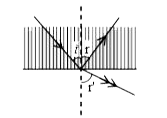
A ray of light passes from a denser medium to a rarer medium at an angle of incidence i. The reflected and refracted rays make an angle of `90^@` with each other. The angle of reflection and refraction are resepectively r and r'. The critical angle is given by :

A

`sin^(-1) ` (sin r )

B

`sin^(-1) ` (tan r')

C

`sin^(-1) ` (tan i)

D

`sin^(-1) `(sin i)

Text Solution

Verified by Experts

The correct Answer is:

C

n `= (sin i)/(sin r.) and n = (1)/( sin i_(c ))`
`rArr " " sini_(c ) = (sin i)/(sin (90 - r)) = tani (therefore anglei = angler )`
`rArr i_(c ) = sin^(-1) (tani)`
Promotional Banner

Topper's Solved these Questions

  • RAY OPTICS

    ERRORLESS|Exercise Assertion & Reason|30 Videos
  • RAY OPTICS

    ERRORLESS|Exercise NCERT BASED QUESTIONS ( Microscope and Telescope)|34 Videos
  • MAGNETISM

    ERRORLESS|Exercise Assertion and Reason|22 Videos
  • WAVE OPTICS AND ELECTROMAGNETIC THEORY

    ERRORLESS|Exercise ASSERTION & REASON |27 Videos

Similar Questions

Explore conceptually related problems

A ray of light from a denser medium strikes a rarer medium at an angle of incidence I (see figure ). The reflected and refracted rays make an angle of 90^(@) with each other. The angles of reflection and refraction are r and r^() . The critical angle is

A ray of light from a denser medium strike a rarer medium at an angle of incidence I (see Fig). The reflected and refracted rays make as angle of 90degrees with each other. The angles of reflection and refraction are r and r The critical angle is

A ray of light from a denser medium strikes a rarer medium at an angle of incidenc i. The reflected and refracted rays make an angle of pi//2 with each other. If the angles of reflection and refraction are r and r^(') , then the criticall angle will be

A ray of light from a denser medium strikes a rarer medium at angle of incidence i . The refrected and the refracted rays make an angle of 90^@ with each other. The angles of reflection and refraction are r and r^' respectively. The critical angle is (i) sin^-1(tanr) (ii) sin^-1(tani) (iii) sin^-1(tanr) (iv) tan^-1(tani)

A ray of light from a denser medium strikes a rarer medium at an angle of incidence i. if the reflected and the refracted rays are mutually perpendicular to each other, what is the value of the critical angle ?

A ray of light from a rarer medium strikes a denser medium at angle of incidence 60°. The reflected and refracted rays are perpendicular to each other. The refractive index of denser medium and angle of deviation respectively are

A ray of light is incident at an angle i from denser to rare medium. The reflected and the refracted rays are mutually perpendicular. The angle of reflection and the angle of refraction are respectively r and r'. Then the critical angle will be:

ERRORLESS-RAY OPTICS-PAST YEARS QUESTIONS
  1. Brilliance of diamond is due to

    Text Solution

    |

  2. An endoscope is employed by a physician to view the internal parts of ...

    Text Solution

    |

  3. A ray of light passes from a denser medium to a rarer medium at an ang...

    Text Solution

    |

  4. The speed of light in media M1 and M2 are 1.5 xx 10^8 m//s and 2.0 xx ...

    Text Solution

    |

  5. In total internal reflection when the angle of incidence is equal to t...

    Text Solution

    |

  6. When a biconvex lens of glass having refractive index 1.47 is dipped i...

    Text Solution

    |

  7. A convex lens is dipped in a liquid whose refractive index is equal to...

    Text Solution

    |

  8. Two identical thin planoconvex glass lenses (refractive index 1.5) eac...

    Text Solution

    |

  9. A boy is trying to start a fire by focusing sunlight on a piece of pap...

    Text Solution

    |

  10. An equiconvex lens is cut into two halves along (i) XOX^(') and (ii) Y...

    Text Solution

    |

  11. A beam of parallel rays is brought to focus by a planoconvex lens. A t...

    Text Solution

    |

  12. A combination of two thin lenses with focal lengths f(1) and f(2) resp...

    Text Solution

    |

  13. A concave mirrorr of focal length f(1) is placed at a distance of d fr...

    Text Solution

    |

  14. A luminous object is placed at a distance of 30 cm from the convex len...

    Text Solution

    |

  15. A converging beam of rays in incident on a diverging lens. Having pass...

    Text Solution

    |

  16. Two identical glass (mu(g)=3//2) equi- convex lenses of focal length f...

    Text Solution

    |

  17. An air bubble in a glass slab with refractive index 1.5 (near normal i...

    Text Solution

    |

  18. Two similar thin equi-convex lenses, of focal f each, are kept coaxial...

    Text Solution

    |

  19. The angle of incidence for a ray of light at a refracting surface of a...

    Text Solution

    |

  20. For the angle of minimum deviation of a prism to be equal to its refr...

    Text Solution

    |
