Home
Class 12
PHYSICS
A luminous object is placed at a distanc...

A luminous object is placed at a distance of `30 cm` from the convex lens of focal length `20 cm`. On the other side of the lens, at what distance from the lens a convex mirror of radius of curvature `10 cm` be placed in order to have an upright image of the object coincident with it ?

A

12 cm

B

30 cm

C

50 cm

D

60 cm

Text Solution

Verified by Experts

The correct Answer is:
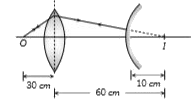
C

u = - 30 cm, f = 20 cm
`(1)/(v) = (1)/(20) - (1)/(30) = + (1)/(60)`
v = 60 cm

`therefore` Separation between lens and mirror
= 60 - 10 = 50 cm.
Promotional Banner

Topper's Solved these Questions

  • RAY OPTICS

    ERRORLESS|Exercise Assertion & Reason|30 Videos
  • RAY OPTICS

    ERRORLESS|Exercise NCERT BASED QUESTIONS ( Microscope and Telescope)|34 Videos
  • MAGNETISM

    ERRORLESS|Exercise Assertion and Reason|22 Videos
  • WAVE OPTICS AND ELECTROMAGNETIC THEORY

    ERRORLESS|Exercise ASSERTION & REASON |27 Videos

Similar Questions

Explore conceptually related problems

A luminous object is placed at a distance of 30 cm from the convex lens, of focal length 20 cm. On the other side of the lens, at what distance from thelens a convex mirror of radius of curvature 10 cm be placed in order to have an image of the object coincident with it

An object is placed at a distance of 30 cm from a convex lens of focal length 20 cm.

An object is placed at a distance of 20 cm from a convex lens of focal length 10 cm . The image is formed on the other side of the lens at a distance

An object is placed at a distance of 10 cm from a convex lens of focal length 12 cm. Find the position and nature of the image.

A luminous object is placed at a distance of 40 cm from a converging lens of focal length 25 cm. The image obtained in the screen is

An object 4 cm high is placed at a distance of 10 cm from a convex lens of focal length 20 cm. Find the position, nature and size of the image.

ERRORLESS-RAY OPTICS-PAST YEARS QUESTIONS
  1. A combination of two thin lenses with focal lengths f(1) and f(2) resp...

    Text Solution

    |

  2. A concave mirrorr of focal length f(1) is placed at a distance of d fr...

    Text Solution

    |

  3. A luminous object is placed at a distance of 30 cm from the convex len...

    Text Solution

    |

  4. A converging beam of rays in incident on a diverging lens. Having pass...

    Text Solution

    |

  5. Two identical glass (mu(g)=3//2) equi- convex lenses of focal length f...

    Text Solution

    |

  6. An air bubble in a glass slab with refractive index 1.5 (near normal i...

    Text Solution

    |

  7. Two similar thin equi-convex lenses, of focal f each, are kept coaxial...

    Text Solution

    |

  8. The angle of incidence for a ray of light at a refracting surface of a...

    Text Solution

    |

  9. For the angle of minimum deviation of a prism to be equal to its refr...

    Text Solution

    |

  10. A ray is ihncident at an angle of incidence ii on one surface of a pri...

    Text Solution

    |

  11. Angle of prism is A and its one surface is silvered. Light rays fallin...

    Text Solution

    |

  12. The refracting angle of a prism is A, and refractive index of the mate...

    Text Solution

    |

  13. A leaf which contains only green pigments, is illuminated by a laser l...

    Text Solution

    |

  14. A beam of light composed of red and green ray is incident obliquely at...

    Text Solution

    |

  15. The Cauchy’s dispersion formula is

    Text Solution

    |

  16. Fraunhofer spectrum is a

    Text Solution

    |

  17. A thin prism of angle 15^(@) made of glass of refractive index mu(1)=1...

    Text Solution

    |

  18. A thin prism having refracting angle 10^(@) is made of glass of refrac...

    Text Solution

    |

  19. The refractive index of the material of a prism is sqrt(2) and the ang...

    Text Solution

    |

  20. Pick the wrong answer in the context with rainbow.

    Text Solution

    |

