Home
Class 12
PHYSICS
In an astronomical telescope in normal a...

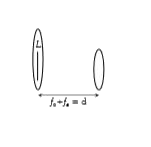
In an astronomical telescope in normal adjustment a straight black line of length `L` is drawn on inside part of objective lens. The eye piece forms a real image of this line. The length of this image is `I`. The magnification of the telescope is

A

`(L)/(l)`-1

B

`(L + 1)/(L- l) `

C

`(L )/(l)`

D

`(L)/(l) + 1 `

Text Solution

Verified by Experts

The correct Answer is:
C

Magnification by eyepiece
`m = (f)/(f + u)`
`- (l)/(L) = (f_(e))/(f_(e) + [- (f_(o) + f_(e) )] ) rArr (l)/(L) = (f_(e))/(f_(o))`
`m = (f_(o))/(f_(e)) = (L)/(l)`.
Promotional Banner

Topper's Solved these Questions

  • RAY OPTICS

    ERRORLESS|Exercise Assertion & Reason|30 Videos
  • RAY OPTICS

    ERRORLESS|Exercise NCERT BASED QUESTIONS ( Microscope and Telescope)|34 Videos
  • MAGNETISM

    ERRORLESS|Exercise Assertion and Reason|22 Videos
  • WAVE OPTICS AND ELECTROMAGNETIC THEORY

    ERRORLESS|Exercise ASSERTION & REASON |27 Videos

Similar Questions

Explore conceptually related problems

When as tronomical telescope is adjusted for normal adjustment the finla image is formed at

In an astronomical telescope, the final image for normal vision is formed at

The image formed by the telescope in normal adjustment position is at

An astronomical telescope arranged for normal adjustment has a magnification of 6. If the length of the telescope is 35cm, then the focal lengths of objective and euye piece respectivley =, are

The focal length of objective and eye-piece of a telescope are 100 cm and 5 cm respectively. Final image is formed at least distance of distinct vision. The magnification of telescope is

In an astronomical telescope, focal length of eye piece is 5 cm and focal length of objective is 75 cm . The final image is formed at the least distance of distinct vision (=25 cm) from the eye. What is the magnifying power of the telescope ?

ERRORLESS-RAY OPTICS-PAST YEARS QUESTIONS
  1. Which colour of the light has the longest wavelength?

    Text Solution

    |

  2. Identify the wrong description of the above figures

    Text Solution

    |

  3. For a normal eye, the cornea of eye provides a converging power of 40 ...

    Text Solution

    |

  4. A person can see objects clearly only when they lie between 50cm and ...

    Text Solution

    |

  5. A wire mesh consisting of very small squares is viewed at a distance o...

    Text Solution

    |

  6. We wish to see inside an atom. Assuming the atom to have a diameter of...

    Text Solution

    |

  7. A telescope has an objective lens of focal length 200cm and an eye pie...

    Text Solution

    |

  8. If the focal length of objective lens is increased then magnifying pow...

    Text Solution

    |

  9. In an astronomical telescope in normal adjustment a straight black lin...

    Text Solution

    |

  10. An astronomical telesope has objective and eyepiece of focal lengths 4...

    Text Solution

    |

  11. An astronaut is looking down on earth's surface from a space shuttle a...

    Text Solution

    |

  12. On observing light from three different stars P, Q and R, it was found...

    Text Solution

    |

  13. The ratio of resolving powers of an optical microscope for two wavelen...

    Text Solution

    |

  14. An astronomical refracting telescope will have large angular magnific...

    Text Solution

    |

  15. A ray is incident at an angle of incidence i on one surfcae of a small...

    Text Solution

    |

  16. Assume that light of wavelength 600 nm is coming from a star. The limi...

    Text Solution

    |

  17. A lens of large focal length and large aperture is best suited as an o...

    Text Solution

    |

  18. A convex lens A of focal length 20cm and a concave lens G of focal le...

    Text Solution

    |

  19. Find the value of angle of emergence from the prism. Refractive index ...

    Text Solution

    |

  20. A point object is placed at distance 60cm from a convex lens of focal ...

    Text Solution

    |

