Home
Class 12
PHYSICS
Certain amount of an ideal gas is taken ...

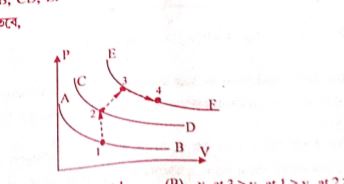
Certain amount of an ideal gas is taken from its initial state 1 to final state through the paths `1 rarr 2 rarr 3 rarr4` as shown in figure, AB, CD, EF are all isotherms. If `v_p` is the most probable speed of the molecules, then

A

`v_p " at " 3 = v_p " at " 4 gt v_p " at " 2 gt v_p " at " 1`

B

`v_p " at " 3 gt v_p " at " 1 gt v_p " at " 2 gt v_p " at " 4`

C

`v_p " at " 3 gt v_p " at " 2 gt v_p " at " 4 gt v_p " at " 2`

D

`v_p " at " 2 = v_p " at " 3 gt v_p " at " 1 gt v_p " at " 4`

Text Solution

Verified by Experts

Promotional Banner

Similar Questions

Explore conceptually related problems

An ideal gas undergoes change in its state from the initial state I to the final state F via two possible paths as shown. Then

A certain gas is taken to the five states representes by dots in the graph. The plotted lines are isotherms. Order of the most probable speed v_(p) of the molecules at these five states is

Find the work done by an ideal gas during a closed cycle 1rarr2rarr3rarr4rarr1 as shown in figure.

A given mass of a gas expands from the state A to the state B by three paths 1,2 and 3 as shown in the figure, If W_(1),W_(2) and W_(3) respectively be the work done by the gas along the three paths then

A given mass of gas expands from state A to state B by three paths 1, 2 and 3 as shown in the figure If w_(1), w_(2) and w_(3) respectively are be the works done by the gas along three paths, then

P - V diagram of an ideal gas is shown. The gas undergoes from initial state A to final state B such that initial and final volumes are same. Select the correct alternative for given process AB.

One mole of an ideal gas goes from an initial state A to final state B via two processs : It first undergoes isothermal expansion from volume V to 3 V and then its volume is reduced from 3 V to V at constant pressure. The correct P-V diagram representing the two process in (figure)

An ideal gas is taken from the state A (P, V) to the state B (P//2, 2 V) along a st. line path as shown in Fig. Select the correct statement from the following:

