Home
Class 11
CHEMISTRY
As isolated box, equally partitioned con...

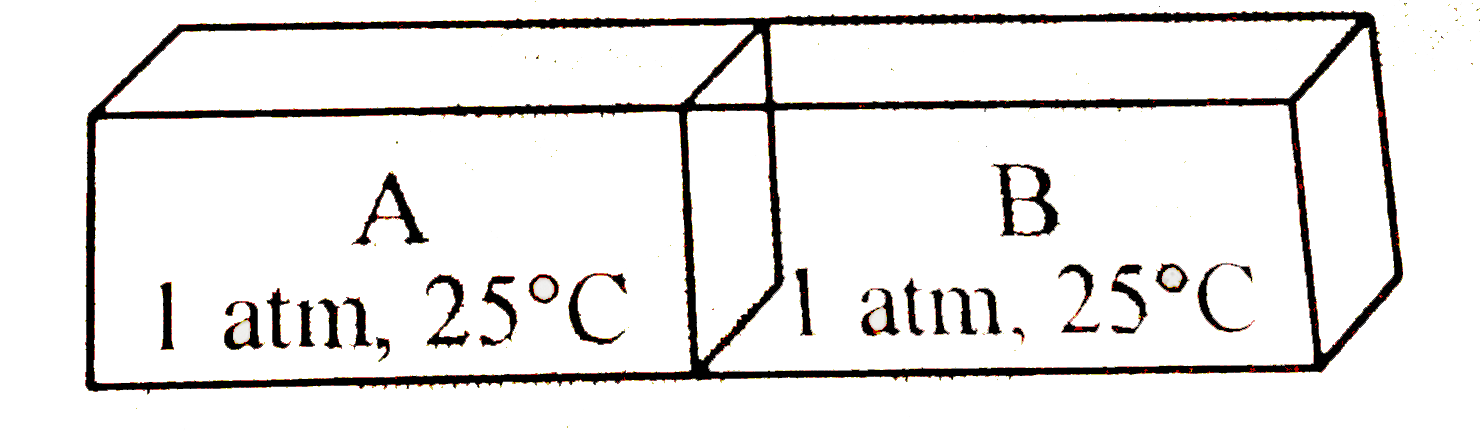
As isolated box, equally partitioned contains two ideal gases A and B as shown

What the partition is removed, the gases mix. The changes in enthalpy `( Delta H)` and entropy `( Delta S)` in the process, respectively, are

A

Zero, positive

B

Zero, negative

C

Positive, zero

D

Negative, zero

Text Solution

Verified by Experts

The correct Answer is:

A

According to kinetic theory of gases Force of attraction and repulsion amongst molecules of ideal gas are negligible so, `Delta H = 0` And randomness increases due to increase in volume so `Delta S` = +ve.
Promotional Banner

Topper's Solved these Questions

  • THERMODYNAMICS AND THERMOCHEMISTRY

    ERRORLESS|Exercise NCERT Based Questions (Heat of Reaction)|67 Videos
  • THERMODYNAMICS AND THERMOCHEMISTRY

    ERRORLESS|Exercise NCERT Based Questions (Bond Energy)|15 Videos
  • THERMODYNAMICS AND THERMOCHEMISTRY

    ERRORLESS|Exercise NCERT Based Questions (First Law of Thermodynamics and Hess Law)|55 Videos
  • THE S-BLOCK ELEMENTS

    ERRORLESS|Exercise Assertion & Reason|10 Videos

Similar Questions

Explore conceptually related problems

Two vessels divided by a partition cotain one mole of N_(2) and two moles of O_(2) gas. If the partition is removed and gases mixed isothermally, find the change in entrope due to mixing assuming initial and final pressure are same.

Two liquid A & B having densities 2rho and rho respectively, are kept in a cylindrical container separated by a partition as shown in figure. The height of each liquid in the container is h and area of cross section of the container is A. Now the partition is removed. Calculate change in gravitational potential energy ( DeltaU ) of the system (a) assuming that the two liquids mix uniformly. (b) Assuming that the two liquids are immiscible. What do you conclude from the sign of DeltaU in the above two cases?

An insulated cylindrical vessel is divided into three identical parts by two partitions 1 and 2. The left part contains O_(2) gas, the middle part has N_(2) and the third chamber has vacuum. The average molecular speed in oxygen chamber is V_(0) and that in nitrogen chamber is sqrt((8)/(7)) V_(0) . Pressure of the gases in two chambers is same. Partition 1 is removed and the gases are allowed to mix. Now the stopper holding the partition 2 is removed and it slides to the right wall of the container, so that the mixture of gases occupy the entire volume of the container. Find the average speed of O_(2) molecules now.

A container of volume 1m^3 is divided into two equal parts by a partition. One part has an ideal gas at 300K and the other part is vacuum. The whole system is thermally isolated from the surroundings. When the partition is removed, the gas expands to occupy the whole volume. Its temperature will now be .......

Following figure shows two process A and B for a gas. If Delta Q_(A) and Delta Q_(B) are the amount of heat absorbed by the system in two case, and Delta U_(A) and Delta U_(B) are changes in internal energies, respectively, then :

A container of volume 1m^(3) is divided into two equal compartments by a partition. One of these compartments contains an ideal gas at 300 K . The other compartment is vacuum. The whole system is thermally isolated from its surroundings. The partition is removed and the gas expands to occupy the whole volume of the container. Its temperature now would be

A well insulated box contains a partition dividing the box into two equal volumees as shown in figure. Initially, the left hand side contains an ideal monoatomic gas and the other half is a vacuum. The partition is suddenly removed so that the gas expands throughout the entire box. (a) Does the temperature of gas change? (b) Does the internal energy of the system change? (c) Does the gas work?

A container of volume 1m^(3) is divided into two equal compartments, one of which contains an ideal gas at 300K. The oterh compartment is vaccum. The whole system is thermally isolated from its surroundings. The partition is removed and the gas expands to occupy the whole volume of the container. Its temperature now would be

ERRORLESS-THERMODYNAMICS AND THERMOCHEMISTRY-NCERT Based Questions (IInd & IIIrd Law of Thermodynamics and Entropy)
  1. In which of the following entropy decreases

    Text Solution

    |

  2. For conversion C (graphite)rarrC (diamond) the DeltaS is

    Text Solution

    |

  3. If for a given substance, melting point is T(B) and freezing point is ...

    Text Solution

    |

  4. Which of the following would be expected to have the largest antropy p...

    Text Solution

    |

  5. Mixing of non-reacting gases is generally accompanied by

    Text Solution

    |

  6. An irreversible process occurring isothermally in an isolated system l...

    Text Solution

    |

  7. For chemical reactions, the calculation of change in entropy is normal...

    Text Solution

    |

  8. For which of the following processes is DeltaS negative?

    Text Solution

    |

  9. A container has hydrogen and oxygen mixture in ratio of 4 : 1 by weigh...

    Text Solution

    |

  10. For the gas phase reactions PCl(5)(g) hArr PCl(3)(g) + Cl(2)(g) Whi...

    Text Solution

    |

  11. Considering entropy (S) as a thermodynamics parameter, the criterion f...

    Text Solution

    |

  12. Entropy changesh for the process, H(2)O(l) to H(2)O at normal pressure...

    Text Solution

    |

  13. For an exothermic reaction, which is true

    Text Solution

    |

  14. The entropy change can be calculated by using the expression DeltaS-(q...

    Text Solution

    |

  15. A : For an isolated system Delta G = - TDeltaS("total") R: For an i...

    Text Solution

    |

  16. For stable equilibrium, which of the following is/are true ?

    Text Solution

    |

  17. A concentrated solution of copper sulphate, which is dark blue in c...

    Text Solution

    |

  18. As isolated box, equally partitioned contains two ideal gases A and B ...

    Text Solution

    |

  19. For a process to occurs spontaneously

    Text Solution

    |

  20. The latent heat of melting of ice at 0^(@)C is 6 kJ "mol"^(-1) . The e...

    Text Solution

    |
