Home
Class 11
CHEMISTRY
For a reaction AtoB, enthalpy of reactio...

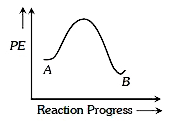
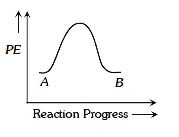
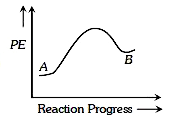
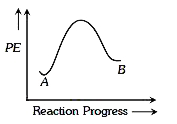
For a reaction `AtoB`, enthalpy of reaction is `-4.2kJmol^(-1)` and enthalpy of activation is `9.6KJmol^(-1)`. The correct potential energy profile for the reaction is shown in option.

A

B

C

D

Text Solution

Verified by Experts

The correct Answer is:

A

`Delta H_(rxn)= (E_(a))_(f)- (E_(a))_(b)`
`-4.2 = (E_(a))_(f)- (E_(a))_(b)`
`-4.2= 9.6- (E_(a))_(b)`
`(E_(a))_(b)= 9.6 + 4.2 = 13.8 kJ mol^(-1)`
Since reaction is exothermic, so possible graph is (a) only. Also `(E_(a))_(f) lt (E_(a))_(b)`, so answer is option (a).
Promotional Banner

Topper's Solved these Questions

  • THERMODYNAMICS AND THERMOCHEMISTRY

    ERRORLESS|Exercise (Assertion & Reason)|18 Videos
  • THERMODYNAMICS AND THERMOCHEMISTRY

    ERRORLESS|Exercise NCERT Based Questions (Free Energy and Work Function) |37 Videos
  • THE S-BLOCK ELEMENTS

    ERRORLESS|Exercise Assertion & Reason|10 Videos

Similar Questions

Explore conceptually related problems

For an exothermic reaction ArarrB , the activation energy is 65kJmol^(-1) and enthalpy of reaction is 42kJmol^(-1) . The activation energy for the reaction BrarrA will be:

The enthalpy of reaction, Delta_(1) H , is

For a reaction A rarr B, E_(a) = 10 kJ mol^(-1), DeltaH = 5 kJ mol^(-1) . Thus, potential energy profile for this reaction is:

In an exothermic reaction A rarr B , the activation energy of the forward reaction is 200 kJ mol^(-1) . The enthalpy of the reaction is 280 kJ mol^(-1) . The activation energy of the reverse reaction B rarr A is

The reaction X to Y is an exothermic reaction. Activation energy of the reaction for X into Y is 150 kJ mol^(-1) . Enthalpy of reaction is 135 kJ "mol"^(-1) . Calculate the activation energy for the reverse reaction, Y to X in kJ mol^(-1) .

For a reaction ArarrB,E_a=10kJ//mol,DeltaH=5kJ//mol . Thus potential energy profile for this reaction is

ERRORLESS-THERMODYNAMICS AND THERMOCHEMISTRY-PAST Years Questions
  1. The enthalpy of hydrogenation of cyclohexene is -119.5kJ mol^(-1). If ...

    Text Solution

    |

  2. The values of DeltaH and DeltaS for the reaction, C("graphite")+CO(2...

    Text Solution

    |

  3. Which of the following pairs of a chemical reaction is certaion to res...

    Text Solution

    |

  4. The enthalpy and entropy change for the reaction Br(2)(l) + Cl(2)(g)...

    Text Solution

    |

  5. The standard enthalpy or the decomposition of N2 O5 to NO2 is 58.04 kJ...

    Text Solution

    |

  6. Standard enthalpy and standard entropy changes for the oxidation of am...

    Text Solution

    |

  7. For vaporization of water at 1 atmospheric pressure, the values of Del...

    Text Solution

    |

  8. Using the Gibbs energy change, Delta G^(@)=+ 63.3 kJ, for the followin...

    Text Solution

    |

  9. Which of the following statements is correct for a reversible process ...

    Text Solution

    |

  10. The correct thermodynamic conditions for the spontaneous reaction at a...

    Text Solution

    |

  11. Which of the following is true fo the reacion H(2)O(l)hArr H(2)O(g) at...

    Text Solution

    |

  12. For a spontaneous process the correct statement is -

    Text Solution

    |

  13. For the equilibrium H(2)O(l) iff H(2)O(g) at 1 atm and 298 K

    Text Solution

    |

  14. Match List I ( Equations) with List II (Type of processes) and select...

    Text Solution

    |

  15. For a given reaction, Delta H = 35.5 kJ mol^(-1) and Delta S = 83.6 JK...

    Text Solution

    |

  16. Which of the following is correct option for the free expansion of an ...

    Text Solution

    |

  17. For the reaction, 2Cl(g) rarr Cl2(g), the correct option is:

    Text Solution

    |

  18. For a reaction AtoB, enthalpy of reaction is -4.2kJmol^(-1) and enthal...

    Text Solution

    |

  19. Which one among the following is the correct option for right relation...

    Text Solution

    |

  20. For irreversible expansion of an ideal gas under isothermal condition,...

    Text Solution

    |
