Home
Class 12
CHEMISTRY
EMF of a cell is related to standard EMF...

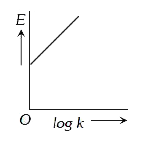
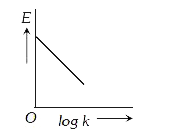
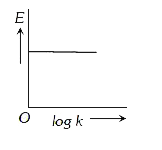
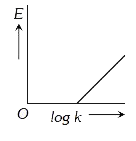
EMF of a cell is related to standard EMF,`E^(@)` by the equation
`E=E^(@)-(0.0591)/(n)logk`
Where k is reaction quotient and n the volume of electrons which is correct graphical representation

A

B

C

D

Text Solution

AI Generated Solution

The correct Answer is:

To solve the problem, we need to analyze the equation given and understand how to represent it graphically. The equation provided is: \[ E = E^\circ - \frac{0.0591}{n} \log K \] Where: - \( E \) is the EMF of the cell. - \( E^\circ \) is the standard EMF. - \( n \) is the number of electrons transferred in the reaction. - \( K \) is the reaction quotient. ### Step-by-Step Solution: 1. **Identify the Variables:** - From the equation, we can identify that \( E \) (EMF of the cell) is dependent on \( \log K \) (the logarithm of the reaction quotient). 2. **Rearranging the Equation:** - The equation can be rearranged to fit the linear equation format \( Y = C - MX \): \[ E = E^\circ - \left(\frac{0.0591}{n}\right) \log K \] - Here, we can identify: - \( Y \) (dependent variable) = \( E \) (EMF of the cell) - \( C \) (intercept) = \( E^\circ \) (standard EMF) - \( M \) (slope) = \(-\frac{0.0591}{n}\) - \( X \) (independent variable) = \( \log K \) 3. **Determine the Slope:** - The slope \( M \) is negative since it is represented as \(-\frac{0.0591}{n}\). This indicates that as \( \log K \) increases, \( E \) decreases. 4. **Graphical Representation:** - On a graph, the Y-axis will represent the EMF of the cell (\( E \)), and the X-axis will represent \( \log K \). - The graph will have a negative slope, indicating that as the reaction quotient \( K \) increases, the EMF of the cell decreases. 5. **Finding the Correct Option:** - We need to identify the option that shows a negative slope. Based on the analysis: - Option A: Positive slope - Option B: Negative slope (correct option) - Option C: Zero slope - Option D: Positive slope - Therefore, the correct option is **Option B**.

To solve the problem, we need to analyze the equation given and understand how to represent it graphically. The equation provided is: \[ E = E^\circ - \frac{0.0591}{n} \log K \] Where: - \( E \) is the EMF of the cell. - \( E^\circ \) is the standard EMF. - \( n \) is the number of electrons transferred in the reaction. ...
Promotional Banner

Topper's Solved these Questions

  • CHEMICAL KINETICS

    ERRORLESS|Exercise PAST YEARS QUESTIONS|51 Videos
  • CHEMICAL KINETICS

    ERRORLESS|Exercise Assertion & Reason|6 Videos
  • CHEMICAL KINETICS

    ERRORLESS|Exercise NCERT BASED QUESTIONS (Photochemical Reaction)|4 Videos
  • CARBOXYLIC ACIDS

    ERRORLESS|Exercise Assertion & Reason|5 Videos
  • CHEMISTRY IN EVERYDAY LIFE

    ERRORLESS|Exercise Assertion & Reason|4 Videos

Similar Questions

Explore conceptually related problems

The cell potential (E_(cell)) of a reaction is related as /_\G=-nF E_(cell) , where /_\ G represents max. useful electrical work n=no. of moles of electrons exchanged during the section for reversible cell reaction d(/_\G)=(/_\_rV)dp-(/_\_rS),dT at constant pressure d(/_\G)=-(/_\_rS).dT :' At constant pressure /_\G=/_\H-T./_\S :. /_\G=/+\H+T(d(/_\G))/((dT)_P) ((dE_(cell))/(dT))_P is known as temperture coefficient of the e.m.f of the cell. The temperature coefficient of the e.m.f of cell, ((dE)/(dT))_P si given by:

In an electrochemical cell, if E^(@) is the e.m.f. of the cell involving 'n' mole of electrons, then DeltaG^(@) is

A group of N cells where e.m.f. varies directly with the internal resistance as per the equation E_(N)=1.5r_(N) are connected as shown in the figure. The current I in the circuit is:

The driving force DeltaG diminishes to zero on the way to equilibrium, just as in any other spontaneous process. Both DeltaG and the corresponding cell potential (E=-(DeltaG)/(nF)) are zero when the redox reaction comes to equilibrium. The Nernst equation for the redox process of the cell may be given as : E=E^(@)-0.059/n log Q The key to the relationship is the standard cell potential E^(@) , derived from the standard free energy changes as : E^(@)=-(DeltaG^(@))/(nF) At equilibrium, the Nernst equation is given as : E^(@)=0.059/n log K The equilibrium constant K_(c) for the reaction : Cu(s)+2Ag^(+) (aq.)+2Ag(s)" "(E_(cell)^(@)=0.46 V) will be :

Establish a relation between E.M.F. and potential difference of a cell.
