Home
Class 12
CHEMISTRY
When a small quantity of aqueous solutio...

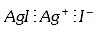
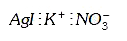
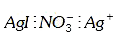
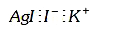
When a small quantity of aqueous solution of Kl is added to a very dilute aqueous solutins of silver nitrate,the colloidal particles of silver iodide which are associated with Helmholtz double layer

A

B

C

D

Text Solution

AI Generated Solution

The correct Answer is:

To solve the question regarding the addition of a small quantity of aqueous solution of KI to a very dilute aqueous solution of silver nitrate (AgNO3) and its effect on colloidal particles of silver iodide (AgI) associated with the Helmholtz double layer, we can follow these steps: ### Step-by-Step Solution: 1. **Understanding the Reaction**: When KI is added to AgNO3, a precipitation reaction occurs. The iodide ions (I⁻) from KI react with silver ions (Ag⁺) from AgNO3 to form silver iodide (AgI), which is a colloidal substance. **Reaction**: \[ \text{Ag}^+ (aq) + \text{I}^- (aq) \rightarrow \text{AgI} (s) \] 2. **Formation of Colloidal Silver Iodide**: The AgI formed is in a colloidal state, meaning it exists as small particles suspended in the solution. These particles can be stabilized by electrical charges. 3. **Helmholtz Double Layer**: The colloidal particles of AgI are associated with a Helmholtz double layer, which consists of a layer of charged particles (in this case, Ag⁺ ions) adsorbed on the surface of the AgI particles. This layer helps stabilize the colloid by preventing the particles from aggregating. 4. **Effect of Adding KI**: When KI is added, the iodide ions (I⁻) will interact with the Ag⁺ ions already present in the solution. As more AgI is formed, the positively charged Ag⁺ ions will be attracted to the surface of the AgI particles, enhancing the positive charge of the colloidal particles. 5. **Resulting Charge on Colloidal Particles**: The increase in Ag⁺ ions adsorbed on the AgI particles will lead to the formation of a positively charged colloidal solution. This positive charge is crucial for the stability of the colloid, as it helps to maintain the separation between the particles. 6. **Conclusion**: The addition of KI to the dilute AgNO3 solution results in the formation of positively charged colloidal silver iodide particles due to the adsorption of Ag⁺ ions on the surface of the AgI particles. ### Summary of the Solution: - KI reacts with AgNO3 to form AgI. - AgI exists as colloidal particles stabilized by a Helmholtz double layer. - Adding KI increases the concentration of Ag⁺ ions, enhancing the positive charge on AgI particles.

To solve the question regarding the addition of a small quantity of aqueous solution of KI to a very dilute aqueous solution of silver nitrate (AgNO3) and its effect on colloidal particles of silver iodide (AgI) associated with the Helmholtz double layer, we can follow these steps: ### Step-by-Step Solution: 1. **Understanding the Reaction**: When KI is added to AgNO3, a precipitation reaction occurs. The iodide ions (I⁻) from KI react with silver ions (Ag⁺) from AgNO3 to form silver iodide (AgI), which is a colloidal substance. **Reaction**: ...
Promotional Banner

Topper's Solved these Questions

  • SURFACE CHEMISTRY

    ERRORLESS|Exercise PAST YEARS QUESTIONS|27 Videos
  • SURFACE CHEMISTRY

    ERRORLESS|Exercise ASSERTION AND REASON|14 Videos
  • SURFACE CHEMISTRY

    ERRORLESS|Exercise NCERT BASED QUESTIONS (Cataylst and catalysis)|33 Videos
  • SOLUTIONS

    ERRORLESS|Exercise ASSERTION AND REASON|16 Videos
  • THE d-AND f- BLOCK ELEMENTS

    ERRORLESS|Exercise Assertion and Reason |11 Videos

Similar Questions

Explore conceptually related problems

When mercuric iodide is added to an aqueous solution of Kl the

When an aqueous solution of CuSO_(4) is sstirred with a silver spoon then :

What happens when a piece of copper is added to a solution of silver nitrate ?

ERRORLESS-SURFACE CHEMISTRY-NCERT BASED QUESTIONS (Colloids, Emulsion, Gel and their properties with Application)
  1. The dispersed phase in colloidal iron (III) hydroxide and collodial go...

    Text Solution

    |

  2. Which of the following process is not responsible for the presence of ...

    Text Solution

    |

  3. When a small quantity of aqueous solution of Kl is added to a very dil...

    Text Solution

    |

  4. Sedimentation potential is reverse of :

    Text Solution

    |

  5. When a freshly precipitated substance is converted into a colloidal so...

    Text Solution

    |

  6. Gold numbers of protective colloids A, B, C and D are 0.50, 0.01, 0.10...

    Text Solution

    |

  7. Purification of colloids is done by the process of

    Text Solution

    |

  8. The concentration of electrolyte required to coagulate a given amount ...

    Text Solution

    |

  9. Which of the following can protect a gold sol from coagulation by NaCl...

    Text Solution

    |

  10. Gold number is maximum for the lyophilic sol is

    Text Solution

    |

  11. Method by which lyophobic sol can be protected.

    Text Solution

    |

  12. Gold number is

    Text Solution

    |

  13. On addition of one mL solution of 10% NaCl to 10 mL gold sol in the pr...

    Text Solution

    |

  14. Gold number is associated with

    Text Solution

    |

  15. A negatively charged suspension of clay in water will need for precipi...

    Text Solution

    |

  16. Gelatian is mostly used in making ice cream in order to

    Text Solution

    |

  17. Lyophilic sols are more stable than lyophobic sols because

    Text Solution

    |

  18. The number of moles of lead nitrate needed to coagulate 2 mole of coll...

    Text Solution

    |

  19. Which of the following pairs of ions would be expected to form precipi...

    Text Solution

    |

  20. Statement : to stop bleeding from an injury ferric chloride can be app...

    Text Solution

    |
