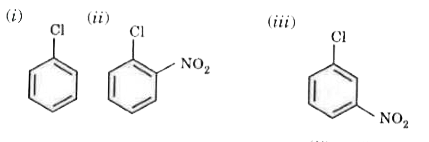
A
B
C
D
Text Solution
Verified by Experts
The correct Answer is:



Topper's Solved these Questions
HELOALKANES AND HALOARENES
ERRORLESS|Exercise NCERT BASED QUESTIONS (Uses of Halogen Containing Compounds)|11 VideosHELOALKANES AND HALOARENES
ERRORLESS|Exercise NCERT BASED QUESTIONS (Different Halogen Derivatives of Hydrocarbons)|14 VideosHELOALKANES AND HALOARENES
ERRORLESS|Exercise NCERT BASED QUESTIONS (Dihalides, Trihalides, Tetrahalides, Unsaturated Halides )|46 VideosGENERAL PRINCIPLES & PROCESSES OF ISOLATION OF ELEMENTS
ERRORLESS|Exercise ASSERTION & REASON|8 VideosORGANIC COMPOUNDS CONTAINING NITROGEN
ERRORLESS|Exercise Assertion and Reason|15 Videos
Similar Questions
Explore conceptually related problems
ERRORLESS-HELOALKANES AND HALOARENES-NCERT BASED QUESTIONS (Haloarenes)
- The set of compounds in which the reactivity of halogen atom in the as...
Text Solution
|
- Toluene reacts with excess of CI(2) in presence of sunlight to give a...
Text Solution
|
- Which of the following statements about benzyl chloride is incorrect ?
Text Solution
|
- Aryl halides do not undergo uncleophilic substitution reactions under ...
Text Solution
|
- Which of the following is most reactive towards hydrolysis:-
Text Solution
|
- The product of the above reaction is
Text Solution
|
- Which of the following is an appropriate set of reactants for the prep...
Text Solution
|
- 1,2 di bromo cyclohexane on dehydrohalogenation gives
Text Solution
|
- Which of the following possess highest m.pt .
Text Solution
|
- Cholorobenzene is formed by reaction of chlorine with benzene in the p...
Text Solution
|
- The reaction of toluene with chlorine in the presence of iron and in t...
Text Solution
|
- Reactions of C(6)H(5)CH(2)Br with aqueous sodium hydroxide follows……..
Text Solution
|
- Which is the correct increasing order of boiling points of the follow...
Text Solution
|
- C(6)H(6)CI(6) on treatment with alcoholic KOH yields .
Text Solution
|
- Arrange the compounds in increasing order of rate of reaction towards...
Text Solution
|
- Arrange the compounds in increasing order of rate of reaction towards...
Text Solution
|
- Arrange the compounds in increasing order of rate of reaction towards...
Text Solution
|
- Arrange the compounds in increasing order of rate of reaction towards...
Text Solution
|
- 4-Nitrotoluene is treated with bromine to get a cornpound 'P'. 'P' i...
Text Solution
|
- Identify the product (E) in the following sequence of reactions
Text Solution
|