Home
Class 11
CHEMISTRY
Identify X in the following sequence of ...

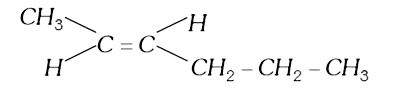
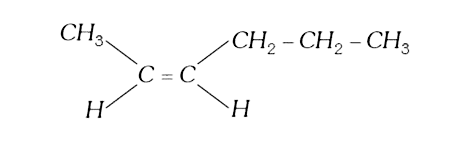
Identify X in the following sequence of reactions
`CH_(3) - underset(Br)underset(|)CH-underset(Br)underset(|)-CH_(2)-CH_(2)-CH_(3) overset(1. NaNH_2)underset(2. "Na in liquid" NH_3) rarr X `

A

`CH_(3) - underset(Br)underset(|)CH-underset(NH_2)underset(|)CH-CH_(2)CH_(2)CH_(3)`

B

C

D

`CH_(3)-underset(NH_2)underset(|)CH-underset(NH_2)underset(|)CH-CH_(2)CH_(2)CH_(3)`

Text Solution

AI Generated Solution

The correct Answer is:

To solve the problem, we need to analyze the given sequence of reactions step by step. ### Step 1: Understanding the Starting Material The starting material is: \[ \text{CH}_3 - \text{Br} \quad \text{(1-bromopropane)} \] \[ \text{CH} - \text{Br} \quad \text{(2-bromopropane)} \] \[ \text{CH}_2 - \text{CH}_2 - \text{CH}_3 \quad \text{(propane)} \] This can be represented as: \[ \text{CH}_3 - \text{Br} - \text{CH} - \text{Br} - \text{CH}_2 - \text{CH}_2 - \text{CH}_3 \] ### Step 2: Reaction with NaNH₂ When we treat the compound with sodium amide (NaNH₂), it acts as a strong base and will facilitate an elimination reaction (E2 mechanism). In this case, two moles of HBr will be eliminated from the molecule. ### Step 3: Elimination Reaction The elimination of HBr will lead to the formation of a triple bond (alkyne). The reaction can be summarized as follows: - The bromine atoms are removed, and hydrogen atoms are also removed from adjacent carbon atoms. - This results in the formation of a terminal alkyne. The product after this step will be: \[ \text{CH}_3 - \text{C} \equiv \text{C} - \text{CH}_2 - \text{CH}_2 - \text{CH}_3 \] This is 1-heptyne. ### Step 4: Reduction with Sodium in Liquid Ammonia The next step involves treating the alkyne with sodium in liquid ammonia. This process is known as Birch reduction, which converts alkynes to trans-alkenes. ### Step 5: Formation of the Final Product The Birch reduction will lead to the formation of a trans-alkene. The product will be: \[ \text{CH}_3 - \text{C} = \text{C} - \text{CH}_2 - \text{CH}_2 - \text{CH}_3 \] This compound is 1-heptyne, which will be a trans-alkene. ### Final Answer Thus, the compound X that results from the sequence of reactions is: \[ \text{CH}_3 - \text{C} = \text{C} - \text{CH}_2 - \text{CH}_2 - \text{CH}_3 \]

To solve the problem, we need to analyze the given sequence of reactions step by step. ### Step 1: Understanding the Starting Material The starting material is: \[ \text{CH}_3 - \text{Br} \quad \text{(1-bromopropane)} \] \[ \text{CH} - \text{Br} \quad \text{(2-bromopropane)} \] \[ \text{CH}_2 - \text{CH}_2 - \text{CH}_3 \quad \text{(propane)} \] ...
Promotional Banner

Topper's Solved these Questions

  • HYDROCARBONS

    ERRORLESS|Exercise NCERT BASED QUESTION (AROMATIC HYDROCARBON)|78 Videos
  • HYDROCARBONS

    ERRORLESS|Exercise PAST YEAR QUESTIONS|88 Videos
  • HYDROCARBONS

    ERRORLESS|Exercise NCERT BASED QUESTION (ALKENE)|76 Videos
  • GENERAL ORGANIC CHEMISTRY

    ERRORLESS|Exercise ASSERTION AND REASON|14 Videos
  • HYDROGEN

    ERRORLESS|Exercise ASSERTION & REASON|6 Videos

Similar Questions

Explore conceptually related problems

The major product of the following reaction is: CH_3underset(Br)underset(|)CHCH_2underset(Br)underset(|)CHCH_2CH_3overset(KOH,CH_3OH)underset(heat)rarr

Write the IUPAC name of the following compound: CH_(3)-underset(Br)underset(|)CH-CH_(2)-underset(Cl)underset(|)CH-CH_(3)

CH_(3)CH=CH-CH_(3) + Br_(2) to CH_(3)-underset(Br)underset(|)(C )H-underset(Br)underset(|)(C )H-CH_(3) is an

The major product of the following reaction is : CH_3CH_2underset(Br)underset(|)(CH)-underset(Br)underset(|)CH_2overset((i)KOHalc.)underset{:((ii)NaNH_2), (" in liq"NH_3):}to

The IUPAC name for the compound CH_(3) - underset(OH)underset(|)CH - CH_(2) -underset(Br)underset(|)CH-CHO, is

CH_(3)underset(Br)underset(|)CH-overset(CH_(3))overset(|)underset(OH)underset(|)(C)-C-O-CH_(3)

The major product of the following reaction is : CH_(3)CH_(2)underset(Br)underset(|)CH-underset(Br)underset(|)CH_(2) underset(II. NaNH_(2) "in liq." NH_(3))overset(I.KOH alc.)to

Give IUPAC name of : CH_(3) - CH_(2) - underset(Br)underset(|)(CH) - - underset(Br)underset(|)overset(CH_(3))overset(|)(C ) - CH_(2)CI

ERRORLESS-HYDROCARBONS-NCERT BASED QUESTION (ALKYNE)
  1. What is the major product of the following reaction ? CH(3)C-=C-CH(2)...

    Text Solution

    |

  2. A compound C5H8 which gives white ppt. with ammonical AgNO3.A give (CH...

    Text Solution

    |

  3. Identify X in the following sequence of reactions CH(3) - underset(...

    Text Solution

    |

  4. Which one of the following characteristics apply to both ethene and et...

    Text Solution

    |

  5. A gas decolourises KMnO4 solution but gives no precipitate with ammoni...

    Text Solution

    |

  6. Acetylenic hydrocarbons are acidic because

    Text Solution

    |

  7. Lewisite, a chemical weapon, is prepared by the reaction of acetylene ...

    Text Solution

    |

  8. Acetylene can be prepared from

    Text Solution

    |

  9. A compound is treated with NaNH(2) to give sodium salt. Identify the c...

    Text Solution

    |

  10. KMnO4 will oxidised acetylene to

    Text Solution

    |

  11. Which of the following reagents distinguish ethylene from acetylene?

    Text Solution

    |

  12. If acetylene is passed through an electric arc in the atmosphere of ni...

    Text Solution

    |

  13. Acetylene is prepared industrially by passing electric discharge throu...

    Text Solution

    |

  14. When acetylene is passed into dilute sulphuric acid containing Hg^"2+...

    Text Solution

    |

  15. Acetylene adds on to HCN gives

    Text Solution

    |

  16. What happens when a mixture of acetylene and hydrogen is passed over h...

    Text Solution

    |

  17. Catalyst used in dimerisation of acetylene to prepare chloroprene is

    Text Solution

    |

  18. Which of the following will be the final product when C2H2 reacts with...

    Text Solution

    |

  19. When acetylene is treated with very dil. HCl in the presence of HgCl2,...

    Text Solution

    |

  20. Excess of CH(3)COOH is reacted with CH-=CH in presence of Hg^(2+), the...

    Text Solution

    |
