Home
Class 12
CHEMISTRY
In Nitrogen family the H-M-H angle in th...

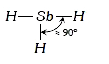
In Nitrogen family the H-M-H angle in the hydrides `MH_(3)` gradually becomes closer to `90^(@)` on going from N to Sb. This due to

A

The basic strength of hydrides increases

B

Almost pure p-orbitals are used for M  H bonding

C

The bond energies of M  H bond increase

D

The bond pairs of electrons become nearer to the central atom

Text Solution

Verified by Experts

The correct Answer is:
B


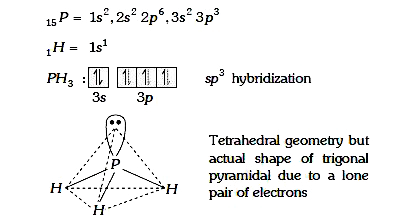
Similarly all the hydrides have trigonal pyramidal shape with a lone pair of electrons.
Assume that no hybridization occurs and all these central atoms are using pure P - orbitals. Then the bond angle H - M - H should be `90^@`. This is because each M - H bond uses one P - orbital and each P - orbital is oriented `90^@` from the other `(P_x , P_y and P_z )`.
Thus the degree of hybridization decreases down the group and the angles become closer to `90^@`. In `NH_3` the bond pair – bond pair repulsion is highest due to small size of N atom. So the H - N - H angle opens up a bit wider and the bond angle is maximum.
Promotional Banner

Topper's Solved these Questions

  • THE P -BLOCK ELEMENTS (NITROGEN, OXYGEN, HALOGEN AND NOBLE FAMILY)

    ERRORLESS|Exercise NCERT BASED QUESTIONS (Oxygen Family)|50 Videos
  • THE P -BLOCK ELEMENTS (NITROGEN, OXYGEN, HALOGEN AND NOBLE FAMILY)

    ERRORLESS|Exercise NCERT BASED QUESTIONS (Halogen Family)|73 Videos
  • THE d-AND f- BLOCK ELEMENTS

    ERRORLESS|Exercise Assertion and Reason |11 Videos

Similar Questions

Explore conceptually related problems

Fifth group elements form hydrides to type AH_(3) . The hydrides have a lone pair of electrons. The hydries are reducing in nature and the reducing power is related to the stability of A-H bonds. The hydrides are covalent and low boiling. Their boiling points depends on their ability to from hydrogen bond and their molecular size which decide the intermolcular forces in the hydrides . The H-M-H bond angle of V group hydrides decrease from 107^(circ) to 90^(circ) for NH_(3) to SbH_(3) , this is due to:

Why is the H-O-H bond angle in H_(2)O smaller than H-N-H bond angle in NH_(3) ?

Assertion : H-S-H bond angle in H_(2)S is closer to 90^(@) but H-O-H bond angle in H_(2)O is 104.5^(@) Reason: lp-lp repulsion is stronger in H_(2)S than in H_(2)O

Boron forms a numbr of hydrides having the general formuale B_(n)H_(n+4)1 and B_(n)H_(n+6) These hydrides are called boranes. The simpest hydride of boron is diborane, B_(2)H_(6) . Boranes contain special types of bonds known as multicientre bonds. Bornaes have high of combustion. From B_(2)H_(6) . which of the following can b e prepared except:

A particle is thrown with speed u at an angle of projection theta with horizontal as shown. (i) The avergae velocity of particle from O to A is u cos theta (ii) The average velocity of particle from O to H (highest point) is (u)/(2) sqrt(1 + 3 cos^(2) theta) (iii) The average velocity of particle from J to K is u cos theta (iv) The angle between the velocity and the acceleration between O and H is greater than 90^(@) , between H to A is less than 90^(@) and at highest point is 90^(@)

The angle of elevation of the highest point P of a vertical tower at point A on the horizontal ground is 45^(@) . The height of tower is 'h'/ The angle of a elevation of the tower becomes 60^(@) from B on moving a distance 'd' at 30^(@) angle from the horizontal. Prove that: d=h(sqrt(3)-1)

ERRORLESS-THE P -BLOCK ELEMENTS (NITROGEN, OXYGEN, HALOGEN AND NOBLE FAMILY)-ASSERTION & REASON
  1. In Nitrogen family the H-M-H angle in the hydrides MH(3) gradually bec...

    Text Solution

    |

  2. Statement-1 : Liquid NH(3) is used for refrigeration. Statement-2 : ...

    Text Solution

    |

  3. Asseration:Although:Although PF(5),PCl(5) and PBr(5) are known, the pe...

    Text Solution

    |

  4. Assertion : PCl(5) is covalent in gaseous and liquid state but ionic i...

    Text Solution

    |

  5. Assertion : H(3)PO(3) is a diabasic acid. Reason: There are two H at...

    Text Solution

    |

  6. Statement-1 : Electrovalency of oxygen is two (O^(2-)) Statement-2 :...

    Text Solution

    |

  7. Assertion: Reaction of SO(2) and H(2)S in the presence of Fe(2)O(3) ca...

    Text Solution

    |

  8. Asseration: SeCl(4), does not havea tetrahedral structure. Reason: S...

    Text Solution

    |

  9. Assertion. Ozone is a powerful oxidising agent in comparison to O(2) ...

    Text Solution

    |

  10. Statement SO(2) can be used as reductant as well as oxidant. Explanat...

    Text Solution

    |

  11. Statement-1 : At room temperature oxygen exists as a diatomic gas, whe...

    Text Solution

    |

  12. Assertion. Nitrogen is less reactive than molecular oxygen. Reason. ...

    Text Solution

    |

  13. Assertion: N(2)H(4) cannot reduce S(2)O(3)^(2-) Reason : S(2)O(3)^(2...

    Text Solution

    |

  14. Assertion : Sb(2)S(3) is not soluble in yellow ammonium sulphide. Re...

    Text Solution

    |

  15. Assertion : The cyanide radical is a pseudo halide. Reason : The cy...

    Text Solution

    |

  16. Statement-1 : Chlorine and sulphur dioxide both are bleaching agents. ...

    Text Solution

    |

  17. Assertion : Halogens do not occur in free state. Reason : Halogens a...

    Text Solution

    |

  18. Assertion (A): The halogens absorb visible light. Reason (R ): All h...

    Text Solution

    |

  19. Asseration: F-F bond in F(2) molecule is strong. Reason: F-atom is s...

    Text Solution

    |

  20. Assertion : Chlorine has higher electron affinity than fluorine. Rea...

    Text Solution

    |

  21. Assertion : Xenon forms fluorides. Reason : Due to the strong elect...

    Text Solution

    |