Home
Class 12
BIOLOGY
Alfred Hershey and Martha Chase made a b...

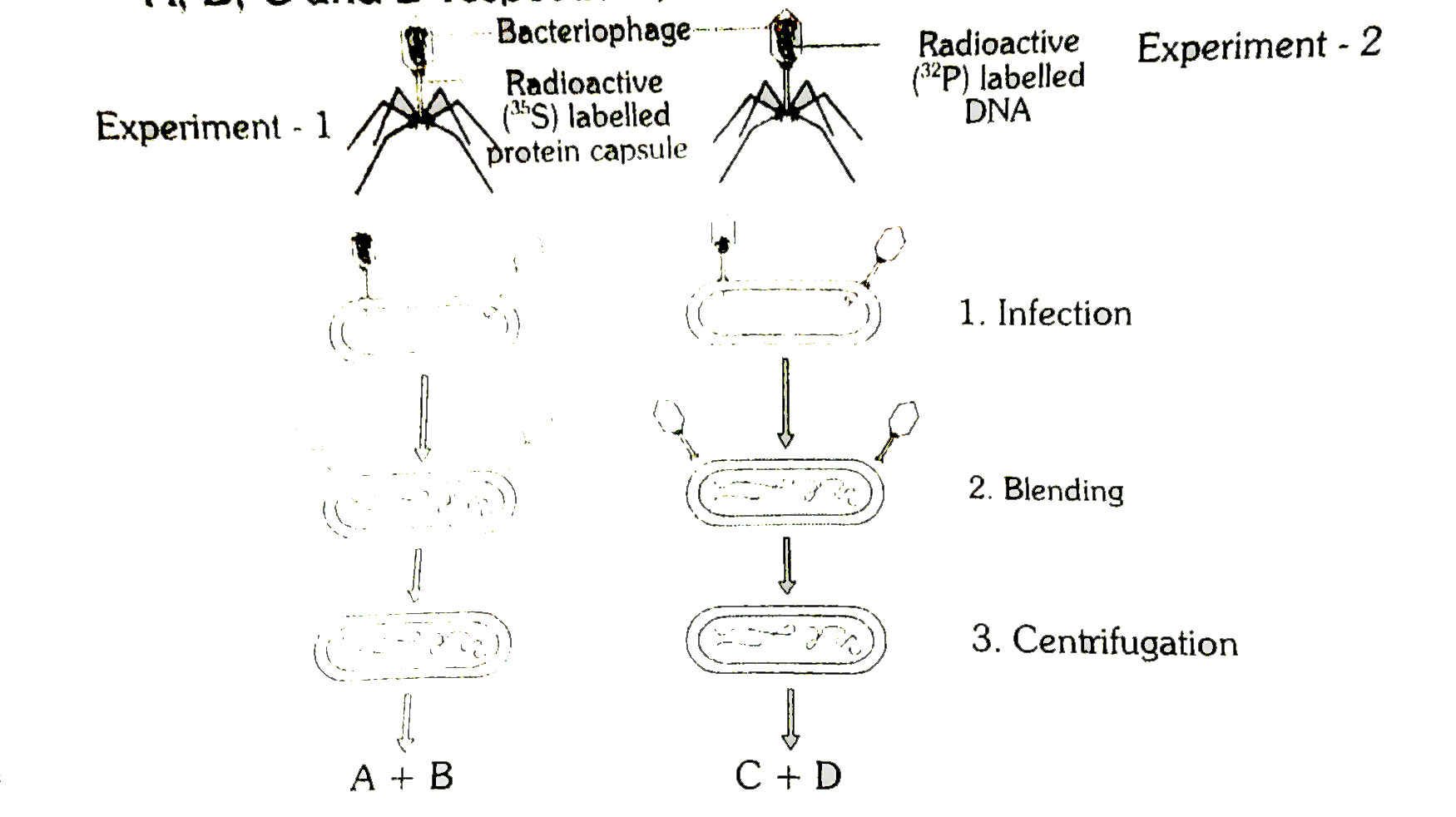
Alfred Hershey and Martha Chase made a big contribution in providing DNA role as the hereditary molecules. The experiment is shown in the figure. A and C are the presence or absence of radioactivity detected in cells . B and D are the presence or absence of radioactivity detected in supernatants cells. Identify A,B,C and D respectively

A

A - No Radioactivity (`""^(35)`S) detected in cells, B - Radioactivity (`""^(35)`S) detected in supernatant, C - No Radioactivity (`""^(32)`P) detected in cells, D - Radioactivity (`""^(32)`P) detected in supernatant

B

A - No Radioactivity (`""^(35)`S) detected in cells, B - Radioactivity (`""^(35)`S) detected in supernatant, C - Radioactivity (`""^(32)`P) detected in cells, D - No Radioactivity (`""^(32)`P) detected in supernatant

C

A - Radioactivity (`""^(35)`S) detected in cells, B - No Radioactivity (`""^(35)`S) detected in supernatant, C - Radioactivity (`""^(32)`P) detected in cells, D - No Radioactivity (`""^(32)`P) detected in supernatant

D

A - No Radioactivity (`""^(35)`S) detected in cells, B - Radioactivity (`""^(32)`P) detected in supernatant, C - Radioactivity (`""^(35)`S) detected in cells, D - No Radioactivity (`""^(32)`P) detected in supernatant

Text Solution

Verified by Experts

The correct Answer is:

B

A – No Radioactivity (35S) detected in cells,
B – Radioactivity (35S) detected in supernatant,
C – Radioactivity (32P) detected in cells,
D – No Radioactivity (32P) detected in supernatant
Promotional Banner

Similar Questions

Explore conceptually related problems

Figure-I-Mango, Figure-II-Coconut are shown in the following digram. Identify the parts of the fruit A,B,C and D are respectively

(a) What is this diagram representing? (b) Name the parts a, b and c. (c) In the eukaryotes the DNA molecules are organized within the nucleus. How is the DNA molecule organized in a bacterial cell in absence of a nucleus?

Study the given figure and identify the cells labelled as A, B, C and D

(a) What is this diagram representing ? (b) Name the parts a, b, c and d. (c) In the eukaryotes the DNA molecules are organised within the nucleus. How is the DNA molecule organised in a bacterial cell in absence of a nucleus ?

Read the following statements and select the correct option stating which one is true (T) and which one is false (F). A. ABO grouping is based on the presence or absence of two surface antigens on leucocytes. B. During first pregnancy there is least chance of occurrence of erythroblastosis fetalis due to Rh incompatibility C. During blood clotting, conversion of fibrinogen to fibrin occurs by action of enzyme thrombokinase D. All chordates possess chambered, muscular dorsal heart to pump blood throughout the body

A small, electrically charged bead can slide on a circular, frictionless, thin, insulating ring. Charge on the bead is Q and its mass is m . A small electric dipole, having dipole moment P is fixed at the centre of the circle with the dipole’s axis lying in the plane of the circle. Initially, the bead is held on the perpendicular bisector of the dipole (see fig.) Ignore gravity and answer the following questions. (a) Write the speed of the bead when it reaches the position theta shown in the figure. (b) Find the normal force exerted by the ring on the bead at position theta . (c) How does the bead move after it is released? Where will the bead first stop after being released? (d) How would the bead move in the absence of the ring?

Which of the following characteristics are found in a healthy cell ? A. Metastasis B. Presence of contact inhibition C. Presence of proto - oncogenes D. Uncontrolled cell division
