Home
Class 11
PHYSICS
Keeping one vector constant, if directio...

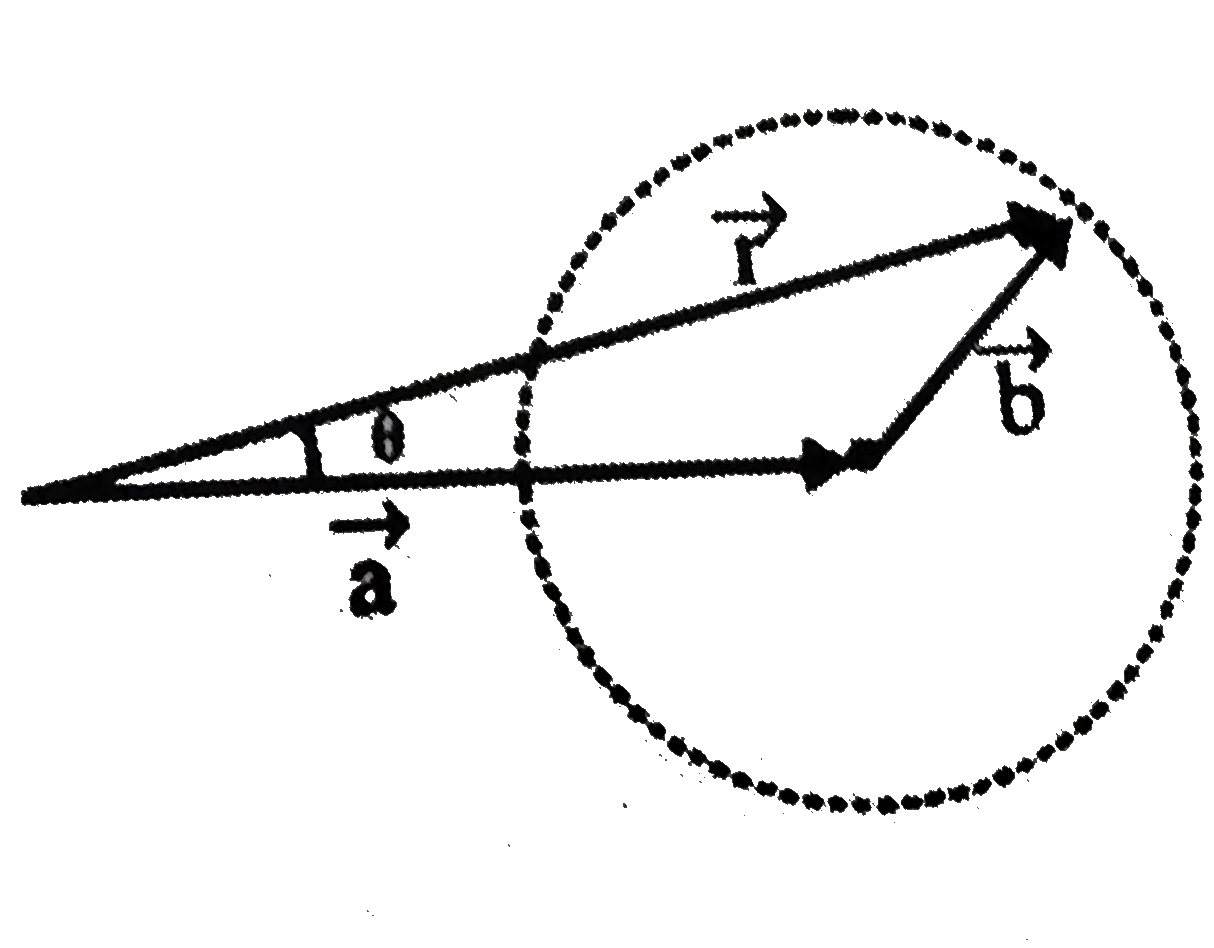
Keeping one vector constant, if direction of other to be added in the first vector is changed continuously, tip of the resultant vector describes a circles, In the following figure vector `vec(a)` is kept constant. When vector `vec(b)` addede to `vec(a)` changes its direction, the tip of the resultant vector `vec(r)=vec(a)+vec(b)` describes circles of radius b with its centre at the tip of vector `vec(a)`. Maximum angle between vector `vec(a)` and the resultant `vec(r)=vec(a)+vec(b)` is

A

All three vectors must be parallel

B

`vec(b) and vec(c)` must be parallel to each other, but `vec(a)` need not be parallel to `vec(b) and vec(c)`

C

`vec(a) and vec(b)` must be perpendicular to each other

D

It is impossible for three non-zero vectors `vec(a), vec(b) and vec(c)` to have the property stated above

Text Solution

Verified by Experts

The correct Answer is:

D

Initially `a+b=c`
when `3a+ 2b= 2c`
`because c= a+b`
`therefore 3a+ 2b= 2(a+b) rArr a= 0`
Hence it is impossible for three non-zero vectors to have the property stated above
Promotional Banner

Similar Questions

Explore conceptually related problems

If vec(a).vec(b)=|vec(a)xx vec(b)| , then angle between vector vec(a) and vector vec(b) is :

If a vector vec(A) is parallel to another vector vec(B) then the resultant of the vector vec(A)xxvec(B) will be equal to

When two vector vec a and vec b are added,the magnitude of the resultant vector is always

Which one of the following is correct ? If the vector vec(c) is normal to the vectors vec(a) and vec(b) , then vec(c) , is :

If vector vec a+vec b bisects the angle between vec a and vec b, then prove that |vec a|=|vec b|

Find the angle between two vectors vec a and vec b, if |vec a xxvec b|=vec a*vec b

Two vectors vec(A) and vec(B) lie in plane, another vector vec(C ) lies outside this plane, then the resultant of these three vectors i.e., vec(A)+vec(B)+vec(C )

The vector vec(a) lies in the plane of vectors vec(b) and vec(c) . Which one of the following is correct ?

The resultant of two vectors vec(A) and vec(B) is perpendicular to the vector vec(A) and its magnitudes is equal to half of the magnitudes of vector vec(B) (figure). The angle between vec(A) and vec(B) is

If for two vectors vec(A) and vec(B), vec(A)xxvec(B)=0 , the vectors
