Home
Class 11
PHYSICS
If three forces vec(F(1)),+vec(F(2))andv...

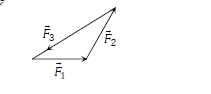
If three forces `vec(F_(1)),+vec(F_(2))andvec(F_(3))` are represented by three sides of a triangle and `vec(F_(1))+vec(F_(2))=-vec(F_(3))` , then these three forces are concurrent forces and satisfy the condition for equilibrium .
Statement II : A triangle made up of three forces `vecF_(1),vecF_(2)andvecF_(3)` as sides taken in the same order ,satisfy the condition for translatory equilibrium . In the light of the above statements ,choose the most appropriate answer from the options given below :

A

Both Statement I and Statement II are true

B

Statement I is true but Statement II is false

C

Both Statement I and Statement II are false

D

Statement I is false but Statement II is true

Text Solution

Verified by Experts

The correct Answer is:
A


Here `vec(F)_(1) + vec(F)_(2) + vec(F)_(3)= 0`
`vec(F)_(1)+ vec(F)_(2)= - vec(F)_(3)`
Since `vec(F)_("net")= 0` (equilibrium)
Both statements are correct
Promotional Banner

Similar Questions

Explore conceptually related problems

Statement 1: Three force vec(f_1) , vec(f_2) and vec(f_3) are acted at vertices of a triangular body such that vec(f_1) + vec(f_2) = - vec(f_3) and these force are concurrent forces, Statement 2: It explain translations equilibrium

What are concurrent forces ? Obtain a condition for the equilibrium of three concurrent forces

If veca, vecb and vecc are represented by three sides of equilateral triangle taken in same order. P.T. veca+vecb+vec c=vec0 .

Three concurrent force of the same magnitude are in equilibrium. What is the angle between the forces? Also name the triangle formed by the forces as sides.

Three forces vec(F)_(1), vec(F)_(2) and vec(F)_(3) are represented as shown. Each of them is equal magnitude. Now match the given columns and select the correct option from the codes given below.

Two forces vec(F_(1)) and vec(F_(2)) are acting at right angles to each other , find their resultant ?

When force vec(F)_(1),vec(F)_(2),vec(F)_(3) are acting on a particle of mass m , the particle remains in equilibrium. If the force vec(F)_(1) is now removed then the acceleration of the particle is :

When force vec(F_(1)), vec(F_(2)),vec(F_(3))"…..."vec(F_(n)) act on a particle , the particle remains in equilibrium . If vec( F_(1)) is now removed then acceleration of the particle is

Two forces vec(F)_(1)=500N due east and vec(F)_(2)=250N due north have their common initial point. vec(F)_(2)-vec(F)_(1) is

If vec a,vec b,vec c represent the sides of a triangle taken in order,then write the value of vec a+vec b+vec *

