Home
Class 11
PHYSICS
Three students S1, S2 and S3 perform an...

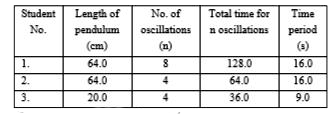
Three students `S_1, S_2 and S_3` perform an experiment for determining the acceleration due to gravity (g) using a simple pendulum. They use different lengths of pendulum and record time for different number of oscillations. The observations are as shown in the table.

(Least count of length = 0.1 m least count for time = 0.1 s)
If `E_1, E_2 and E_3` are the percentage errors in 'g' for students 1, 2 and 3 respectively, then the minimum percentage error is obtained by student no._____.

Text Solution

Verified by Experts

The correct Answer is:

1

`T=t/n=2pisqrt(1/g)`
`implies g = (4pi^2l)/(T^2)`
`implies (Deltag)/g xx100= (Deltal)/l xx100 + 2(DeltaT)/T xx100`
`=((Deltal)/l+(2Deltat)/(nT))100%`
`E_1=20/64%`
`E_2=30/64%`
`E_3 =19/18 %`
Promotional Banner

Similar Questions

Explore conceptually related problems

Student I, II and III perform an experiment for measuring the acceleratioon due to gravity (g) using a simple pendulum . Theu use different lengths of the pedulum and /or record time for different number of oscillations . The observation are shoen in the table . Least count for length =0.1cm Least count for time =0.1s If E_(I) , E_(II) and E_(III) are the percentage errors in g,i.e (Deltag)/(g)xx100 for students I, II, and III respectively ,

Students I_(1),J_(1), J_(3) and I_(2) perform an experiment for measuring the acceleration due to gravity (g) using a simple predulum, they use different lengths of the pendulum and record time for different number of oscillations. The observations are shown in the table. Least count for length = 0.1 cm , least count for time = 1s {:("Students",underset("pendulum (cm)")("Length of the"),underset("oscillations(n)")("No.of"),underset("of pendulum (s)")("Time period")),(I_(1),100.0,20,20),(J_(1),400.0,10,40),(J_(1),100.0,10,20),(I_(1),400.0,20,40):} If P_(1),P_(2),P_(3) and P_(4) are the % error in g for students I_(1),J_(1),J_(3) and I_(2) respectively then -

Student I ,II , and III perform an experiment for measuring the acceleration due to gravity (g) usinf a simple pendulum. They use lengths of the pendulum and // or record time for different number of oscillations . The observations are shown in the following table . Least count for length = 0.1 cm {:(underset(III)underset(II)underset(I)underset()underset()("Student"),underset(20.0)underset(64.0)underset(64.0)underset((cm))underset("Pendulam")("Length of "),underset(4)underset(4)underset(8)underset((n))underset("n Oscillation")("Number of"),underset(9.0)underset(16.0)underset(16.0)underset((s))underset("Period")("Time")):} Least count for time = 0.1 s . If E_(I), E_(II) , and E_(III) are the percentage errors in g , i.,e., ((Delta g)/( g) xx 100) for students I,II , and III, respectively , then

The acceleration due to gravity at a place is pi^(2)m//s^(2) . Then, the time period of a simple pendulum of length 1 m is

The acceleration due to gravity on a planet is 3//2 times that on the earth. If length of a seconds pendulum on earth is 1m , length of second pengulum on surface of planet is

A student uses a simple pendulum of ecactly 1 m length to determine g, the acceleration due to gravity. He uses a stop watch with the least count of 1 s for this and records 40 s for 20 oscillation. For this observation, which of the following statement (s) is (are) true?

A student uses a simple pendulum of exactly 1m length to determine g , the acceleration due ti gravity. He uses a stop watch with the least count of 1sec for this and record 40 seconds for 20 oscillations for this observation, which of the following statement (s) is (are) true?

While measuring acceleration due to gravity by simpe pendulum a student makes a positive error of 1% in the length of the pendulum and a negative error of 3% in the value of the time period. His percentage error in the measurement of the value of g will be -
