Home
Class 11
PHYSICS
Three identical particles are joined tog...

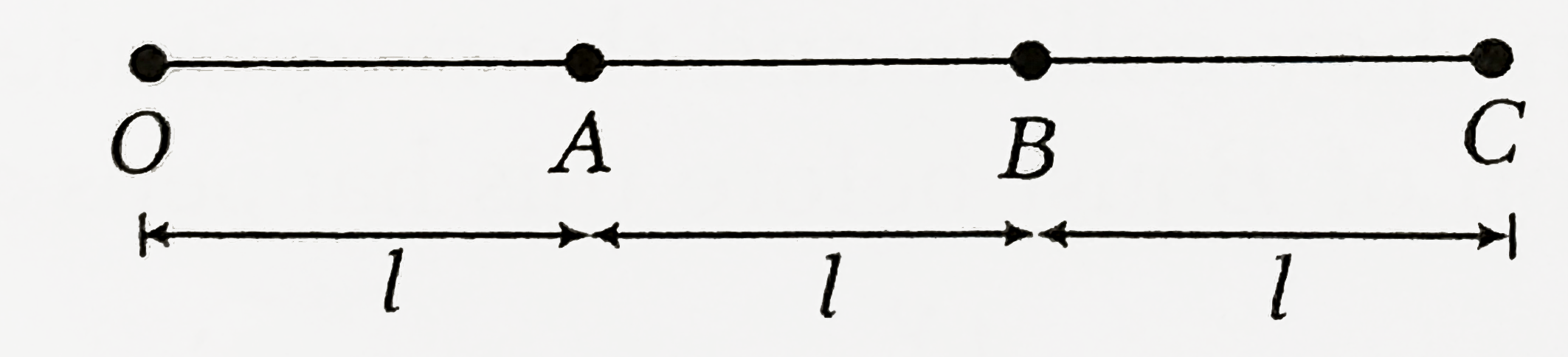
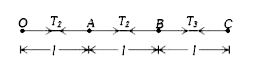
Three identical particles are joined together by a thread as shown in figure. All the three particles are moving in a horizontal plane. If the velocity of the outermost particle is `v_(0)`, then the ratio of tensions in the three sections of the string is `(T_(BC):T_(AB):T_(DA))`

A

`3:5:7`

B

`3:4:5`

C

`7:11:6`

D

`3:5:6`

Text Solution

Verified by Experts

The correct Answer is:
D

`T_(3) = m omega^(2) (3l)`

`T_(2) - T_(3) = m omega^(2) (3r)`
`T_(1) - T_(2) = momega^(2)( r)`
`rArr T_(1) = momega^(2) (4r)`
`T_(1):T_(2) = 4:3`
Promotional Banner

Similar Questions

Explore conceptually related problems

Three identical particles are joined together by a thread as shown in figure All the partical are moving in a horizontal plane If the vertical of the outermost particle is v_(0) then the ratio of tension in the three sections of the string (T_(1):T_(2):T_(3) = ?) is

Three particles A, B, Care located at the comers of an equilateral triangle as shown in figure. Each of the particle is moving with velocity v. Then at the instant shown, the relative angular velocity of

Two particles each of mass m are moving in horizontal circle with same angular speed. If both string are of same length then the ratio of tension in string (T_(1))/(T_(2)) is

The x-t graph of particle moving along a straight line is shown in figure The a-t graph of the particle is correctly shown by

The x-t graph of particle moving along a straight line is shown in figure The v-t graph of the particles is correctly shown by

The x-t graph of a particle moving along a straight line is shown in figure The v-t graph of the particle is correctly shown by

A horizontal plane supports a fixed vertical cylinder of radius R and a particle is attached to the cylinder by a horizontal thread AB as shown in Fig. The particle initially rest on a horizontal plane. A horizontal velocity v_(0) is imparted to the particle, normal to the threading during subsequent motion. Point out the false statements:

The x-t graph of a particle moving along a straight line is shown in figure The a-t graph of the particle is correctly shown by

The acceleration-time graph of a particle moving along x-axis is shown in the figure. If the particle starts with velocity 3 m/s at t = 0, find the velocity of particle at t = 4 s.

The acceleration of a particle varies with time t as a=t^(2)+t+2 where t is in seconds. The particle starts with an initial velocity v-3m/s at t=0. find the velocity of the particle at the end of 5s.

