Home
Class 11
PHYSICS
A particle at a distance of 1 m from the...

A particle at a distance of 1 m from the origin starts moving such that `dr//d theta = r`, where `(r, theta)` are polar coordinates. Then the angle between resultant velocity and tangential velocity component is

A

30 degrees

B

45 degrees

C

60 degrees

D

Dependent on where the particle is

Text Solution

Verified by Experts

The correct Answer is:
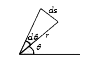
B

`(dr)/(d theta) = r = (ds)/(d theta) rArr (dr)/(dt) = (ds)/(dt) rArr v_(t) = v_(r)` So, `alpha = 45^(@)`
Promotional Banner

Similar Questions

Explore conceptually related problems

When a projectile is fired at an angle theta w.r.t horizontal with velocity u, then its vertical component:

A particle starts from the origin of coordinates at time t = 0 and moves in the xy plane with a constant acceleration alpha in the y-direction. Its equation of motion is y= betax^2 . Its velocity component in the x-direction is

A particle starts from the origin of coordinates at time t = 0 and moves in the xy plane with a constant acceleration alpha in the y-direction. Its equation of motion is y = beta x^(2) . Its velocity component in the x-directon is

if the displacement of the particle at an instant is given by y = r sin (omega t - theta) where r is amplitude of oscillation. omega is the angular velocity and -theta is the initial phase of the particle, then find the particle velocity and particle acceleration.

A point moves along an arc of a circle of radius R . Its velocity depends on the distance s covered as v=lambdasqrt(s) , where lambda is a constant. Find the angle theta between the acceleration and velocity as a function of s .

A particle is projected along a horizontal field whose coefficient of friction varies as mu=A//r^2 , where r is the distance from the origin in meters and A is a positive constant. The initial distance of the particle is 1m from the origin and its velocity is radially outwards. The minimum initial velocity at this point so the particle never stops is

If the equation for the displacement of a particle moving in a circular path is given by (theta)=2t^(3)+0.5 , where theta is in radians and t in seconds, then the angular velocity of particle after 2 s from its start is

A point object moves along an arc of a circle or radius'R' . Its velocity depends upon the distance covered 'S' as V=KsqrtS Where'K' is a constant. IF theta is the angle between the total acceleration and tangential accleration , then

If r=1-costheta," then "r(d theta)/(dr)=

