Home
Class 11
PHYSICS
A modern gran -prix racing car of masses...

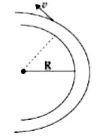
A modern gran -prix racing car of masses m is travelling on a flat track in a circular arc of radius R with a speed `v`. If the coefficient of static friction between the tyres and the track is `mu_(s)`, then the magnitude of negative lift `F_(L)` acting downwards on the car is `:` ( Assume forces on the four tyres are identical and g = acceleration due to gravity )

A

`m (( v^(2))/( mu _(s) R) - g)`

B

` - m ( g + ( v^(2))/( mu_(s) R))`

C

` m (( v^(2))/( mu_(s) R) + g)`

D

` m ( g - ( v^(2))/( mu_(s) R))`

Text Solution

Verified by Experts

The correct Answer is:

A

` ( mv^(2))/( r) = mu _(s) N`
`rArr N = ( mv ^(2))/( mu_(s) R)`
mg + F = N
F = N - mg
`F = ( m v^(2))/( mu_(s) R) - mg = m (( v^(2))/( mu _(s) R) - g)`
Promotional Banner

Similar Questions

Explore conceptually related problems

A car is taking turn on a circular path of radius R. If the coefficient of friction between the tyres and road is mu , the maximum velocity for no slipping is

A car is moving along a straight horizontal road with a speed v_(0) . If the coefficient of friction between the tyres and the road is mu , the shortest distance in which the car can be stopped is

A car is travelling along a curved road of radius r. If the coefficient of friction between the tyres and the road is mu the car will skid if its speed exceeds .

A car is moving along a straight horizontal road with a speed v_(0) . If the coefficient of friction between the tyre and the road is mu, the shortest distance in which the car can be stopped is.

A car has to move on a level turn of radius 45 m. If the coefficient of static friction between the tire and the road is mu_s=2.0, find the maximum speed the car can take without skidding.

Find the maximum velocity for skidding for a car moved on a circular track of radius 100 m . The coefficient of friction between the road and tyre is 0.2

A car is moving on a horizontal circular road of radius 0.1 km with constant speed. If coefficient of friction between tyres of car and road is 0.4, then speed of car may be (g=10m//s^(2))

What will be maximum speed of a car on a curved road of radius 30 m , If the coefficient of friction between the tyres and the road is 0.4? (g=9.8 m//s^(2))

What is the minimum stopping distance for a vehicle of mass m moving with speed v along a level road. If the coefficient of friction between the tyres and the road is mu .

What is the minimum stopping distance for a vehicle of mass m moving with speed v along a level road. If the coefficient of friction between the tyres and the road is mu
