Home
Class 11
PHYSICS
A rope of mass 0.1 kg is connected at th...

A rope of mass 0.1 kg is connected at the same height of two opposite walls. It is allowed to hang under its own weight. At the contact point between the rope and the wall, the rope makes an angle ` theta = 10^(@)` with respect to horizontal. The tension in the rope at its midpoint between the wall is

A

2.78 N

B

2.56 N

C

2.82 N

D

2 .71 N

Text Solution

Verified by Experts

The correct Answer is:
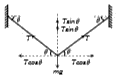
C

`2T sin theta = mg`
`rArr T = (mg)/(2 sin theta) = (0.1 xx 9.8)/(2 sin 10^(@))`
`rArr T = 2.82 N`
Promotional Banner

Similar Questions

Explore conceptually related problems

A rope of mass 0.2 kg is connected at the same height of two opposite walls. It is allowed to hang under its own weight. At the contact point between the rope and the wall, the rope makes an angle theta=30%^(@) with respect to horizontal. The tension in the rope at its midpoint between the walls is

The tops of two poles of height 60 metres and 35 metres are connected by a rope. If the rope makes an angle with the horizontal whose tangent is 5/9 metres, then what is the distance (in metres) between the two poles?

A wooden block of mass 100 kg rests on a flat wooden floor, the coefficient of friction between the two being 0.4 . The block by a rope making an angle of 30^(@) with the horizontal. What is the minimum tension along the rope that just makes the rope sliding?

A block of mass M is pulled along a horizontal frictionless surface by a rope of mass m as shown in A horizontal force F is applied to one end of the rope. Find (a) the acceleration of the rope and block (b) the force that the rope exerts on the block (c) the tension in the rope at its mid point

A mass M is suspended by a rope from a rigid support at A as shown in figure. Another rupe is tied at the end B, and it is pulled horizontally with a force. If the rope AB makes an angle theta with the vertical in equilibrium then the tension in the string AB is

A 40 kg mass, hanging at the end fo a rope of length l, oscillates in a vertical plane with an angular amplitude theta_0. What is the tension in the rope when it makes en angle theta with the vertical ? If the breaking strength of the rope is 80kg, what is the maximum amplitude with which the mass can oscillate without the rope breaking?

A rope of mass m is hung from a ceiling. The centre point is pulled down with a vertical force F. The tangent to the rope at its ends makes an angle alpha with horizontal ceiling. The two tangents at the lower point make an angle of theta with each other. Find theta .

A ball of mass m is suspended from a rope of length L. It describes a horizontal circle of radius r with speed v. the rope makes an angle theta with vertical given by sin theta = r//2 . Determine (a) the tension in the rope and (b) the speed of the ball. (c) time period of ball.

A rope of length L has its mass per unit langth lambda varies according to the function lambda(x)=e^(x//L) . The rope is pulled by a constant force of 1 N on a smooth horizontal surface. The tension in the rope at x=L//2 is :

On a pulley of mass M hangs a rope with two masses m_(1) and m_(2) (m_(1) gt m_(2) ) tied at the ends as shown in the figure. The pulley rotates without any friction, whereas the friction between the rope and the pulley is large enough to prevent any slipping. Which of the following plots best represents the difference between the tensions in the rope on the two sides of the pulley as a function of the mass of the pulley ?

