Home
Class 11
PHYSICS
In the arrangement shown, the pulleys ar...

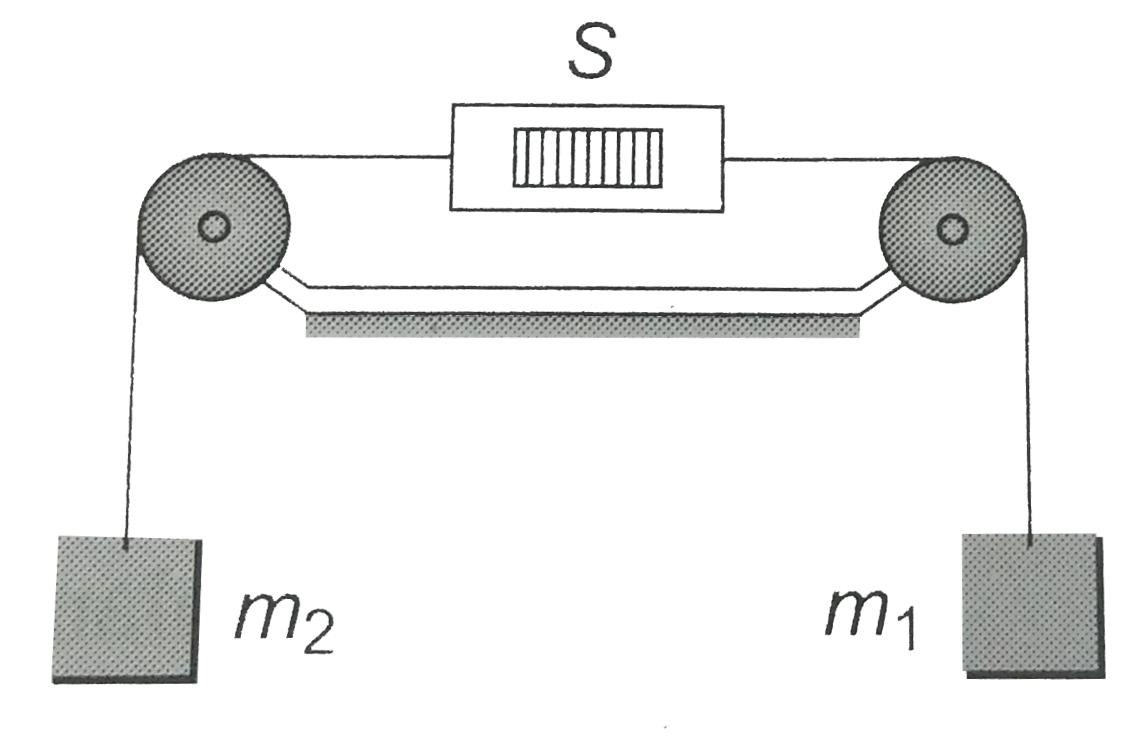
In the arrangement shown, the pulleys are fixed and ideal, the strings are light, `m_(1)gtm_(2)` and S is a spring balance which is itself massless. The readings of S (in units of mass) is

A

`m_(1) - m_(2)`

B

`(1)/(2) (m_(1) + m_(2))`

C

`(m_(1)m_(2))/(m_(1) + m_(2))`

D

`(2m_(1)m_(2))/(m_(1) + m_(2))`

Text Solution

Verified by Experts

The correct Answer is:

D

Reading of spring balance = T
`T = (2m_(1) m_(2))/(m_(1) + m_(2)) gN`
Mass `= (2m_(1)m_(2))/(m_(1) + m_(2))`
Promotional Banner

Similar Questions

Explore conceptually related problems

In the arrangement shown, the pulleys, string and the spring balance, all the ideal. If m_(1) gt m_(2) , then the reading of the spring balance is

In the arrangement shown, inclined plane is smooth, strings and pulleys are massless. Find T_(1)/T_(2)

In the system shown in fig the pulley is frictionless and the string massless if m_(1)=m_(2) thrust on the pulley will be:

In the arrangement , shown below pulleys are massless and frictionless and threads are inextensible , block of mass m_(1) will remain at rest if

In the arrangement shown, the mass m will ascend with an acceleration ( Pulley and rope are massless)

In the arrangement shown in figure, pulleys are light and spring are ideal. K_(1) , k_(2) , k_(3) and k_(4) are force constant of the spring. Calculate period of small vertical oscillations of block of mass m .

In the arrangements shown, the pulleys, strings and springs are weightless and the systems can move freely without friction The extension of spring in 1 is x_(1) and that in 2 is x_(2) Then .

In the arrangement shown in fig. m_(1)=1kg, m_(2)=2 kg . Pulleys are massless and strings are light. For what value of M, the mass m_(1) moves with constant velocity.

Two blocks A and B are arranged as shown in figure.The pulleys are light and frictionless.The strings are light and inextensible.If the acceleration of the block B is 3m/s^(2) ,then the acceleration of the block A is __________ m/s^(2)
