Home
Class 11
PHYSICS
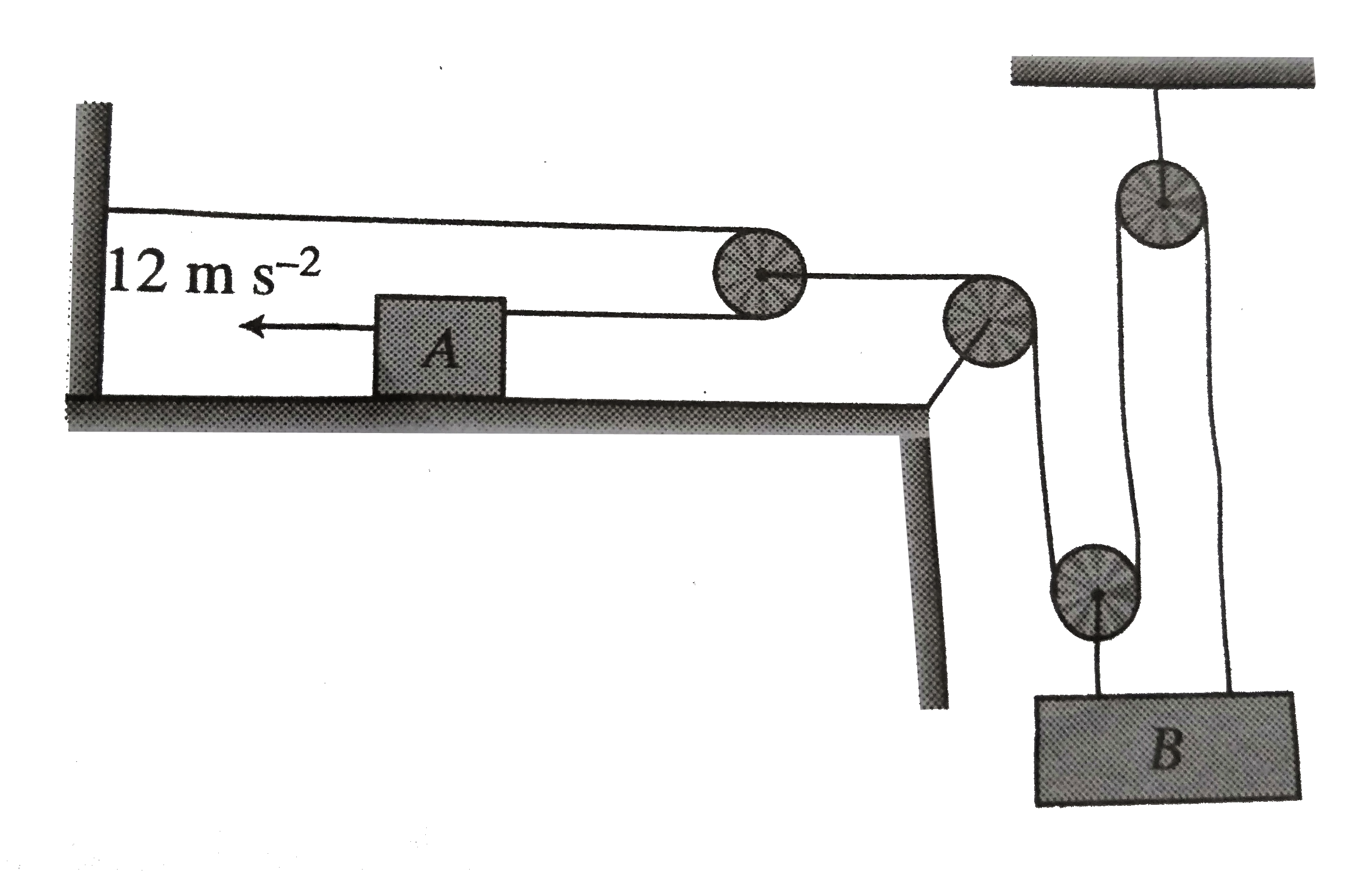
Block A is given an acceleration 12 ms^(...

Block A is given an acceleration `12 ms^(-2)` towards left as shown in fig. Assuming block B always remains horizontal, find the acceleration (in `ms^(-2)`) of B.

Text Solution

Verified by Experts

The correct Answer is:
2

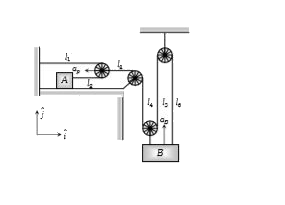
`I_(1) + I_(2) = C rArr l_(1) + l_(2)= 0`

`rArr -a_(p) + (12-a_(p)) = 0`
`rArr a_(p) = 6ms^(-2)`
`l_(3) + l_(4) + l_(5) + l_(6) = C`
`a_(p) - a_(B) - a_(B) -a_(B)=0`
`rArr a_(p) = 3a_(B)`
`rArr a_(B) = 2ms^(-1)`
Promotional Banner

Similar Questions

Explore conceptually related problems

Wedge B is pulled by an acceleration 2g towards left. Find the acceleration of block A-

The system shown in fig. is given an acceleration a towards left. Assuming all the surfaces to be frictionless, find the normal reactions applied by wedge on the sphere.

The acceleration of block is( g=10 ms-2)

The system shown in the Fig. is given an acceleration 'a' towards left. Assuming all the surfaces to be frictionless, find the force on the sphere.

If block A is moving with an acceleration of 5ms^(-2) , the acceleration of B w.r.t. ground is

If block B moves towards right with acceleration b, find the net acceleration of block A.

The masses of the blocks A, B and C shown in fig (a) are 4 kg, 2kg and 2 kg respectively Block A moves with an acceleration of 2.5 ms^(-2) a. Block C is removed from its in position and placed on block A (b). What is now the acceleration of block C ? b. The position of the block A and B subsequently interchanged find the new acceleration of C .The coefficient of friction in the same for all the conect surface

Block C shown in figure-1.79 is going down at acceleration 2 m//s^(2) . Find the acceleration of blocks A and B.

Block A is moving with acceleration A along a frictionless horizontal surface. When a second block, B is placed on top of Block A the acceleration of the combined blocks drops to 1/5 the original value. What is the ratio of the mass of A to the mass of B?

