Home
Class 11
PHYSICS
A boy begins to walk eastward along a st...

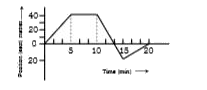
A boy begins to walk eastward along a street in front of his house and the graph of his position from home is shown in the following figure. His average speed for the whole time interval is equal to

A

8m/min

B

6m/min

C

`8/3`m/min

D

2m/min

Text Solution

Verified by Experts

The correct Answer is:

B

`v_(avg) = (40+0+60+20)/(20)` = 6m/min
Promotional Banner

Similar Questions

Explore conceptually related problems

A person walks along an east-west street and a graph of his displacement from home is shown in figure. His average velocity for the whole time interval is:-

A person walks along an east-west street and a graph of his displacement from home is shown in figure. His average velocity for the whole time interval is :-

A girl walks along an east-west street, and a graph of her displacement from home is as shown in figure. Her average velocity for the whole time interval is-

Position-time graph for a particle moving along x- direction is as shown in the figure. Average speed of the particle from t = 0 to t = 4 is :

The position (x) - time (t) graph for a particle moving along a straight line is shown in figure. The average speed of particle in time interval t = 0 to t = 8 s is

Velocity time graph for the motion of a particle along a straight line is as shown in figure. Average speed of the particle for the whole motion is:

The position versus time graph of the motion of a boy along a straight path is shown in the given figure. The total time for which the boy remains in motion is

The velocity time graph of a particle moving along a straight line is shown in the figure. In the time interval from t=0 to t=8 second, answer the following three question. The value of ("maximum speed")/("average speed") for the given time interval is :

A student walks from his house at 6.30 am and reaches his school at 7:15 am. The distance of the school from his house is 6 km. The speed of the student is

Position - time graph for a particle is shown in figure. Starting from t = 0, at what time t, the average velocity is zer?
