Home
Class 11
PHYSICS
An inclined plane of length 5.60 m makin...

An inclined plane of length `5.60` m making an angle of `45^(@)` with the horizontal is placed in a uniform electric field `E=100 Vm^(-1)`. A particle of mass `1 kg` and charge `10^(-2)C` is allowed to slide down from rest position from maximum height of slope. If the coefficient of friction is 0.1, then the time taken by the particle to reach the bottom is

A

1 s

B

1.41 s

C

2 s

D

None of these

Text Solution

Verified by Experts

The correct Answer is:
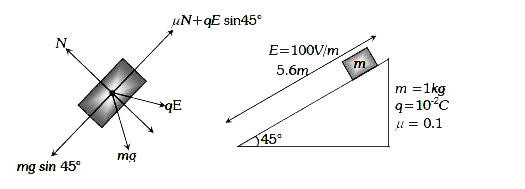
B

`mg sin 45^(@) - f - q E sin 45^(@)` = ma
Since f = `mu N`
mg `sin 45^(@) - mu N - q E sin 45^(@) =` ma ….. (i)
and `N = mg cos 45^(@) + q E cos 45^(@)` ….. (ii)
By eq. (i) and (ii)
`ma = mg sin 45^(@) - mu mg cos 45^(@) - mu g E cos 45^(@) - q E sin 45^(@)`
ma = mg `(1)/(sqrt2) - mu mg xx (1)/(sqrt2) - q E mu xx (1)/(sqrt2) - q E xx (1)/(sqrt2)`
`implies a = (9.8)/(sqrt2) - (0.98)/(sqrt2) - (0.1)/(sqrt2) - (1)/(sqrt2)`
`a = (9.8 - 0.98)/(sqrt2) - ((1 + 0.1)/(sqrt2))`
`= 6.24 - 0.78 = 5.46 m//s^(2)`

Now , `S = ut + (1)/(2) at^(2) implies 5.6 = (1)/(2) xx 5.46 xx t^(2)`
`implies t^(2) ~~ 2 implies t = sqrt2 = 1.41` sec
Promotional Banner

Similar Questions

Explore conceptually related problems

An inclinded plane making an angle of 30^(@) with the horizontal electric field of 100 Vm^(-1) as shown in Figure. A particle of mass 1 kg and charge 0*01 C is allowed to slide down from rest from a height of 1m . If the coefficient of friction is 0*2, find time taken by the particle to reach the bottom.

An inclined plane making an angle of 30^(@) with the horizontal is placed in a uniform horizontal electric field 200 (N)/(C ) as shown in the figure. A body of mass 1kg and charge 5 mC is allowed to slide down from rest at a height of 1m. If the coefficient of friction is 0.2, find the time taken by the body to reach the bottom. [g=9.8m//s^(2), sin 30^(@)=(1)/(2), cos30^(@)=(sqrt(3))/(2)]

A partical of mass 1kg rests on rought contact with a plane inclined at 30^(@) to the horizontal and is just about to slip, Find the coefficient of friction between the plane and the particle.

An inclined plane of inclination theta is placed in uniform horizontal electric field E as shown. A block of mass m having charge q is sliding down on the plane with constant velocity . If coefficient of friction is mu , find charge q in terms of given quantities .

A body is allowed to slide from the top along a smooth inclined plane of length 5m at an angle of inclination 30^(@) .If g=10ms^(-2) , time taken by the body to reach the bottom of the plane is

A particle of mass 6.4xx10^(-27) kg and charge 3.2xx10^(-19)C is situated in a uniform electric field of 1.6xx10^5 Vm^(-1) . The velocity of the particle at the end of 2xx10^(-2) m path when it starts from rest is :

A track has two inclined surface AB and DC each of length 3 m and angle of inclination of 30^@ with the horizontal and a central horizontal part of length 4m shown in figure. A block of mass 0.2 kg slides from rest from point A. The inclined surfaces are frictionless. If the coefficient of friction between the block and the horizontal flat surface is 0.2, where will the block finally come to rest ? [in 10^(-1) m ]

When a body slides down from rest along a smooth inclined plane making an angle of 30^(@) with the horizontal, it takes time 20s. When the same body slides down from rest along a rough inclined plane making the same angle and through the same distance, it takes time 20p is, where p is some number greater than 1. The coefficient of friction between the body and the rough plane is

A body of mass 0.5 kg is taken up an inclined plane of length 10 m and height 5 m and then allowed to slide down to the bottom again. The coefficient of friction between the body and the plane is 0.1. The work done by the frictional force over the round trip is

