Home
Class 11
PHYSICS
An electric bulb suspended from the roof...

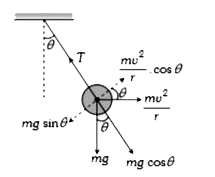
An electric bulb suspended from the roof of a railway train by a flexible wire shifts through an angle of `19^(@) 48` when the train goes horizontally round a curved path of `200m` radius Find the speed of the train .

Text Solution

Verified by Experts

The correct Answer is:
28

Various forces acting on the bulb are shown in figure. Resolving the forces along the length and perpendicular to the wire, we get
`mg sin theta=(mv^(2))/(r).costheta`

`tan theta=(v^(2))/(rg)`
`v=sqrt(rg tan theta)=sqrt(200xx9.8xxtan19^(@)48.)`
`=sqrt(200xx9.8xx0.3600)=sqrt(7.5.6)`
`=2656ms^(-1)`
Promotional Banner

Similar Questions

Explore conceptually related problems

The acceleration of a train travelling at 40 m//s as it goes round a curve of 160 m in radius is ?

A pendulum suspended from the roof of a railway carriage travelling at a speed v mis round a curve of radius 'a' metres makes n oscillations per second. If the same pendulum makes n_1 oscillations per second when the carriage is stationary, what is the value of v_2 ?

Consider a conical pendulum having bob is mass m is suspended from a ceiling through a string of length L. The bob moves in a horizontal circle of radius r. Find (a) the angular speed of the bob and (b) the tension in the string.

The acceleration of a train travelling with speed of 400m//s as it goes round a curve of radius 160 m , is

A train is moving along a horizontal track . A pendulum suspended from the roof makes an angle of 4^(@) with the vertical . If g = 10 m//s^(2) , what is the acceleration of the train ?

A train starts from rest with constant acceleration a=1 m//s^(2) A passenger at a distance S from the train runs at this maximum velocity of 10 m//s to catch the train at the same moment at which the train starts. Find the speed of the train when the passenger catches it for the critical distance:

A train is travelling along a horizontal rail at the rate of 90km//hr and rain, driven by wind blowing in the direction of motion of trani, falls at a velocity of 12.5m//s making an angle of 30^(@) to the vertical. Find the velocity of rain (in magnitude and direction) as seen from the train.

An experimenter is inside a train. He observes that minimum speed at lowest position needed by a pendulum bob to complete a vertical circle is 10 m/s. Calculate the minimum speed (u) needed at the lowest position so as to complete the vertical circle when the train is moving horizontally at an acceleration of a = 7.5 m//s^2 . Find the maximum tension in the string during the motion. [ g = 10 m//s^2 ].

A ball of mass 0.01 kg is suspended from a fixed point O by means of a light and inextensible string of length 10m. The ball is first taken aside such that string becomes horizontal and then released from reast. At the lowermost point of its path, it hits a stationary small block of mass 1.205kg lying on a rough horizontal surface. After striking the block, the ball rebounds and comes to rest when the string makes an angle of 30^@) with the horizontal . Due to the impact the block moves through a distance of 0.5m on the horizontal surface. Find the coefficient of friction between the block and the surface.

An air puck of mass m_(1) is tied to a string allowed to revolved in a circle of radius R on a frictionless horizontal table . The other end of the string passes through a small hole in the centre of the table , and a load of mass m_(2) is tied to the string? The suspended load remains in equilibrium while the pack on the tabletop revolves. a. Find the tension in the string b. Find the radial force acting on the puck c. Find the speed of the puck d. Qualitaively describe what will happen in the monsion of the puck if the value of m_(2) is somewhat increased by placing an additional load on it. e.Qualitaively describe what will happen in the monsion of the puck if the value of m_(2) is instead decreased removing a part from the hanging load.

