Home
Class 11
PHYSICS
A point particle of mass m, moves long t...

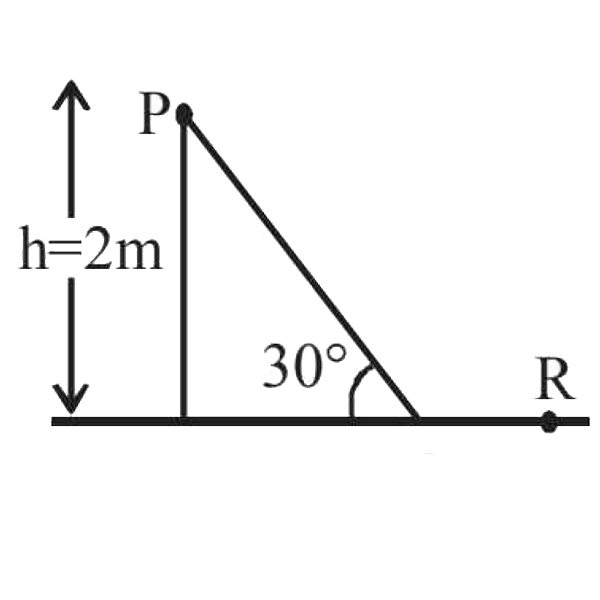
A point particle of mass m, moves long the uniformly rough track PQR as shown in figure. The coefficient of friction, between the particle and the rough track equals `mu`. The particle is released, from rest from the point P and it comes to rest at a point R. The energies, lost by the ball, over the parts, PQ and QR, of the track, are equal to each other, and no energy is lost when particle changes direction from PQ to QR.
The value of the coefficient of friction `mu` and the distance x `(=QR)`, are, respectively close to:

A

`0.2` and `3.5m`

B

`0.29` and `3.5m`

C

`0.29` and `6.5m`

D

`0.2` and `6.5m`

Text Solution

Verified by Experts

The correct Answer is:
B

Energy lost over path PQ
`=mu mg cos30^(@)xx4`........(i)
Energy lost over path QR
`=mu mg x`...........(ii)
By (i) and (ii)
`mu mg x=mu mg cos 30^(@)xx4`
`implies x=4xx(sqrt(3))/(2)=2sqrt(3)=3.45m~~3.5m`

Since , From Q to R energy lost is half of the total energy
`mu mg x =(1)/(2)mg himplies mu =0.29`.
Aliter : Given, `(mu mg h)/(tan theta)=mgh-(mu mgh)/(tan theta)`
`(2mu)/(tan theta)=1impliesmu=(tantheta)/(2)=(tan30^(@))/(2)impliesmu=0.29`
`x=(h)/(tan theta)=2sqrt(3)~~3.5m`
Promotional Banner

Similar Questions

Explore conceptually related problems

A small blockofmass 'm' is released from rest at the top of a rough inclined plane as shown The coefficient of friction between the block and inclined plane is 'mu' Using work-energy theorem, find the speed of block as it passes the lowest point.

Figure shows an irregular wedge of mass m placed on a smooth horizontal surface. Part BC is rough. If the coefficient of friction between the block and wedge is mu , and the block comes to rest with respect to wedge at a point E on the rough surface then BE will be

A particle of mass m slides along a curved-flat-curved track. The curved portions of the track are smooth. If the particle is released at the top of one of the curved portions, the particle comes to rest at flat portion of length l and of mu=mu_(ki n etic) after covering a distance of

A particle of mass m=5.00kg is released from point A and it slides on the frictionless track shown in figure. Determine (a) the particle's speed at points B and C and (b) the net work done by the gravitational force as the particle moves from A to C.

A block is released from rest from point on a rough inclined place of inclination 37^(@). The coefficient of friction is 0.5.

A small roller coaster starts at point A with a speed u on a curved track as shown in the figure The friction between the roller coaster and the track is negligible and it always remains in contact with the track. The speed of roller coaster at point D on the track will be

A particle initially at rest is released from A as shown in figures. The approximate variation of direction of resultant acceleration as particle moves from A to B is :

A particle moves in one dimension in a conservation force field. The potential energy is depicted in the graph below. If the particle starts to move from rest from the point A , then

A point particle of mass m is released from a distance sqrt(3)R along the axis of a fixed ring of mass M and radius R as shown in figure. Find the speed of particle as it passes through the centre of the ring.

