Home
Class 11
PHYSICS
An insect crawls up a hemispherical surf...

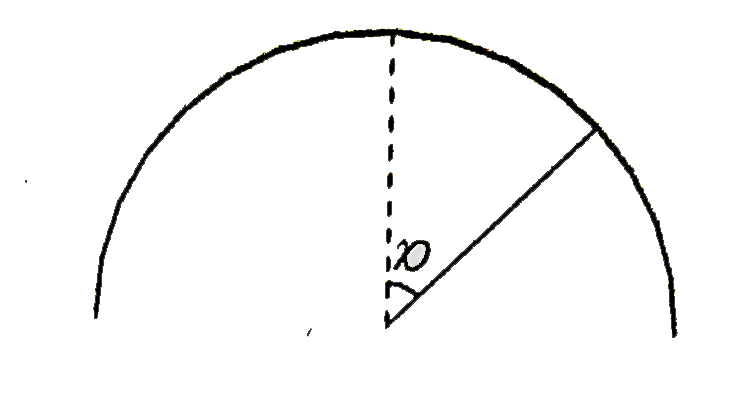
An insect crawls up a hemispherical surface very slowly (see the figure). The coefficient of friction between the insect and the surface is 1/3. If the line joining the centre of the hemispherical surface to the insect makes an angle `alpha` with the vertical, the maximum possible value of `alpha` is given by

A

`cotalpha=3`

B

`tan alpha=3`

C

`sec alpha=3`

D

`cosec alpha =3`

Text Solution

Verified by Experts

The correct Answer is:
A

`N= mg cos alpha` ,br> `:.f= mu N=mu mg cos alpha`

and `f=mu N=mg sin alpha`
`:.mu mg cos alpha=mg sin alpha`
`implies cot alpha=(1)/(mu)=3`
Promotional Banner

Similar Questions

Explore conceptually related problems

An insect craws up a hemispherical surface very slowly (see fig.). The coefficient of friction between the insect and the surface is 1//3 . If the line joining the center of the hemispherical surface to the insect makes an angle alpha with the vertical, the maximum possible value of alpha is given by

A force of 100N is applied on a block of mass 3kg as shown in the figure. The coefficient of friction between the surface and the block is mu=(1)/(sqrt(3) . The friction force acting on the bock is.

The coefficient of friction between a hemispherical bowl and an insect is sqrt(0.44) and the radius of the bowl is 0.6m . The maximum height to which an insect can crawl in the bowl will be .

An insect of mass m, starts moving on a rough inclined surface from point A. As the surface is vert sticky, the corfficient of fricion between the insect and the incline is mu=1 . Assume that it can move in any direction, up the incline or down the incline then

In the situration shown in the figure the friction coefficient between M and the horizontal surface is mu . The force F is applied at an angle theta with vertical. The correct statements are

A uniform hemisphere placed on an incline is on verge of sliding. The coefficient of friction between the hemisphere and the incline is mu = 0.3 . Find the angle phi that the circular base of the hemisphere makes with the horizontal. Given sin (tan^(-1) 0.3) cong 0.29 " and "sin^(-1) (0.77) cong 50^(@)

Knowledge Check

  • An insect craws up a hemispherical surface very slowly (see fig.). The coefficient of friction between the insect and the surface is 1//3 . If the line joining the center of the hemispherical surface to the insect makes an angle alpha with the vertical, the maximum possible value of alpha is given by

    A
    `cot alpha=3`
    B
    `tan alpha=3`
    C
    `sec alpha=3`
    D
    `cosec alpha=3`
  • The coefficient of friction between an insect and a hemispherical bowl of radius r is mu . The maximum height to which the insect can crawl in the bowl is

    A
    `( r )/( sqrt( 1+ mu^(2)))`
    B
    `r[1-(1)/( sqrt( 1+ mu^(2)))]`
    C
    `r sqrt( 1+ mu^(2))`
    D
    `r[ sqrt( 1+ mu^(2))-1]`
  • A force of 100N is applied on a block of mass 3kg as shown in the figure. The coefficient of friction between the surface and the block is mu=(1)/(sqrt(3) . The friction force acting on the bock is.

    A
    15N downward
    B
    25N upward
    C
    20N downword
    D
    30N upward

