
Home
Class 11
PHYSICS
The coefficient of static friction betwe...

The coefficient of static friction between two blocks is 0.5 and the table is smooth. The maximum horizontal force that can be applied to move the blocks together is N. (take `g = 10 ms^(-2)`)

Text Solution

Verified by Experts

The correct Answer is:
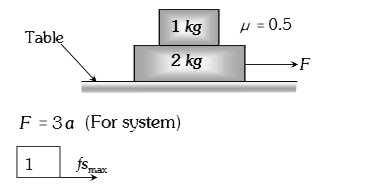
15


`f_(max)=1a` (for 1kg block)
`muxx1xxg=a`
`implies5=a`
`F=15N`
Promotional Banner

Similar Questions

Explore conceptually related problems

The coefficient of static friction between the two blocks shown in figure is mu and the table is smooth. What maximum horizontal forced F can be applied to he block of mass M so that the block move together?

Two blocks ( m = 0.5 kg and M = 4.5 kg) are arranged on a horizontal frictionless table as shown in figure. The coefficient of static friction between the two blocks is (3)/( 7) . Then the maximum horizontal force that can be applied on the larger block move together is "_____________" N. ( Round off to the Nearest Integer ) [Take as 9.8 ms^(-2) ]

The coefficient of static friction between a wooden block of mass 0.5 kg and a vertical rough wall is 0.2. The magnitude of horizontal force that should be applied on the block to keep it adhere to the wall will be ____N.

Coefficient of static friction between the two blocks in Fig. 7.124 is mu and the table is frictionless . Maximum horizontal force which can be applied on the lower such that the blocks move together , is :

A block is kept on a horizontal table. The table is undergoing simple farmonic motion of frequency 3Hz in a horizontal plane. The coefficient of static friction between the block and the table surface is 0.72. find the maximum amplitude of the table at which the block does not slip on the surface g=10ms^(-1)

Mass of upper block and lower block kept over the table is 2 kg and 1 kg respectively and coefficient of friction between the blocks is 0.1. Table surface is smooth. The maximum mass M for which all the three blocks move with same acceleration is (g = 10 m/s2) -

The two blocks, m= 10 kg and M = 50 kg are free to move as shown. The coefficient of static friction between the blocks is 0.5 and there is no friction between M and the ground. A minimum horizontal force F is applied to hold m against M that is equal to -

Four blocks are arranged on a smooth horizontal surface as shown. The masses of the blocks are given (see the diagram). The coefficient of static friction between the top and the bottom blocks is mu_(s) . What is the maximum value of the horizontal force F, applied to one of the bottom blocks as show, thilt makes all four blocks move with the same acceleration ?

Four block are arranged on a smooth horizontal surface as shown in figure .The masses of the blocks are given (see the fig ) The coefficient of static friction between the top and the bottom blocks is mu_(s) What is the maximum value of the horizontal force F applied to one of the bottom blocks as shown that makes all four block with the same acceleration ?

