Home
Class 11
PHYSICS
The potential energy function for a part...

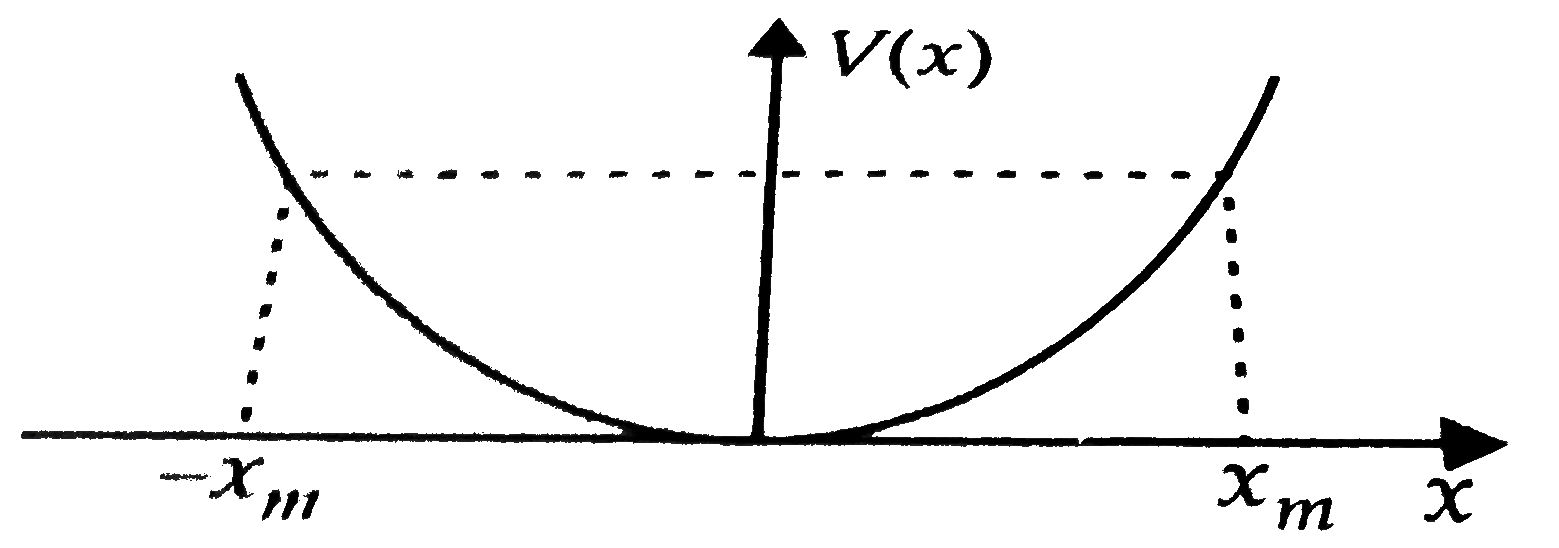
The potential energy function for a particle executing linear SHM is given by `V(x)= 1/2kx^2` where k is the force constant of the oscillator. For `k = 0.5 Nm^(-1)`, the graph of V(x) versus x is shown in the figure A particle of total energy E turns back when it reaches `x=pmx_m`.if V and K indicate the potential energy and kinetic energy respectively of the particle at `x= +x_m`,then which of the following is correct?

A

`V = 0 , K = E`

B

`V = E , K = 0`

C

`V lt E , K = 0`

D

`V = 0 , K lt E`

Text Solution

Verified by Experts

The correct Answer is:

B

Total energy is `E = PE + KE " "…(i)`
When particle is at `x = x_m` i.e., at extreme position,
returns back. Hence, at `x = x_m, x = 0, KE = 0`
From Eq. (i) `E=PE +0 = PE = V(x_m) =1/2 kx_(m)^2`
Promotional Banner

Similar Questions

Explore conceptually related problems

The potential energy of a particle (U_(x)) executing SHM is given by

The potential energy function for a particle executing simple harmonic motion is given by V(x)=(1)/(2)kx^(2) , where k is the force constant of the oscillatore. For k=(1)/(2)Nm^(-1) , show that a particle of total energy 1 joule moving under this potential must turn back when it reaches x=+-2m.

The potential energy function of a particle in the x-y plane is given by U =k(x+y) , where (k) is a constant. The work done by the conservative force in moving a particlae from (1,1) to (2,3) is .

Potential energy of a particle at position x is given by U=x^(2)-5x . Which of the following is equilibrium position of the particle?

A graph of potential energy V(x) verses x is shown in figure. A particle of energy E_(0) is executing motion in it. Draw graph of velocity and kinetic energy versus x for one complete cycle AFA.

The total energy of a particle executing SHM is E. Its kinetic energy is K at the mean position. Then always

A satellite has kinetic energy K, potential energy V and total energy E. Which of the following statements is true?

The potential energy of a particle with displacement X is U(X) . The motion is simple harmonic, when (K is a positive constant)
