Home
Class 11
PHYSICS
Two rectangular blocks A and B of masses...

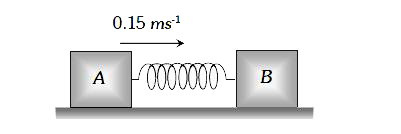
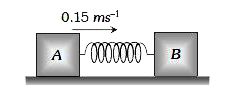
Two rectangular blocks A and B of masses 2 kg and 3 kg respectively are connected by a spring of spring constant `10.8 Nm^(-1)` and are placed on a frictionless horizontal surface. The block A was given an initial velocity of `0.15ms^(-1)` in the direction shown in the figure. The maximum compression of the spring during the motion is

A

0.01 m

B

0.02 m

C

0.05 m

D

0.03 m

Text Solution

Verified by Experts

The correct Answer is:
C

Block A moves with velocity `0.15ms^(-1)` compresses the spring which pushes B towards right. A goes on compressing the spring till the velocity acquired by B becomes equal to the velocity of A. Let this velocity be v . This state occurs when the spring is in a state of maximum compression. Let x be the maximum compression in this stage.
According to the law of conservation of linear momentum, we get `m_Au = (m_A + m_B)v`

`implies v=(m_Au)/(m_A+m_B) = (2xx0.15)/(2+3) = 0.06 ms^(-1)`
According to the conservation of energy, we get
`1/2 m_Au^2=1/2(m_A+m_B) v^2+1/2kx^2`
`1/2 m_Au^2-1/2(m_A+m_B) v^2=1/2kx^2`
`1/2 xx2 xx(0.15)^2-1/2(2+3)(0.06)^2 =1/2 kx^2`
` 0.0225 - 0.009=1/2 kx^2 implies 0.0135 =1/2 kx^2`
`implies x sqrt((0.027)/k)=sqrt((0.027)/(10.8))=0.05 m`
Promotional Banner

Similar Questions

Explore conceptually related problems

Two blocks of masses m_(1) =1kg and m_(2) = 2kg are connected by a spring of spring constant k = 24 N/m and placed on a frictionless horizontal surface. The block m_(1) is imparted an initial velocity v_(0) = 12cm/s to the right. The amplitude of osciallation is

Two blocks A and B of masses 5 kg and 2 kg respectively connected by a spring of force constant = 100Nm^(-1) are placed on an inclined plane of inclined 30^(@) as shown in figure If the system is released from rest

The spring constant of the spring shown in the figure is 250Nm^(-1) . Find the maximum compression of the spring?

Two blocks A and B of mass 2 m and m respectively are connected to a massless spring of spring constant K. if A and B moving on the horizontal frictionless surface with velocity v to right. If A collides with C of mass m elastically and head on, then the maximum compressions of the spring will be

Two block of masses 10 kg and 4 kg are connected by a spring of negligible mass and placed on a frictionless horizontal surface. An impluse given a velocity of 14 m/s to the heavier block in the direction of the leghter block. The velocity of centre of mass is :

Two blocks of masses 10 kg and 4 kg are connected by a spring of negligible mass and placed on a frictionless horizontal surface. An impulse gives a velocity of 14 m/s to the heavier block in the direction of the lighter block. The velocity of the centre of mass is -

Two blocks of masses 10 kg and 4 kg are connected by a spring of negligible mass and placed on a frictionless horizontal surface. An impulse gives a velocity of 14 m//s to the heavier block in the direction of the lighter block. The velocity of the centre of mass is

Two blocks A and B of mass 2m and m respectively are connected to a massless spring of force constant K as shown in figure A and B are moving on the horizontal frcitionless surface with velocity v to right with underformed spring. If B collides with C elastically, then maximum compression of the spring will be

A block of mass 200 g is given velocity 2(m)//(s) on a horizontal surface as shown in the figure. Find the maximum compression of spring of spring constant k=100(N)//(m)

Two blocks of masses 5kg and 2kg are connected by a spring of negligible mass and placed on a frictionless horizontal surface. An impulse provides a velocity of 7m/s to the heavier block in the direction of the lighter block. The velocity of the centre of mass is :-

