Home
Class 11
PHYSICS
The ring R in the arrangement shown can ...


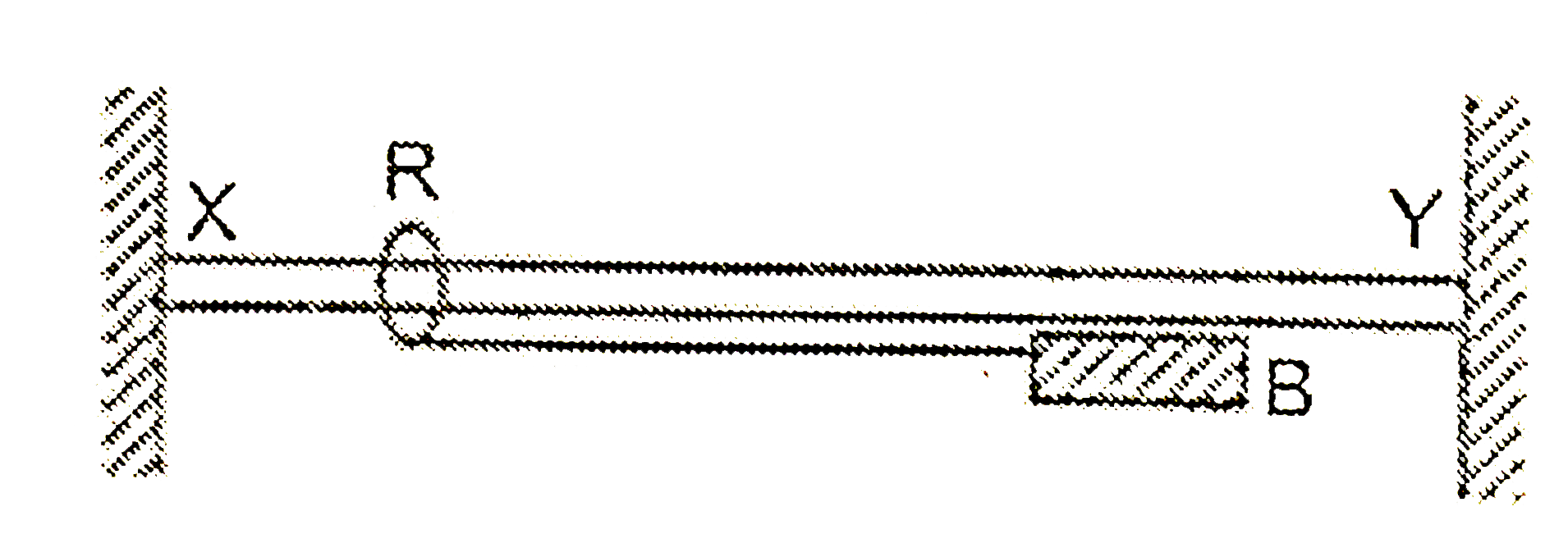
The ring R in the arrangement shown can slide along a smooth, fixed, horizontal rod XY. If is attached to the block B by a light sring. The blocks is released from rest, with the string horizontal.

A

One point in the string will have only vertical motion

B

R and B will always have momenta of the same magnitude

C

When the string becomes vertical, the speeds of R and B will be inversely proportional to their masses

D

R will lose contact with the rod at some point

Text Solution

Verified by Experts

The correct Answer is:

A, C

There are no horizontal forces acting on the ‘ R plus B ’ system. Hence, its centre of mass will move down vertically, and horizontal momentum will be conserved.
Promotional Banner

Similar Questions

Explore conceptually related problems

In the system shown in figure, the block A is released from rest. Find Tension in the string.

All surfaces are smooth Find the horizontal displacements of the block and the wedge when the block slides down from top to bottom .

In the arrangement shown, the pulleys are smooth and the strings are inextensible. The acceleration of block B is :

A ring of mass m free to slide on a fixed smooth horizontal rod is attached to a particle of mass M kg by a inextensible string of length l. Initially, both M and m are at rest and the string is vertical. A horizontal velocity v_(0) is imparted to the particle. The maximum height up to which block will rise w.r.t its initial position is (M = 2m)

A ring of mass m and radius r has a particle of mass m attached to it at a point A. the ring can rotate about a smooth horizontal axis which is tangential to the ring at a point B diametrically opposite to A. The ring can rotate about a smooth horizontal axis which is tangential to the ring at a point B diametrically opposite to A. The ring is released from rest when AB is horizontal. find the angular veloicity and the angular acceleration of the body when AB has turned through an angle (pi)/(3) .

One end of a light spring of natural length d and spring constant k is fixed on a rigid wall and the other is attached to a smooth ring of mass m which can slide without friction on a vertical rod fixed at a distance d from the wall. Initially the spring makes an angle of 37^(@) with the horizontal as shown in fig. When the system is released from rest, find the speed of the ring when the spring becomes horizontal. [ sin 37^(@) = 3/5]
