Home
Class 11
PHYSICS
A particle of mass m moving with horizon...

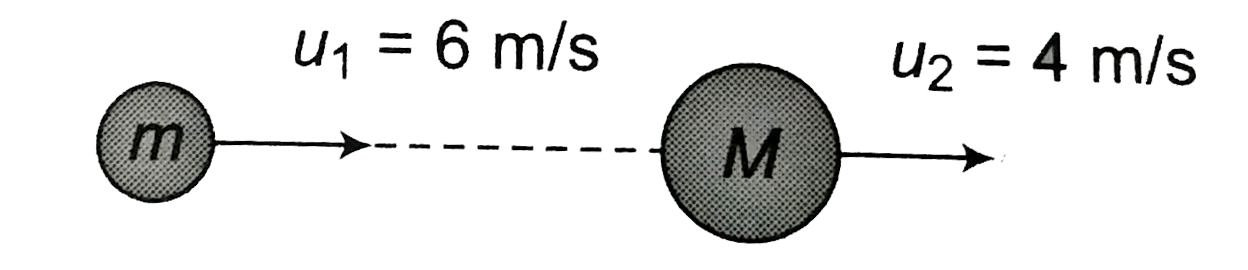
A particle of mass `m` moving with horizontal speed `6 m//s` as shown in the figure. If `m lt lt M` then for one - dimensional elastic collision , the speed of lighter particle after collision will be

A

2m/sec in original direction

B

2 m/sec opposite to the origin

C

4 m/sec opposite to the original direction

D

4 m/sec in original direction

Text Solution

Verified by Experts

The correct Answer is:

A

`m_1 = m, u_1=6m//s, m_2 = M, u_2 =4m//s`
`v_1=((m_1-m_2)/(m_1+m_2))u_1=(2m_2u_2)/(m_1+m_2)=-u_1+2u_2`
`implies -6 + 8 = 2m//s " " [:. "As" m_1/m_2lt ltlt1]`
Promotional Banner

Similar Questions

Explore conceptually related problems

Two particles each of mass m moving with equal speed 2m/s along the indicated direction in the figure undergo a perfectly inelastic collision.Velocity of combined system after collision is ?

A particle of mass m moving with velocity vecV makes a head on elastic collision with another particle of same mass initially at rest. The velocity of the first particle after the collision will be

A particle of mass m strikes a disc of radius R and mass m with a speed u as shown in the figure. What is the speed of the particle just after the collision if the collision is perfectly inelastic ?

A light particle moving horizontally with a speed of 12 m//s strikes a very heavy block moving in the same direction at 10 m//s . The collision is one-dimensional and elastic. After the collision, the particle will

A particle of mass m moving with speed V collides eleastically with another particle of mass 2mFind speed of smaller mass after head on collision

A particle of mass m moving with speed u hits a wedge of mass M as shown in figure. If coefficient of restitution is e and friciton can be neglected, then find the speed of the wedge with respect to ground just after the collision.

A particle of mass m moving with a speed v hits elastically another staionary particle of mass 2m on a smooth horizontal circular tube of radius r . Find the time when the next collision will take place?
