Home
Class 11
PHYSICS
A ball of mass m suspended from a rigid ...

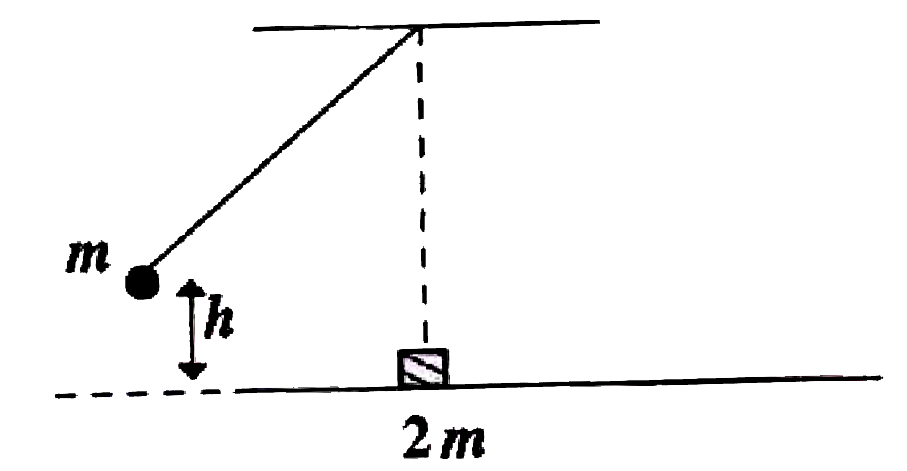
A ball of mass m suspended from a rigid support by an inextensible massless string is released from a height h above its lowest point. At its lowest point it collides elastically with a block of mass 2m at rest on a frictionless surface. Neglect the dimensions of the ball and the block. After the collision the ball rises to a maximum height of–

A

`h/3`

B

`h/2`

C

`h/8`

D

`h/9`

Text Solution

Verified by Experts

The correct Answer is:

D

As `mgh = 1/2 mv^2`
`implies v =sqrt(2gh)` , velocity of ball before collision
Using law of conservation of momentum
`mv =mv_1 +2mv_2`
`implies v_1 +2v_2 = v " "...(i)`
`v_1 and v_2` are velocity of ball and block after collision as coefficient of restitution (e)
`e=(v_2-v_1)/(v-0)`
`implies v_2 -v_1 = v " "...(iii) ` [ as e = 1 ]
From (i) + (ii)
`v_2 =v/3 and v_1 =v/3`
Hence, after collision maximum height
`H_(max) =(v_1^2)/(2g) =(((sqrt(2gh)/3))/(2g))^2`
`H_(max) =h/9`
Promotional Banner

Similar Questions

Explore conceptually related problems

A steel ball of mass 0.5 kg is fastened to a cord 20 cm long and fixed at the far end and is released when the cord is horizontal. At the bottom of its path the ball strikes a 2.5 kg steel block initially at rest on a frictionless surface. The collision is elastic. The speed of the block just after the collision will be.

A small ball of mass m collides elastically with a simple pendulum with bob of mass ma at rest. The macimum height attained by the bob after collision is

A ball of mass m_(1) moving with a certain speed collides elastically with another ball of mass m_(2) kept at rest . If the first ball starts moving in reversed direction after the impact then

A ball of mass m moving with velocity v collides elastically with another ball of identical mass coming from the opposite direction with velocity 2v. Their velocities after collisions are-

A tennis ball is released from height h above ground level. If the ball makes inelastic collision with the ground, to what height will it rise after third collision

A ball A of mass M collides elastically with a similar ball B at rest as shown in figure. Initially velocity of ball A is u m/s. After collision,

A block of mass 180 g is placed on a spring (spring constant k = 120 N//m ) fixed from below. A ball of mass 20 g is dropped from height 20 m and the collision is completely inelastic. Find the maximum compression of the spring. Neglect the initial compression of the spring due to the block.
